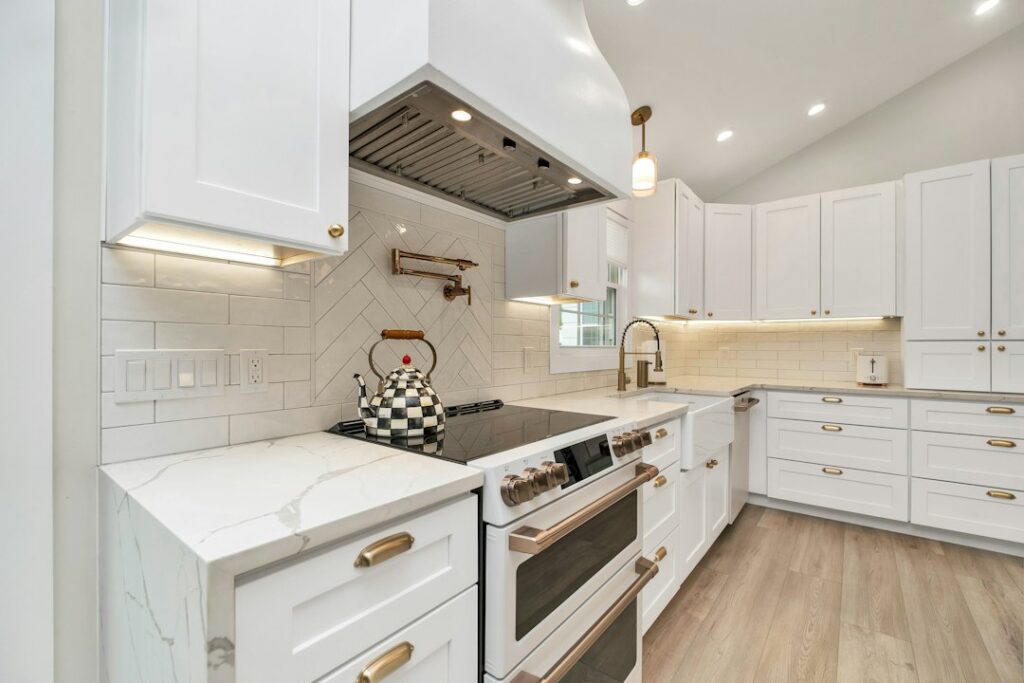
Shaker doors are simple: a flat center panel inside a five-piece frame. That simplicity puts the wood itself on display, which is why the species you choose matters so much. Maple shaker cabinets give you a smooth, tight grain that looks clean and modern in a natural finish and paints beautifully, but maple can turn splotchy when stained dark. Oak, the other common hardwood for shaker doors, behaves almost the opposite way.
Part of our Kitchen Remodeling guide — explore the full guide →
If you are deciding between maple and oak, or trying to pick a stain color for maple doors, the details here will help you avoid the most common disappointment: a sample that looked perfect in the showroom and blotchy in your kitchen.
- What Makes Maple Shaker Cabinets Different
- Maple vs Oak Shaker Doors
- Stain Colors That Work on Maple
- Painted vs Natural Maple
- How to Stain Maple Shaker Doors Without Blotching
- Solid Wood vs MDF Center Panels
- Hardware and Design Choices
- Cost Ranges
- Troubleshooting and Care
- When to Call a Pro
- Frequently Asked Questions
What Makes Maple Shaker Cabinets Different
Hard maple is dense, pale and fine grained. On a shaker door, the stiles and rails show long, straight grain with occasional soft figure, and the flat panel reads as calm and even. That quiet surface is the main reason people choose maple shaker cabinets: they suit transitional, Scandinavian and modern farmhouse kitchens where heavy grain would compete with tile, stone countertops or patterned floors.
Maple is also hard. It resists dents better than many cabinet woods, which matters on lower doors that take kicks from shoes, toys and vacuum cleaners. It machines crisply, so the inside edge of the shaker frame stays sharp and the joints between rails and stiles stay tight.
Maple vs Oak Shaker Doors
Oak shaker cabinets have been around for decades, and the newer versions look nothing like the honey-toned kitchens of the 1990s. Here is how the two species compare on a shaker profile.
| Feature | Maple | Oak |
|---|---|---|
| Grain | Fine, subtle, closed | Bold, open, visible |
| Stain behavior | Can blotch with dark stains | Takes stain evenly |
| Painted finish | Very smooth | Grain texture shows through |
| Hardness | Very hard | Hard |
| Typical style | Clean, modern, painted | Rustic, warm, textured |
Red oak has pinkish tones and pronounced cathedral grain. White oak is cooler and more muted, and rift or quarter-sawn white oak produces a straight, linear grain that has become popular in modern shaker kitchens. If you want visible wood texture and plan to stain, oak is the easier species. If you want a smooth painted finish or a light natural look, maple usually wins.
Stain Colors That Work on Maple
Maple looks its best in light to medium tones. Clear coat or natural finishes show the creamy color of the wood and will gently amber over the years. Light honey, wheat and soft gray-brown stains keep the grain even. Medium tones such as a warm caramel or a mid-brown can work well if the wood is pre-treated.
Dark espresso and deep walnut stains are where trouble starts. Maple’s dense, uneven pores absorb pigment unevenly, leaving dark blotches in some areas and pale streaks in others. Cabinet makers get around this with toners, gel stains or sprayed dye stains that sit more on the surface. If you want very dark cabinets, ask whether the finish uses a toner process, and look at a full door sample rather than a small chip.
Finishes to consider
- Natural or clear: brightest, shows the wood’s natural variation
- Light stain: warms the tone while hiding minor color differences between boards
- Glazed: a stain or tint wiped into the inside corners of the shaker frame to highlight the profile
- Painted: white, greige, navy, sage and charcoal are common choices on maple
Painted vs Natural Maple
Maple is one of the best woods for painted shaker doors because its tight grain does not telegraph through the paint. You get a smooth, almost furniture-like finish. The tradeoff is that solid wood moves with humidity, so painted doors can show a hairline crack at the joint where rail meets stile, especially in climates with big seasonal swings. That is normal wood movement, not a defect, and it is less visible on doors with an MDF center panel.
A natural finish on maple avoids the joint-line issue and shows off the wood, but color variation between boards is part of the look. Some doors may have mineral streaks or darker heartwood. If you want perfect uniformity, paint or a light toner is the safer choice.
How to Stain Maple Shaker Doors Without Blotching
If you are refinishing existing maple doors or building your own, these steps reduce blotching:
- Remove doors and hardware. Label each door and its location with tape so they go back in the right spot.
- Clean and degrease. Kitchen doors carry grease that blocks stain. Wash with a degreasing cleaner and let dry.
- Sand evenly. Sand to 150 or 180 grit. Going finer than about 180 can burnish maple and make blotching worse.
- Apply a pre-stain conditioner or washcoat. A thin coat of conditioner or a diluted sealer partially fills the pores so stain absorbs more evenly.
- Use gel stain or dye. Gel stains sit on the surface and give more uniform color on maple than thin liquid stains. Wipe in the direction of the grain on rails and stiles.
- Test first. Try the full sequence on the back of a door or on a spare piece of the same wood.
- Topcoat. Finish with two or three coats of a durable clear finish, sanding lightly between coats.
Work in a well-ventilated area, wear gloves and eye protection, and keep solvent-based stains and rags away from pilot lights and flames. Lay oily rags flat outdoors to dry or store them in a sealed metal can filled with water, because linseed-based products can heat up and ignite as they cure.
Solid Wood vs MDF Center Panels
Not every maple shaker door is solid maple all the way through. Many stain-grade doors use a solid maple frame with a maple veneer center panel, which stays flatter than a glued-up solid panel and resists cracking. Paint-grade doors often pair a maple frame with an MDF center panel, since MDF does not expand and contract with humidity and gives an extremely smooth painted surface. Both are legitimate constructions. Ask which one you are getting, because it affects how a stain looks across the panel and how likely you are to see seasonal movement lines.
Cabinet boxes are a separate question. Plywood boxes hold screws better and tolerate occasional moisture under a sink, while particleboard boxes cost less. A maple door on a well-built plywood box will outlast most kitchen remodel cycles.
Hardware and Design Choices
Shaker doors are a blank canvas for hardware. Slim bar pulls in matte black or brushed nickel suit painted maple. Warm brass or bronze cabinet door pulls look rich against a natural maple finish. Mount pulls on the stile of upper doors near the bottom corner and on the stile of lower doors near the top corner. For drawers, a pull roughly one-third the drawer width looks balanced.
Maple pairs well with quartz in white or light gray, warm wood floors, and simple tile backsplashes. Oak shaker cabinets often work better against busier stone or encaustic tile because the bold grain can hold its own visually.
Cost Ranges
Maple shaker cabinets typically fall in the middle of the cabinet market. Stock and semi-custom maple boxes with shaker doors often run roughly $150 to $500 per linear foot for the cabinets alone, while custom work can climb to $600 to $1,200 or more per linear foot. Oak is often similar or slightly less in the same lines, with rift white oak priced higher because it uses more of each log. Paint usually adds a small upcharge over stain, and specialty toner finishes may add more. Replacing only the doors and drawer fronts on sound boxes is a common way to get the shaker look for much less than a full replacement.
Troubleshooting and Care
- Blotchy stain: sand back and apply a conditioner or switch to a gel stain or toner.
- Yellowing on painted or natural doors: some oil-based finishes amber with age. Water-based topcoats stay clearer.
- Hairline cracks at painted joints: normal seasonal movement. Keep indoor humidity steady between about 35 and 50 percent.
- Greasy buildup: clean with mild dish soap and warm water, then dry. Avoid abrasive pads.
When to Call a Pro
Refinishing a few doors is a realistic weekend project. A full kitchen of doors, a sprayed finish or a dark toner on maple is better done by a cabinet refinisher with a spray booth. Hire a pro too if you are changing the layout, moving sinks or appliances, or adding under-cabinet lighting that needs new wiring, since plumbing changes call for a licensed plumber and new electrical circuits or outlets call for a licensed electrician.
Frequently Asked Questions
Is maple or oak better for shaker cabinets?
Maple is better for painted or light natural finishes with a smooth look. Oak is better if you want visible grain and plan to stain the cabinets.
Can maple shaker cabinets be stained dark?
Yes, but dark stains often blotch on maple. Toners, gel stains or a pre-stain conditioner give more even results.
Do maple cabinets turn yellow over time?
Natural maple ambers gradually with light exposure. A water-based clear coat slows the change compared with oil-based finishes.
Why do painted maple doors crack at the corners?
Solid wood rails and stiles expand and contract with humidity, which can open a hairline line in the paint at the joints. It is cosmetic and common.
Are oak shaker cabinets back in style?
Yes, especially white oak in rift or quarter-sawn cuts with light, natural finishes. They read very differently from older orange-toned oak kitchens.