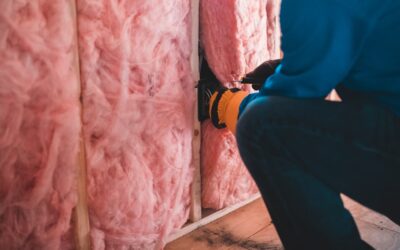
If your attic feels like an oven in summer and your heating bills climb every winter, the answer may be lying right above your ceiling. Blow-in insulation, also called loose-fill insulation, is a material made of small particles of fiber or foam that is blown into place with a machine rather than rolled out in batts. Because it is installed as loose pieces, it flows around obstacles, fills irregular cavities, and settles into the gaps that rigid batts often leave behind. That ability to conform to awkward spaces is exactly why it has become a go-to choice for attics and existing walls.
How Blow-In Insulation Works
Insulation works by slowing the transfer of heat. Loose-fill material traps countless small pockets of air, and that trapped air resists conduction, keeping heat inside in winter and outside in summer. A contractor uses a blowing machine that breaks up bales of insulation, mixes them with air, and pushes the fluffy material through a long hose to wherever it is needed. The installer simply directs the hose to lay down an even blanket at the target depth.
Because the material is blown in rather than cut and fitted, it surrounds wiring, pipes, joists, and other obstructions, leaving fewer gaps where heat can leak. Those gaps, called thermal bridges and voids, are where a lot of energy is lost in homes insulated only with poorly fitted batts.
The Two Main Types
Most residential blow-in insulation is one of two materials, each with its own strengths.
- Cellulose: Made primarily from recycled paper and treated with borate for fire and pest resistance. It is dense, fills gaps tightly, and has a high recycled content, which appeals to eco-conscious homeowners. It is heavier and can settle more over time.
- Fiberglass: Made from spun glass fibers, the same base material as common batts. It is lighter, resists moisture better than cellulose, and does not absorb water. It can be slightly less effective at the highest temperatures unless installed at proper density.
Mineral wool is a third, less common loose-fill option valued for fire resistance and sound dampening.
Understanding R-Value
R-value measures how well insulation resists heat flow, and higher is better. Blow-in cellulose generally delivers roughly R-3.2 to R-3.8 per inch, while loose-fill fiberglass runs around R-2.2 to R-2.7 per inch. The U.S. Department of Energy recommends attic levels of roughly R-38 to R-60 in most climates, which translates to a foot or more of loose-fill depth depending on the material. Your ideal R-value depends on your climate zone, so check the DOE recommendations for your region before deciding on depth.
Where Blow-In Insulation Is Used
The most common application is the attic floor, where loose-fill can be laid quickly to deep, uniform levels over an open expanse. It is also widely used to insulate existing walls without tearing them open: an installer drills small holes between the studs, blows the material into the cavity, and patches the holes. This dense-pack technique is one of the few practical ways to add insulation to a finished home. It also works in enclosed floors and hard-to-reach cavities.
The Pros
Blow-in insulation earns its popularity for several reasons.
- It fills irregular spaces and seals gaps that batts miss, improving real-world performance.
- It can be added to existing walls and attics with minimal demolition.
- Installation over a large attic is fast, often completed in a day.
- Cellulose uses high recycled content, and the dense fill also dampens sound.
- It is cost-effective for upgrading the insulation of an older home.
The Cons
It is not perfect for every situation. Loose-fill can settle over time, especially cellulose, reducing depth and R-value, so it is sometimes installed slightly higher to compensate. It can shift or be disturbed in windy or vented attics if not properly contained. Cellulose can absorb moisture and is slow to dry, which matters in damp areas, while fiberglass can leave airborne particles during installation. It also typically requires a blowing machine and is best installed by a pro, though machines can be rented for the determined DIYer.
Blow-In vs. Batt Insulation
Homeowners often weigh loose-fill against traditional fiberglass batts, and each has its place. Batts are precut blankets that fit between standard joist and stud spacing, and they are the easier choice for open walls during new construction or a gut renovation where you can install them by hand. Where batts struggle is anywhere with obstructions or non-standard spacing, because cutting and fitting them around wires, pipes, and odd cavities leaves gaps that undermine performance.
Blow-in shines in exactly those situations: existing closed walls, irregular attics, and around obstacles where it flows in and fills completely. Many homeowners combine the two, using batts in open walls and blow-in to top up an attic or to densely pack a finished wall. The right answer depends on whether the cavity is open or closed and how much labor you want to invest.
DIY Versus Hiring a Pro
An experienced DIYer can rent a blower from a home improvement store and tackle an open attic, often getting the machine free with a minimum material purchase. But getting consistent depth, hitting the target density for fiberglass, and safely working around recessed lights, soffit vents, and electrical junctions takes care. Wall dense-packing in particular is best left to professionals who can verify the cavity is fully filled. For most homeowners, a professional install ensures the rated R-value is actually achieved and that critical clearances around heat sources are maintained.
Keep in mind that insulation works best alongside air sealing. Loose-fill slows heat transfer, but it does not stop air from leaking through gaps around recessed lights, attic hatches, and penetrations. Sealing those leaks before adding insulation lets the new material perform to its rated R-value rather than letting conditioned air slip past it. Pairing air sealing with proper attic ventilation and adequate insulation depth is what delivers the real comfort and energy savings homeowners are after.
So, what is blow-in insulation? It is loose-fill cellulose, fiberglass, or mineral wool blown into attics and walls to fill gaps that rigid batts leave behind. It offers strong R-value per inch, conforms to tricky spaces, and is one of the best ways to upgrade an existing home’s efficiency. Weigh the settling and moisture trade-offs, match the depth to your climate’s recommended R-value, and decide whether the job suits a DIY weekend or a professional crew.