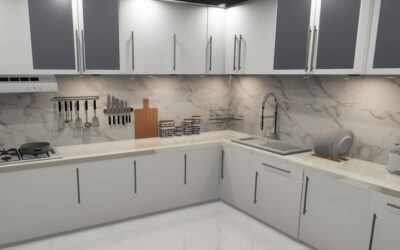
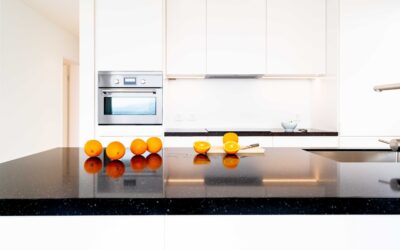
Roughly 60 percent of kitchen remodels still finish in some version of white cabinetry, but the smart money has shifted the countertop. Pairing white cabinets dark countertops is the highest-contrast combination in mainstream kitchen design, and when the undertones line up it looks crisp, expensive, and surprisingly timeless. Get the undertone wrong and the kitchen reads cold, blue, or like a 2014 builder special. The difference between the two outcomes is usually one decision: warm or cool.
Part of our Countertops guide — explore the full guide →
- Why This Combination Has Stayed Relevant
- Choosing the Right Countertop Material
- Getting the White Cabinet Color Right
- Hardware and Faucet Finishes That Tie It Together
- Backsplash Choices for the Contrast
- Flooring Choices That Work Underneath
- Lighting That Makes Dark Counters Look Their Best
- Common Mistakes to Avoid
Why This Combination Has Stayed Relevant
White cabinets paired with dark stone or quartz creates the kind of visual separation that helps a kitchen photograph and live well. The dark surface anchors the eye at counter height, while the white uppers reflect light to keep the room bright. In smaller kitchens under 150 square feet, this contrast can make the space feel bigger because the light cabinets recede and the dark counters define the work zone.
The pairing has also outlasted three or four trend cycles. Walk through any 2010 magazine spread and you will see soapstone or absolute black granite under shaker whites. The same combination in 2026 just swaps the materials for honed leathered granite or matte quartz. The bones still work.
Choosing the Right Countertop Material
Material choice drives both budget and maintenance. Here is how the most common dark options compare for a 30-square-foot kitchen counter run:
- Honed black granite: 60 to 90 dollars per sq ft installed, very durable, needs sealing every 1 to 2 years
- Leathered black granite: 70 to 100 dollars per sq ft, subtle texture hides fingerprints, our favorite for busy kitchens
- Black quartz like Cambria Blackwood or Caesarstone Piatra Grey: 70 to 110 dollars per sq ft, non-porous, no sealing
- Soapstone: 80 to 130 dollars per sq ft, soft and characterful, develops a natural patina
- Black soapstone-look porcelain slab: 65 to 95 dollars per sq ft, lightweight option for islands
If you have young kids or cook acidic foods often, quartz wins. If you want depth and natural character, leathered granite or true soapstone earn their cost. Avoid pure jet-black polished surfaces unless you enjoy wiping fingerprints daily.
Getting the White Cabinet Color Right
Not all whites work with all darks. Pure crisp whites like Benjamin Moore Chantilly Lace or Decorators White read cool and pair best with charcoal, blue-black, or true black counters with cool undertones. Warmer whites like White Dove or Simply White lean cream and need a counter with brown, bronze, or warm-black flecks to keep harmony.
The single biggest mistake homeowners make is choosing cabinets and counters in different stores under different lighting. Always take a cabinet door sample and a slab sample home, lay them flat on the kitchen floor, and look at them at 7 am in natural light and 8 pm under your existing kitchen bulbs. Undertones flip dramatically between the two.
Hardware and Faucet Finishes That Tie It Together
Hardware is where many white-and-dark kitchens fall flat. Polished chrome reads dated against dark stone, and oil-rubbed bronze can feel heavy. The strongest current pairings are matte black, brushed brass, or aged brass. Matte black hardware ties to the counter and creates a true two-tone look. Brass adds warmth that softens the contrast and bridges a cool white to a warm dark counter.
Mixing metals also works. A common winning combo is matte black cabinet pulls with an unlacquered brass bridge faucet, like the Kingston Brass Concord at 280 dollars or the Newport Brass East Linear at 1,100 dollars. Just commit to two finishes maximum across the kitchen.
Backsplash Choices for the Contrast
The backsplash either calms or amplifies the contrast. A simple white 3-by-12 ceramic subway tile, around 4 dollars per sq ft, lets the cabinet-counter contrast carry the room. White brick-look porcelain or a soft Carrara marble adds texture without adding a third color.
If the counter has dramatic veining, like a Calacatta-look black quartz, run the same slab up the wall as a 24-inch slab backsplash behind the cooktop. Slab backsplashes cost an extra 40 to 60 dollars per linear foot but unify the surfaces and read very current. Skip mosaic backsplashes with mixed colors. They fight the clean two-tone story.
Flooring Choices That Work Underneath
Flooring is the third leg of the visual triangle. Light to mid-tone natural wood, like white oak in a natural matte finish, is the most flexible pairing. It pulls warmth into the room and prevents the kitchen from reading too stark. LVP in a white oak or French oak look at 3 to 6 dollars per sq ft delivers the same visual at a third of the cost.
Avoid red-toned woods like cherry or red oak unless the cabinets are warm white. They clash with cool whites and most dark counters. For tile floors, large-format 12-by-24 porcelain in a soft greige hides crumbs and bridges the contrast without competing with the counter.
Lighting That Makes Dark Counters Look Their Best
Dark counters drink light. A kitchen that worked fine with light counters will feel dim once you swap to black. Plan on at least two layers of light: recessed ceiling fixtures at 4-inch diameter spaced every 4 feet, plus under-cabinet LED strips at 3000K. A 12-foot under-cabinet run costs 30 to 80 dollars and roughly doubles the perceived brightness at the work surface.
Pendant lights over an island should hang 30 to 36 inches above the counter and use 60-watt-equivalent warm white bulbs. Glass or open-frame pendants prevent the room from feeling top-heavy, which is a real risk when both the upper field and the lower field of view fight for attention.
Common Mistakes to Avoid
The kitchens that age badly in this style usually share the same errors. Avoid these:
- Choosing a busy multi-color granite that pulls in red or gold flecks against a cool white
- Skipping the lighting upgrade and ending up with a kitchen that feels like a cave at night
- Using polished black anywhere your kids or pets will touch the counter daily
- Pairing pure white cabinets with stainless steel everything and no warm element to break the cool palette
White cabinets dark countertops still ranks as one of the most flexible kitchen palettes you can choose, but only when the undertones, hardware, and lighting all pull the same direction. Spend an extra weekend matching samples in your actual kitchen light, commit to two metal finishes, and add one warm element through wood floors or brass hardware. The result is a kitchen that will still feel current a decade after the install crew packs up.