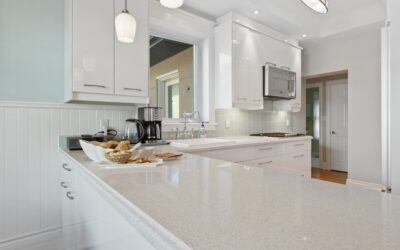
White stone has dominated kitchen design for years, and while quartz and marble grab attention, granite quietly remains the workhorse choice for homeowners who want natural beauty without babysitting it. White granite kitchen countertops deliver the bright, airy look people love along with the heat resistance and durability that only real stone provides. The misconception is that “white granite” is purely white. It almost never is. Each slab carries flecks, veins, and movement in grays, blacks, and golds, and understanding that variation is the key to choosing a slab you’ll love for decades rather than one that fights your design.
Part of our Countertops guide — explore the full guide →
What Makes Granite Different From Other White Counters
Granite is an igneous rock formed deep underground, which gives it a dense, hard, naturally heat-resistant surface. Compared to its white counterparts, it occupies a useful middle ground. Marble is softer and stains and etches easily, demanding constant care. Engineered quartz is consistent and low-maintenance but is man-made and can scorch under a hot pan. Granite splits the difference: it’s natural like marble but far tougher, and it handles heat far better than quartz. The trade-off is that granite is porous and needs periodic sealing, and no two slabs are identical.
Popular White Granite Varieties
Knowing the names helps you shop, since each variety has a distinct character.
- White Ice / Viscont White: A soft white-gray background with gentle gray veining, reading almost like marble at a distance.
- Alaska White: Creamy white with scattered burgundy, gray, and black flecks for a busier, warmer look.
- Colonial White: White to light gray with fine black and garnet speckling, a classic understated pattern.
- River White: A flowing pattern with maroon and gray garnet specks over a white field.
- Bianco Romano: White and gray with subtle taupe and black accents, versatile across many cabinet colors.
Because every slab varies, always view and approve the actual slab at the yard rather than ordering from a small sample. The piece in the warehouse is what ends up in your kitchen.
What White Granite Kitchen Countertops Cost
Granite is priced by the square foot, installed, and white varieties often run slightly higher than common speckled colors because of demand. Expect $40 to $100 per square foot installed for most white granite, with exotic or rare slabs reaching $150 or more. A typical kitchen with around 40 square feet of counter lands somewhere between $2,000 and $5,000 installed. Edge profiles, sink cutouts, and seams can nudge that figure, and a fabricated waterfall edge on an island adds a premium.
The Pros and Cons
Weighing both sides helps set expectations.
- Pros: Naturally heat resistant so you can set a hot pot down briefly, extremely hard and scratch resistant, unique one-of-a-kind appearance, and a durability that lasts the life of the home.
- Cons: Porous and needs sealing once or twice a year, can chip at edges under a hard impact, heavier than quartz so cabinets must be sturdy, and the natural variation means matching multiple slabs takes care.
Sealing: The One Habit That Matters
Because granite is porous, an unsealed white slab can absorb red wine, oil, and coffee, leaving a dark stain that’s hard to remove, and stains show more on light stone. Sealing fills the pores so spills bead on the surface long enough to wipe up. Most white granite needs sealing at installation and then resealing every 6 to 12 months, depending on the stone’s density and how heavily you use the kitchen.
Test it easily: drip a small puddle of water on the counter and wait 15 minutes. If it beads or sits on top, the seal is good. If the stone darkens where the water sat, it’s time to reseal. A quality stone sealer costs $20 to $40 and takes 20 minutes to apply.
Daily Care and Cleaning
Granite is easy to live with once sealed. A few habits keep it pristine:
- Wipe daily with warm water and a few drops of dish soap or a dedicated stone cleaner.
- Avoid acidic cleaners, vinegar, bleach, and ammonia, which break down the sealer and can dull the surface over time.
- Clean up spills promptly, especially wine, juice, and oil, since light stone shows stains more readily.
- Use a cutting board, even though granite resists scratches, because cutting directly on it dulls your knives.
- Use trivets for very hot pans as a habit, even though granite tolerates heat, to protect the sealer.
Design Tips for White Granite
White granite is flexible enough to anchor nearly any kitchen. Pair it with white or light cabinets for a bright, seamless, timeless look, or use it to lighten dark navy, green, or charcoal cabinets for contrast. Pull a vein or fleck color out of the slab into your hardware, backsplash, or bar stools to tie the room together. A subtle, low-movement granite reads as calm and classic, while a bold, high-contrast slab becomes the kitchen’s centerpiece, so choose based on whether you want the counter to blend or to star.
White Granite vs. White Quartz and Marble
Since most homeowners shopping for white counters are weighing these three, it helps to compare them head-to-head. White marble, like Carrara or Calacatta, offers the most coveted soft veining, but it’s the highest-maintenance option: it’s soft, scratches and chips easily, and etches dull spots from any acid, including lemon juice and wine. It demands diligent care and is best for low-traffic kitchens or homeowners who embrace a lived-in patina.
White quartz is engineered, so it’s non-porous, never needs sealing, and offers consistent patterns with no slab-to-slab surprises. Its weaknesses are heat sensitivity, since a hot pan can scorch the resin binder, and a look that some find less natural than real stone. White granite sits between them: tougher and more heat-resistant than both marble and quartz, with the genuine character of natural stone, at the cost of periodic sealing and natural variation. If you cook seriously and want real stone that can take a hot pot and years of use, white granite is often the most practical of the three, while quartz wins on pure low maintenance and marble wins on pure beauty.
The Bottom Line
For homeowners who want the prestige and durability of natural stone with the bright look of white, white granite kitchen countertops are a smart, lasting choice. They cost less than premium quartz in many cases, outlast trends, and handle the heat and wear of a real working kitchen. Commit to the simple sealing routine, choose your actual slab in person, and you’ll have countertops that look stunning and perform reliably for the life of your kitchen.