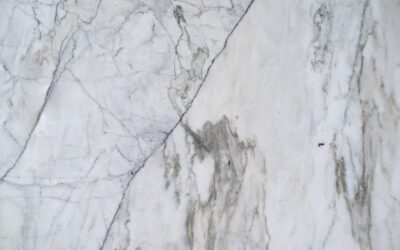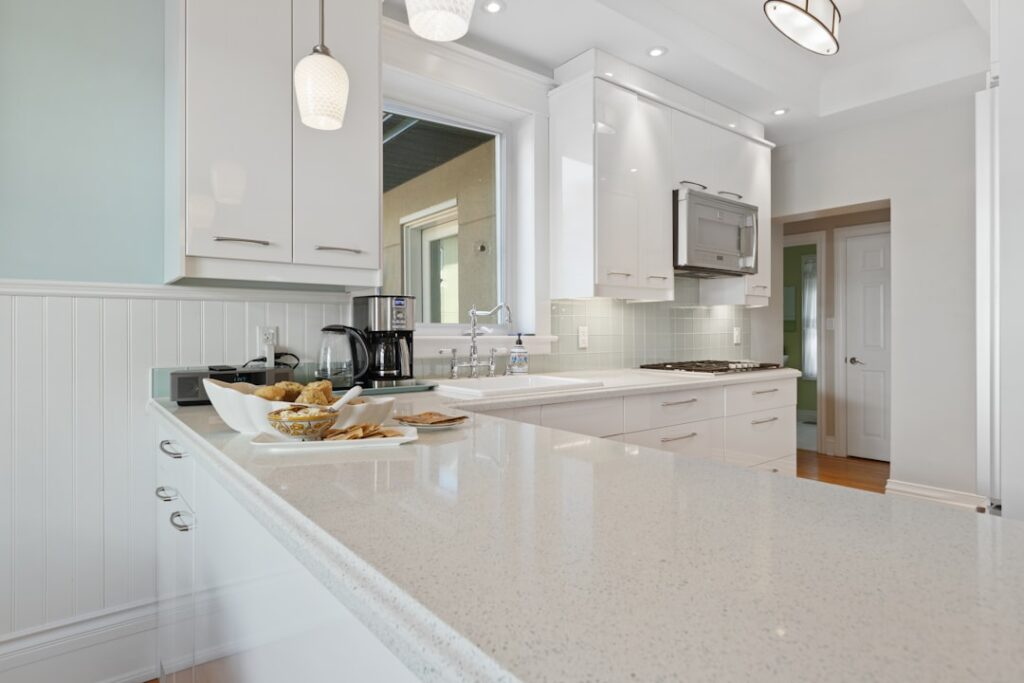
Walk into any high-end kitchen showroom and you will notice the same thing designers have known for years: white granite with veins reads as luxury the moment you see it. Unlike solid white countertops that can look flat under kitchen lighting, veined granite carries movement, depth, and a natural pattern that no two slabs share. Homeowners love the marble-like drama without the fragility that scares people away from real marble. This guide covers the best varieties, realistic pricing, how the veining is formed, and exactly how to keep it looking sharp for decades.
Part of our Countertops guide — explore the full guide →
- What Gives White Granite Its Veins
- Popular Varieties of White Granite with Veins
- White Granite with Veins vs. Marble and Quartz
- How Much White Granite with Veins Costs
- Sealing and Daily Care
- Design Tips for Veined White Countertops
- Common Problems and How to Avoid Them
- Is White Granite with Veins Right for Your Kitchen
What Gives White Granite Its Veins
Granite is an igneous rock, meaning it cooled and crystallized from molten magma deep underground. The white background comes primarily from feldspar and quartz, while the veins and flecks are created by minerals like mica, amphibole, garnet, and iron oxides that concentrated in seams as the rock formed. Those darker mineral bands are what give you the gray, black, gold, or burgundy veining running across a pale field.
Because the pattern is a record of geological pressure and mineral flow, the veins are truly random. A slab quarried a few feet away from another can look noticeably different. That is a selling point rather than a flaw. When you shop, you are choosing an individual piece of stone, not a repeatable manufactured pattern like quartz.
Popular Varieties of White Granite with Veins
Several named quarry stones dominate the market, and knowing them by name will save you time when you talk to a fabricator.
- Alaska White — A soft white to cream base with gray and burgundy waves. It is forgiving with both warm and cool cabinet colors and typically runs $45 to $70 per square foot installed.
- Colonial White — Light gray-white with fine black and garnet speckling rather than bold veins. A good pick if you want subtle movement, usually $40 to $60 per square foot.
- Viscont White — A dramatic gray-white with long, distinct veining that mimics marble. Expect $50 to $75 per square foot.
- Bianco Antico — Creamy background with pink, gray, and taupe crystals. It pairs beautifully with white or gray shaker cabinets, around $55 to $80 per square foot.
- Delicatus White — Bright white with dramatic black and gold veining, one of the boldest options, often $60 to $90 per square foot.
These prices assume a standard 2 cm or 3 cm slab, basic edge profile, and average fabrication. Rare slabs with exceptional veining can climb well past $100 per square foot, and exotic imports occasionally hit $120 or more.
White Granite with Veins vs. Marble and Quartz
Buyers drawn to white granite with veins are usually cross-shopping marble and veined quartz, so it helps to be clear on the trade-offs. Marble delivers the softest, most elegant veining, but it is calcium carbonate and etches when it contacts anything acidic, lemon juice, wine, tomato sauce, even some cleaning sprays. Within a year, a busy marble kitchen shows dull spots.
Granite is far harder, ranking about 6 to 7 on the Mohs scale versus marble’s 3 to 4. It resists scratches, heat, and etching dramatically better. You can set a hot pan down briefly without the panic marble demands, though a trivet is still smart practice. The trade-off is that granite veining tends to be busier and more crystalline than marble’s flowing lines, so it looks natural rather than painterly.
Quartz, an engineered blend of ground stone and resin, offers factory-consistent veined patterns and never needs sealing. But quartz can scorch under a hot pan around 300°F, and the veining, while convincing, repeats across slabs. If you want a one-of-a-kind natural surface that tolerates heat, veined granite wins.
How Much White Granite with Veins Costs
For a typical kitchen with about 40 to 55 square feet of counter, plan on a total installed cost of $2,200 to $4,500 for mid-grade veined white granite. That figure includes templating, fabrication, edge work, and installation. Here is where the money goes:
- Slab material: $25 to $65 per square foot depending on rarity and thickness.
- Fabrication and installation: $30 to $50 per square foot, covering cutting, polishing, and setting.
- Edge upgrades: A basic eased edge is included, but ogee, bullnose, or mitered edges add $10 to $25 per linear foot.
- Sink cutouts: $100 to $250 each for undermount installations.
Always view the actual slab before purchase. Two slabs of the same named granite can differ enough that one might have a bold vein running straight through your island while another looks nearly plain. Tag the slab you want at the yard.
Sealing and Daily Care
Most white granite needs sealing, and lighter stones especially benefit because stains show more against a pale background. Test whether your slab needs it by dripping water on the surface. If the water darkens the stone within a few minutes, it is absorbing moisture and needs a penetrating sealer. Many white granites should be resealed every 12 to 24 months.
Use a quality impregnating sealer, apply it with a clean cloth, let it sit 15 minutes, then buff off the excess. For daily cleaning, skip vinegar, ammonia, and bleach, which break down sealers over time. A few drops of dish soap in warm water, or a pH-neutral stone cleaner, keeps the finish bright. Wipe spills of wine, coffee, or oil promptly so they never sit long enough to penetrate.
Design Tips for Veined White Countertops
The veining in your granite should guide your surrounding choices rather than compete with them. If you picked a bold Delicatus White with heavy black veins, keep the backsplash simple, a plain white subway tile or a full-height slab backsplash in the same stone. Busy patterned tile next to busy granite creates visual chaos.
Warm-toned veining with gold or beige flatters cream, walnut, and brass hardware. Cool gray veining sits better with white, navy, or matte black cabinetry and brushed nickel or chrome fixtures. For islands, consider running the veins lengthwise so the eye follows the long axis of the counter, a small detail fabricators can honor if you flag it during templating.
Common Problems and How to Avoid Them
Even durable granite has failure points, and knowing them upfront saves regret. The most frequent complaint with white varieties is staining around the sink and stovetop, where oil and dark liquids sit. This almost always traces back to a lapsed sealer, so keep a resealing reminder on your calendar. If a stain does set, a poultice made of baking soda and water, applied for 24 hours under plastic wrap, draws most stains out of the stone.
Chipping at the edges is another risk, especially with thinner 2 cm slabs on unsupported overhangs. Insist on proper plywood substrate or steel bracket support for any overhang beyond 10 inches. Seams are unavoidable on large kitchens because slabs top out around 120 inches long; a skilled fabricator places the seam in a low-visibility spot and color-matches the epoxy so the joint nearly disappears. Ask to see photos of past seam work before hiring. Finally, resist using generic granite-shine sprays that leave a waxy film; they build up over time and cloud the polish. Plain warm water and a microfiber cloth keep the surface truest to its natural luster.
Is White Granite with Veins Right for Your Kitchen
If you want the elegance of marble with the durability of stone that can shrug off daily cooking, white granite with veins is one of the smartest countertop investments available. It delivers a natural, unrepeatable pattern, handles heat and scratches far better than marble, and typically costs less than premium quartz or genuine Carrara. Budget for periodic sealing, hand-pick your slab at the yard, and coordinate your veining with cabinets and backsplash. Do that, and you get a surface that looks custom, lasts 30 years or more, and adds real resale appeal to your home.