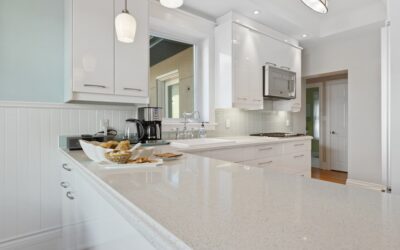
Silver grey granite has earned a permanent place in kitchen and bath design because it delivers the natural depth of real stone in a neutral that goes with almost anything. Unlike a busy, high-movement granite that dictates the whole room, a silvery grey slab reads as a sophisticated, calm backdrop, letting your cabinets, backsplash, and hardware take the lead. Its flecks of crystal catch the light with a subtle shimmer that photographs beautifully and hides crumbs and water spots better than a solid dark stone. This guide covers the popular silver grey granite varieties, what they cost, how to pair them, and how to keep the surface sealed and gleaming for decades.
Part of our Countertops guide — explore the full guide →
What Gives This Granite Its Silvery Look
The silver-grey appearance comes from the natural mineral makeup of the stone, primarily feldspar, quartz, and mica, ground and compressed over millennia. The mica in particular creates the reflective sparkle that makes these granites shimmer under kitchen lighting. Because it is a natural stone, every slab is unique, with its own distribution of light and dark grey, silver flecks, and occasional darker veining, so no two counters are identical.
That natural variation is part of the appeal, but it also means you should always view the actual slabs you are buying rather than relying on a small sample. A grey that looks uniform on a four-inch chip may reveal dramatic movement or darker patches across a full eight-foot slab. Reputable stone yards let you tag the specific slabs for your job, which is the only way to know exactly what you are getting.
Popular Silver Grey Granite Varieties
Several named granites dominate the silver-grey category, each with a distinct character.
- Silver Cloud: a soft, flowing blend of light and mid grey with gentle wave-like movement, popular for its calm, versatile pattern.
- Steel Grey: a more uniform, fine-grained grey with a consistent look, ideal when you want a quiet, solid-feeling surface.
- Silver Pearl and Silver Waves: grey backgrounds with pearly, shimmering movement and darker ribbons for more visual interest.
- Colonial Silver and Silver Sea Green: greys with subtle warm or cool secondary tones that bridge to beige or green palettes.
When comparing varieties, decide how much movement you want. A uniform grey like Steel Grey suits busy backsplashes and patterned floors, while a flowing pattern like Silver Cloud becomes a focal point on its own and pairs best with simple, solid surroundings.
What Silver Grey Granite Costs
Granite pricing depends on the variety, slab thickness, availability, and your local fabrication market. As working numbers for material and standard installation combined, expect the following.
- Common, widely available greys: roughly $40 to $60 per square foot installed.
- Mid-range varieties with more movement: about $60 to $85 per square foot installed.
- Premium or exotic silver granites: $85 to $110 or more per square foot installed.
For a typical 40-square-foot kitchen, that puts most silver grey granite projects between roughly $1,800 and $4,000 including the sink cutout, edge profile, and template work. Edge upgrades, a waterfall island, or a full-height backsplash push the total higher because they consume extra material and fabrication labor. Ask your fabricator to itemize the quote so you can see exactly where the cost lives.
Pairing Silver Grey Granite
The great strength of a grey neutral is that it works with virtually any cabinet color, but a few combinations are especially strong. White cabinets with silver grey granite create a bright, timeless, high-contrast kitchen that never goes out of style. Grey cabinets in a lighter or darker shade than the stone give a modern, tonal, monochromatic look that feels serene and upscale.
For warmth, pair the cool grey with natural wood cabinets or floors, which keep the room from feeling cold, and add brushed brass or matte black hardware to introduce a rich accent. Navy blue lower cabinets under a silver grey top are another popular, sophisticated combination. On the backsplash, a simple white subway tile or a soft grey stone keeps the look clean, while a marble-look tile adds subtle luxury. Because the granite itself is understated, you have real freedom to be bold elsewhere.
Where It Works Beyond the Kitchen
Silver grey granite is not just for kitchen counters. Its durability and neutral tone make it excellent for bathroom vanities, where it resists the water and toiletries that would stain a more porous stone. It also performs well as a fireplace surround, an outdoor kitchen counter, or even flooring and stair treads in tile form, since granite is one of the hardest and most heat- and scratch-resistant natural stones available.
In any of these uses, the same qualities apply, the stone hides everyday wear, tolerates heat and abrasion, and coordinates with almost any surrounding color. That flexibility is a big part of why designers keep returning to grey granite across so many rooms.
Sealing and Care
Like all natural granite, silver grey granite is porous and needs sealing to resist stains, though it is far more forgiving than marble. Test the seal periodically by dropping water on the surface; if it beads, the seal is intact, and if it soaks in and darkens the stone, it is time to reseal, usually every one to three years depending on use and the specific stone. Sealing is a simple wipe-on, wipe-off task most homeowners can do themselves.
For daily care, clean with a pH-neutral stone cleaner or mild soap and water rather than acidic or abrasive products that can dull the polish over time. Wipe spills promptly, use trivets under hot pans as a good habit, and buff the surface dry to prevent water spotting. With that light routine and a current sealer, silver grey granite stays sparkling and stain-free for decades, delivering the natural beauty and durability that make it such a lasting favorite.
Granite Versus Grey Quartz
Many homeowners shopping for a silvery grey counter weigh natural granite against engineered grey quartz, so it helps to know the trade-offs. Granite gives you genuine, one-of-a-kind natural stone with the crystalline sparkle and organic movement that only nature produces, and it handles heat exceptionally well, shrugging off a hot pan that could scorch quartz. The cost of that authenticity is periodic sealing and the reality that no two slabs match, so you must view your actual stone.
Grey quartz, by contrast, offers a consistent, predictable pattern and a nonporous surface that never needs sealing, which appeals to shoppers who want low maintenance and a uniform look. It resists staining more readily than granite but is more sensitive to high heat. Neither is objectively better; the choice comes down to whether you value the natural character and heat tolerance of real stone or the consistency and seal-free convenience of engineered quartz. For homeowners who love the idea of a unique natural surface with a timeless grey neutral, silver grey granite remains hard to beat, and it typically adds solid resale appeal to a kitchen as well.