After fabricating and installing countertops for close to two decades, I can tell you that quartz countertops with blue veining have gone from a rare special-order item to one of the most requested looks in the showroom. Homeowners want the movement and character of natural stone but with a color story that feels intentional rather than accidental. Blue veining delivers exactly that, and because it is engineered rather than quarried, you get consistency you simply cannot guarantee with real marble or granite.
Part of our Countertops guide — explore the full guide →
Before you sign a work order, though, it helps to understand what you are actually buying. Not all blue-veined slabs are created equal, and the price swing between a builder-grade look and a genuine designer slab can be $40 to $60 per square foot. Let me walk you through the whole decision the way I would if you were standing in my shop.
What Gives Quartz Its Blue Veining
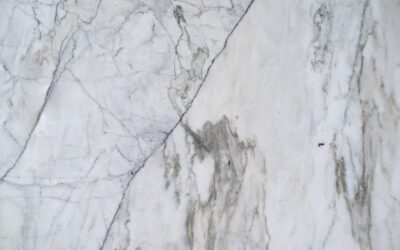
Engineered quartz is roughly 90 to 94 percent ground natural quartz bound with polymer resins and pigments. The veining you see is not natural mineral striation; it is printed or hand-laid pigment applied during the slab-forming process. Manufacturers like Caesarstone, Cambria, and Silestone use proprietary techniques to layer color so the veins run through the depth of the slab rather than sitting only on the surface.
This matters for one practical reason. When your fabricator polishes an edge or shapes a bullnose, a through-body vein will still show color on the profile. Cheaper slabs with surface-only printing can reveal a plain gray or white core at the edge, which looks off on a waterfall or a thick mitered apron. Always ask whether the veining is full-depth before you commit.
Cool Blue Versus Warm Blue Tones
Blue reads very differently depending on the base. A crisp white background with icy cobalt or slate-blue veins feels modern and clean. A creamier, off-white base with softer powder-blue veining leans transitional and pairs beautifully with brass hardware. Bring a cabinet door sample and a flooring chip to the slab yard; blue is notorious for shifting under warm LED lighting.
Best Brands and Patterns to Consider
I steer most clients toward the established engineered lines because their resin quality and warranty support are proven. Here are the ones that consistently deliver good blue-veined options:
- Cambria — patterns like Skye and Delgatie offer dramatic, painterly blue movement; premium pricing, made in the USA, lifetime warranty.
- Caesarstone — cleaner, more subtle veining that suits minimalist kitchens; strong scratch resistance.
- Silestone — good mid-range value with its N-Boost surface treatment for stain resistance.
- MSI Q Premium — budget-friendly blue-veined marble looks, widely stocked at big-box and independent yards.
If you want a truly custom hue, a few fabricators now offer semi-custom pigment work, but expect a 4 to 8 week lead time and a surcharge. For most kitchens, a stock designer pattern gets you 95 percent of the way there at a far lower cost.
What Blue-Veined Quartz Costs
Pricing has three parts: the material, the fabrication, and the install. For quartz countertops with blue veining, budget the following installed ranges as of 2026:
- Builder/entry patterns: $55 to $75 per sq ft installed
- Mid-range designer blue veining: $75 to $95 per sq ft installed
- Premium Cambria-tier slabs: $95 to $130 per sq ft installed
A typical 30 linear foot kitchen runs about 55 square feet of countertop. That puts most blue-veined quartz projects between $4,500 and $7,000 all in. Add $300 to $700 if you want a farmhouse sink cutout, a waterfall end, or a thick mitered edge, since those all consume extra material and labor.
One money-saving tip: bookmatched or heavily veined slabs generate more waste because the fabricator has to align the pattern across seams. If your layout has a big island plus perimeter runs, ask how many slabs the job needs. Sometimes tweaking the seam location saves an entire slab.
Designing Around Blue Veining
Blue is a statement, so let it lead and keep everything else quieter. In the kitchens I have seen age the best, the countertop is the boldest element and the cabinets, backsplash, and floor stay neutral.
Cabinet Pairings That Work
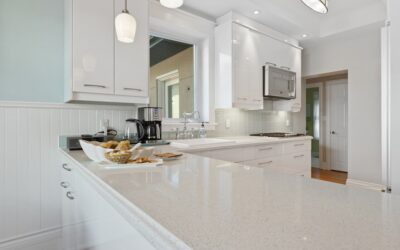
White and off-white cabinets are the safe, timeless choice; they let the blue veins pop without competition. For something richer, deep navy lowers with white uppers create a monochromatic look that feels custom. Warm wood tones like white oak also work if the blue leans slate rather than bright cobalt. I would avoid gray cabinets with blue veining unless the undertones are carefully matched, because two cool grays fighting each other reads muddy.
Backsplash and Hardware
A simple white subway tile or a full-height quartz slab backsplash keeps the focus on the counter. If you run the same veined quartz up the wall, use a single slab so the veining flows continuously. For hardware, brushed brass and matte black both flatter blue; polished chrome can look sterile next to it.
Durability and Daily Living
Here is where quartz earns its keep. Unlike marble, which will etch the first time someone sets down a glass of red wine or a lemon wedge, engineered quartz is non-porous and does not need sealing. That non-porous surface also resists bacteria, which is why I recommend it for families who actually cook.
The one real limitation is heat. Quartz resin can scorch or discolor around 300°F, so never set a hot pan directly on it. Keep trivets near the range and cooktop. Blue-veined slabs, in my experience, hide everyday smudges and water spots better than pure white quartz, which is a quiet bonus for busy households.
- Cleaning: mild soap and water daily; avoid abrasive pads and bleach-heavy cleaners that can dull the finish.
- Sealing: none required, ever.
- Repairs: minor chips can be filled by a fabricator with color-matched resin.
Common Mistakes to Avoid
The biggest regret I hear about is choosing a slab from a tiny sample chip. A 4-inch square cannot show you how a dramatic vein pattern will land on a 9-foot island. Always view the actual full slab you are buying, and mark with tape where the sink and seams will fall. Photograph it under your phone flashlight and in daylight.
The second mistake is over-matching. When people try to echo the blue in the veining across the walls, the barstools, the rug, and the pendant lights, the room starts to feel like a themed hotel lobby. Pick two or three spots to repeat the blue and stop there.
Finally, do not skimp on the fabricator. A great slab installed with mismatched seams and a wavy edge looks worse than a modest slab installed cleanly. Ask to see photos of past blue-veined installs and check that they laser-template rather than eyeball measurements.
Is Blue-Veined Quartz Right for You
If you want the drama of natural stone, the low maintenance of an engineered surface, and a color that still feels fresh five years from now, quartz countertops with blue veining are one of the smartest choices on the market. They cost more than a plain white quartz but far less than a comparable exotic marble, and they will not etch, stain, or need annual sealing.
My honest advice: set a realistic budget around $80 to $100 per square foot installed for a designer look, visit at least two slab yards to compare full slabs, and choose a fabricator who treats the veining as a design element to lay out, not just material to cut. Do that, and you will end up with a countertop that becomes the centerpiece of the whole room.