
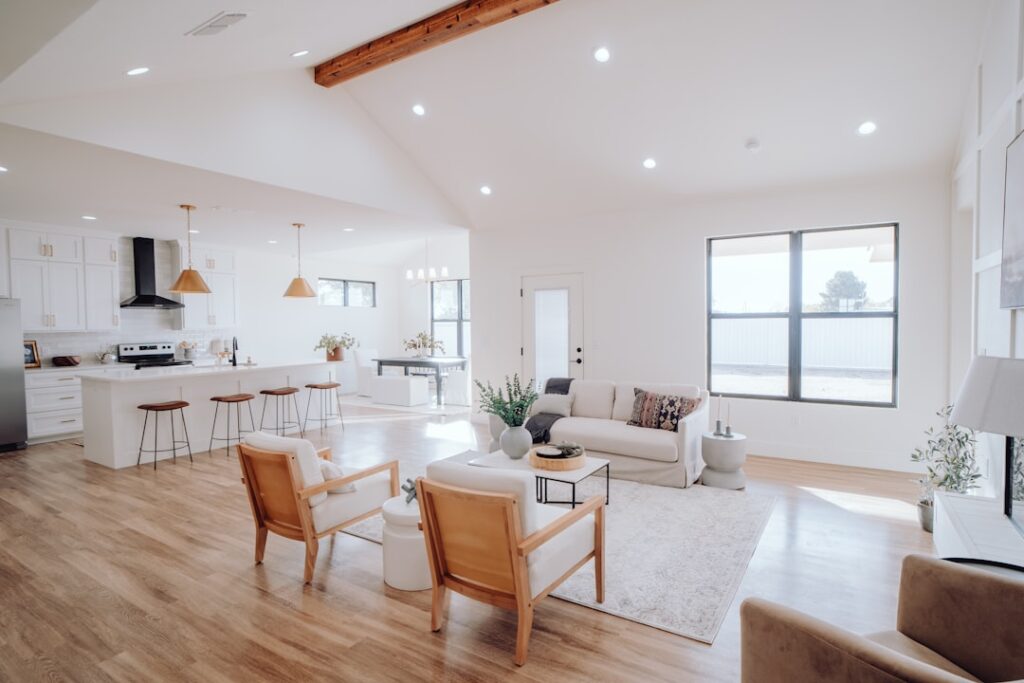
A single board of wide plank engineered wood flooring typically measures 5 to 9 inches across, compared with the 2.25 to 3.25 inch strips that dominated American homes for most of the 20th century. That extra width changes everything about how a room reads. Fewer seams run across the floor, the natural grain of the wood gets more room to breathe, and the whole space tends to feel larger and calmer. At D and G Flooring, we field more questions about wide plank engineered floors than almost any other product, and this guide walks through exactly what you are buying, where it shines, and where it can trip you up.
What Wide Plank Engineered Wood Actually Is
Engineered wood is not laminate and it is not vinyl. Each plank is built in layers. The top layer, called the wear layer or veneer, is genuine hardwood, usually oak, hickory, walnut, or maple. Beneath it sit several plies of cross-laminated birch, poplar, or eucalyptus, glued at alternating 90-degree angles. That crisscross core is the secret to the product. Because the grain directions oppose one another, the plank resists the swelling and shrinking that plagues solid wood when humidity swings.
The “wide plank” label simply refers to boards 5 inches and up. Many premium collections push to 7.5 or 8.5 inches, and some European white oak lines reach a full 10 inches. The veneer thickness matters more than most shoppers realize. A budget board might carry a 0.6 millimeter veneer, while a high-end plank offers 3 to 6 millimeters of real hardwood on top. Thicker veneers can be sanded and refinished one or two times over the floor’s life; the thinnest ones cannot be refinished at all.
The Pros That Win People Over
The biggest advantage is dimensional stability. Wide boards expand and contract more than narrow ones across their face, so a solid wide plank can develop ugly gaps in winter and cupping in summer. The engineered core tames that movement, which is why wide planks are almost always engineered rather than solid these days.
- Real wood surface. You get authentic grain, knots, and character, not a printed photograph.
- Works over concrete. Engineered planks can be glued or floated over a concrete slab, including in basements and over radiant heat, where solid wood is risky.
- Faster, cleaner look. Wider boards mean roughly 30 to 40 percent fewer seams than narrow strip flooring covering the same area.
- Pre-finished durability. Factory finishes cured with aluminum oxide and UV light are tougher than most finishes applied on site.
- Installation flexibility. Depending on the product you can nail, glue, or click it together as a floating floor.
The Cons You Should Weigh Honestly
No floor is perfect, and wide plank engineered wood has real trade-offs. The veneer issue is the one that costs people money. If you buy a thin wear layer, deep scratches reach the plywood underneath and there is no sanding your way out of it. Refinishing requires at least a 2 millimeter veneer, and even then a skilled pro must take a light pass.
Wide boards also telegraph an uneven subfloor more readily than narrow ones. A dip that a 2.25 inch strip would bridge can leave a wide plank feeling hollow or bouncy underfoot. Subfloor flatness tolerances, often 3/16 inch over 10 feet, must be respected. Finally, the wide formats and longer board lengths command a premium, and very wide European oak can run well above standard hardwood pricing.
What It Costs in 2026
Pricing spans a broad range depending on species, veneer thickness, and width. As a general US market guide, expect roughly the following for materials alone:
- Entry-level wide plank with a thin veneer: about $3 to $5 per square foot.
- Mid-grade oak or hickory with a 2 to 3 millimeter veneer: about $5 to $9 per square foot.
- Premium European white oak, extra-wide, thick veneer: about $9 to $15 per square foot and up.
Professional installation generally adds $3 to $7 per square foot depending on method and region. Glue-down over concrete tends to cost more than a floating click installation because it is more labor intensive and uses specialized adhesive. Budget for underlayment, trim, and 7 to 10 percent extra material to cover cuts and future repairs.
Choosing the Right Veneer and Core
Treat veneer thickness as the single most important spec on the data sheet. If you want a floor your grandchildren could refinish, look for 4 to 6 millimeters. For a home you plan to sell within a decade, 2 millimeters strikes a sensible balance. Below 1 millimeter, accept that the floor is essentially a one-life product.
For the core, a Baltic birch plywood core with seven or more plies resists dents and holds fasteners better than a cheaper fiberboard or HDF core. If you are installing over radiant heat, confirm in writing that the manufacturer rates the product for it and follow their maximum surface temperature, commonly 81 to 85 degrees Fahrenheit.
Installation Methods Compared
Three approaches dominate. Nail-down works only over a wood subfloor and gives the most solid feel, but it is the most labor-intensive. Glue-down bonds the plank directly to the subfloor with a flexible urethane adhesive, which is the gold standard over concrete and under wide formats because it eliminates hollow spots. Floating click systems lock board edges together over a foam or cork underlayment, float free of the subfloor, and let a confident homeowner tackle the job in a weekend.
Whatever method you pick, let the flooring acclimate in the room for the time the manufacturer specifies, often 48 to 72 hours, and check the slab moisture content before glue-down. A calcium chloride or relative humidity test that exceeds the adhesive’s limit is the most common cause of failed installs.
Caring for the Floor
Sweep or vacuum with a hard-floor setting weekly to keep grit from acting like sandpaper. Damp-mop with a cleaner formulated for finished wood; never let standing water sit. Add felt pads to furniture legs, keep indoor humidity between roughly 35 and 55 percent, and use rugs at entry doors to trap debris. Refresh the surface with a manufacturer-approved polish rather than wax, which can cloud a urethane finish.
Is It Right for Your Home?
Wide plank engineered wood flooring suits homeowners who want the warmth and resale appeal of genuine hardwood with fewer worries about humidity, basements, and radiant heat. If your budget is tight or your rooms see heavy abuse from pets and kids, weigh a thicker veneer or a tougher species like hickory. Bring your room dimensions and subfloor details to D and G Flooring, and you can match the right width, species, and installation method to how you actually live.
Prefer to explore on your own?
See how new flooring looks in your actual room in seconds — free, no signup.
Try the free Floor Studio →

