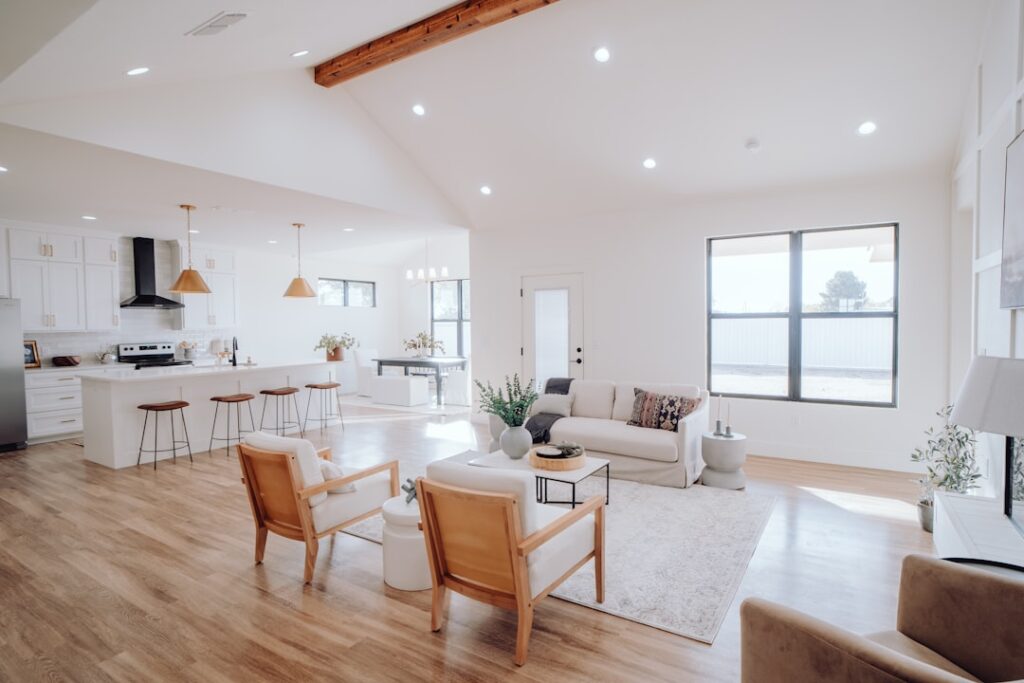
Everyone loves the warmth of a wood floor, but not everyone wants to refinish, baby it around water, or pay solid-hardwood prices. Wood style flooring solves that by giving you the look of real planks in materials that are tougher, more waterproof, and far more budget-friendly, from luxury vinyl and laminate to wood-look porcelain tile. This guide compares the main wood-look options, what each costs, and how to choose the one that fits your room and lifestyle.
What “Wood Style” Actually Means
Wood style flooring is any product engineered to mimic the appearance of natural wood planks using high-resolution printed images, embossed textures, and realistic plank shapes, without being solid wood. Modern printing and surface texturing have gotten so good that from standing height, premium wood-look products are nearly indistinguishable from the real thing.
The reason to choose them comes down to performance: better moisture resistance, more durability, lower cost, and easier installation than solid hardwood.
Luxury Vinyl Plank (LVP)
The runaway favorite. LVP layers a printed wood image and a textured wear layer over a vinyl or rigid stone-plastic core, producing a 100 percent waterproof plank that handles kitchens, baths, and basements with ease. Most click-lock floating versions are DIY-friendly.
Material runs roughly $2 to $5 per square foot, installed about $4 to $9. Look for a wear layer of at least 12 mil, or 20 mil for pets and heavy traffic. The main knock is that it is still plastic, so it will not refinish and very cheap versions look flat.
Laminate
Laminate puts a photographic wood layer over a dense fiberboard (HDF) core, topped with a tough melamine wear layer. It resists scratches and dents better than some vinyl and often shows crisp, realistic wood texture at a low price, roughly $1 to $4 per square foot for material.
The weakness is its wood-based core. Standard laminate swells if water sits in the seams, though newer water-resistant and waterproof laminates have closed much of that gap. Keep traditional laminate out of bathrooms and laundry rooms.
Wood-Look Porcelain Tile
For the most durable and waterproof wood look available, porcelain plank tile is unbeatable. It is completely waterproof, scratch-proof, fade-proof, and works indoors and out, even over radiant heat. Material runs roughly $3 to $10 per square foot.
The trade-offs are that it is hard and cold underfoot, needs skilled tile installation with proper grout joints, and costs more to install than floating floors. But for high-moisture and high-traffic spaces, nothing wood-look lasts longer.
Engineered Hardwood
If you want actual wood but more stability than solid planks, engineered hardwood bonds a real wood veneer over a plywood core. It looks and feels like genuine hardwood because the top layer is real, and it can often be refinished once or twice. Material runs roughly $4 to $10 per square foot.
It handles humidity swings better than solid wood but is not waterproof, so it is best for living areas and bedrooms rather than full baths.
How to Choose the Right Wood Look
Match the material to the room and your priorities.
- Waterproof and budget-friendly: LVP for kitchens, baths, and basements.
- Crisp texture at the lowest cost: Laminate for dry living areas and bedrooms.
- Maximum durability and moisture resistance: Wood-look porcelain tile.
- Real wood feel: Engineered hardwood in living and dining rooms.
What Makes a Wood Look Convincing
The gap between a cheap fake and a convincing wood floor comes down to a handful of details. Embossed-in-register (EIR) texture, where the surface texture aligns with the printed grain, is the single biggest tell; it makes the floor feel like wood under your hand, not just look like it from above.
Pattern variety is the next factor. Premium products use a dozen or more unique plank images, so you do not see the same knot or grain repeating every few boards, a dead giveaway on budget flooring. Beveled or micro-beveled plank edges create realistic seams, and wider, longer planks read more like genuine hardwood than short, narrow strips. When you shop, run your hand over the sample and look for repeating images across multiple boards.
Installation and Subfloor Basics
Most wood-look products today use a floating click-lock system that needs no glue or nails, which is what makes them so DIY-friendly. Acclimate planks in the room for 48 hours, leave a 1/4 to 3/8 inch expansion gap at the walls, and keep the subfloor flat within about 3/16 inch over 10 feet.
Tile is the exception; wood-look porcelain is set in thinset by a skilled installer with proper grout joints and, ideally, an uncoupling membrane. Engineered hardwood can be floated, glued, or nailed depending on the product and subfloor. Whatever the material, a clean, flat, dry subfloor is the foundation of a floor that looks and performs like the real thing.
Maintenance Across Wood-Look Materials
Each wood-look material has its own care routine, and matching your tolerance for upkeep to the product matters. LVP and laminate are the easiest: sweep up grit and damp-mop with a manufacturer-approved cleaner, skipping steam mops and excess water on laminate seams. Both shrug off the daily wear that would scuff real wood.
Wood-look porcelain tile is essentially maintenance-free, needing only sweeping and the occasional mop, with grout lines the only thing requiring periodic attention. Engineered hardwood asks for the most care, since it is real wood; sweep regularly, clean with a wood-specific product, control humidity, and avoid standing water. Use felt pads under furniture and walk-off mats at entries on every wood-look floor to trap the abrasive grit that does the most damage over time. Choose the material whose upkeep you will actually keep up with.
The Bottom Line
The best wood style flooring depends on the trade-off you care about most: cost, waterproofing, refinishability, or feel underfoot. LVP wins for versatility and value, porcelain wins for durability, laminate wins on price, and engineered wood wins if you want the real thing. Whichever you pick, prioritize a realistic embossed texture and a quality wear layer, because those two details separate a convincing wood look from an obvious fake.
Prefer to explore on your own?
See how new flooring looks in your actual room in seconds — free, no signup.
Try the free Floor Studio →