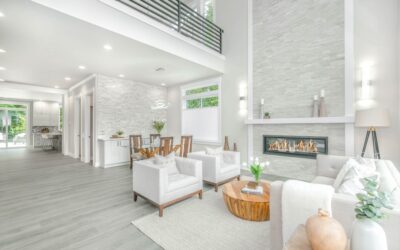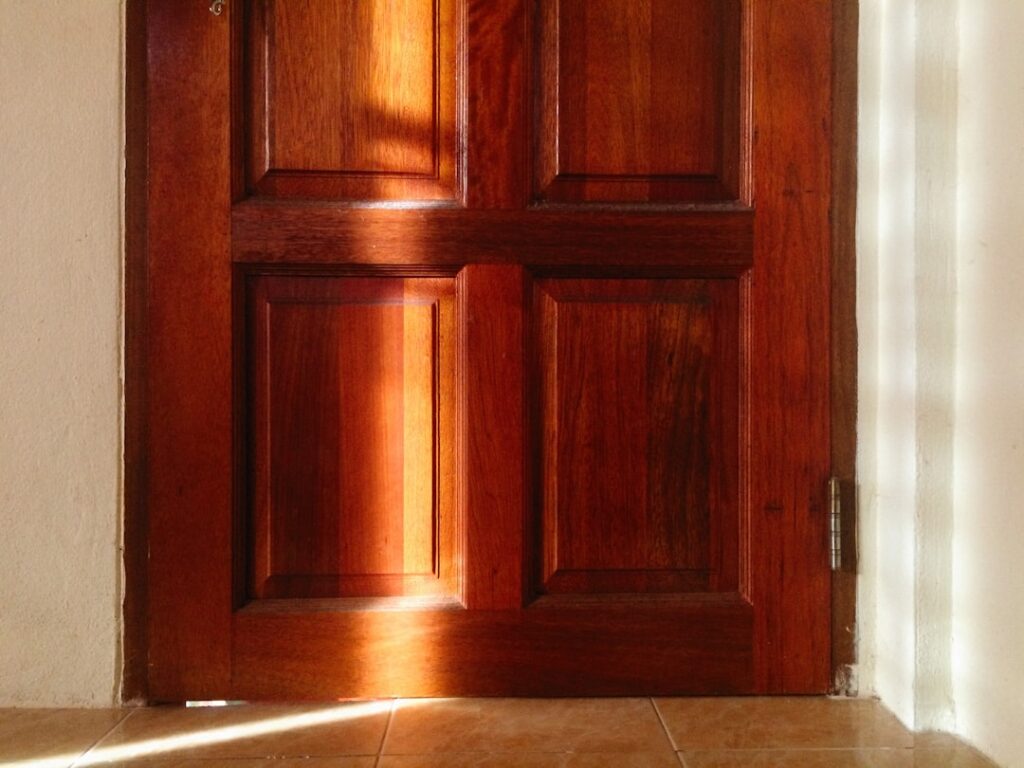
Walk through any new build or whole-house renovation from the last decade and one door shows up more than any other: five stacked horizontal panels, flat and crisp, in every hallway. The 5 panel interior door has become the default upgrade from builder-grade six-panel colonial doors because it reads modern without being stark — equally at home in farmhouse, transitional, and contemporary interiors. But “5 panel” covers several distinct layouts, two core constructions, multiple materials, and a price spread from $60 to $600 per opening. This guide breaks down the styles, specs, and buying decisions so you order the right doors the first time.
Horizontal vs. Vertical Layouts
The panel arrangement changes the personality of the door completely.
Horizontal 5-panel (equal panels)
Five identical flat panels stacked ladder-style — the signature modern-farmhouse door popularized over the past fifteen years. Equal horizontal panels emphasize width, calm a hallway full of doors, and pair naturally with shaker cabinetry and flat casing. This layout dominates current stock programs (Masonite’s Livingston and Lincoln Park, Jeld-Wen’s Conmore, Metrie’s shaker lines).
Horizontal 5-panel (graduated)
A vintage variation from the 1900s–1930s: horizontal panels that are not equal height, often with wider rails toward the bottom. Original versions turn up in salvage yards for $50 to $150 and suit craftsman restorations where an exact-equal modern door would look subtly wrong.
Vertical 5-panel
The traditional configuration seen in Victorian and early-craftsman homes: some combination of vertical panels, commonly two over three or a cross-buck-like arrangement with a horizontal lock rail. Vertical layouts read historic and formal. Fewer stock programs carry them, so expect special order or salvage.
Shaker 5-panel
“Shaker” here describes the profile, not the layout: flat recessed panels with square-edged, ovolo-free sticking — no raised profiles, no bevels. Nearly all modern horizontal 5-panels are shaker-profile. If you want softer, traditional character, look for versions with a small roundover or beaded sticking instead.
Hollow Core vs. Solid Core
Same look, very different door in the hand:
- Hollow core — molded hardboard or MDF skins over a cardboard honeycomb, roughly 25 to 30 lb per door. Cheapest ($60–$120 for a 30-inch slab or $130–$200 prehung), easy to hang solo, but tinny to the knock and nearly transparent to sound (~STC 20).
- Solid core — the same skins over a particleboard or MDF core, 60 to 80 lb. Adds roughly $60 to $120 per door and delivers the two things people actually notice daily: a substantial thunk when closing and meaningful sound damping (~STC 30-ish, roughly halving perceived voice transmission). Bedrooms, bathrooms, and home offices justify solid core; closets and pantries rarely do.
A practical compromise used in a lot of renovations: solid core on the bedroom/bath doors people close at night, hollow core on the six closet doors nobody hears. On a 12-door house, that saves $500 to $800 with zero lived-in difference.
Materials: MDF, Molded, and Pine
- MDF (routed one-piece or stile-and-rail) — the best paint-grade option. Dead-flat panels, no wood grain telegraphing, no seasonal panel cracks at the sticking because there is no floating solid-wood panel to shrink. Weakness: soft edges dent, and MDF hates standing water — not the pick for a kids’ bathroom with a splashy tub unless well-painted and maintained.
- Molded hardboard skins — how most budget 5-panels are made; a wood-fiber skin pressed with the panel profile. Perfectly serviceable painted; the profile is slightly softer-edged than routed MDF.
- Solid pine or fir stile-and-rail — real lumber construction with floating panels. Required if you want a stained door; also the choice for historic accuracy. Costs $250 to $500+ per slab, and painted versions will eventually show hairline paint cracks at panel joints as the wood moves — normal, not a defect.
- Primed wood composite hybrids — pine frames with MDF panels; a good middle path for paint-grade with real-wood screw-holding at the hinges.
Standard Sizes and Thickness
Interior doors follow predictable sizing. Heights: 80 inches (“6/8”) standard, with 84 and 96 inches stocked in fewer styles for tall openings. Widths in 2-inch increments: 24, 28, 30, 32, and 36 inches; 30 and 32 are the bedroom norms, 24–28 for closets and small baths, 36 where accessibility matters (and required on accessible routes). Thickness is 1-3/8 inches standard; 1-3/4 inch doors — the exterior thickness — appear in 8-foot heights and premium lines and need different hinges and latch backsets checked. Measure the existing slab and jamb before ordering: older homes are full of 78-inch doors and out-of-square openings where a prehung unit saves the day.
Prehung vs. Slab
A slab is the door alone — right choice when existing jambs are square, plumb, and staying (you will transfer hinge mortises and the bore; a $20 hinge template and a 2-1/8 inch hole saw handle it). A prehung unit arrives hinged in its jamb, adding roughly $60 to $120 over the slab price and making sense whenever jambs are damaged, trim is being replaced anyway, or you are re-dooring a whole house. Prehungs also solve the misery of matching 1950s hinge mortise layouts. For a whole-house swap, ordering prehungs with matching casing packs is nearly always faster than surgically fitting fifteen slabs.
What 5 Panel Doors Cost
- Hollow-core molded slab: $60 – $120
- Hollow-core prehung: $130 – $220
- Solid-core MDF slab: $130 – $250
- Solid-core prehung: $200 – $350
- Solid pine stile-and-rail slab: $250 – $500+
- 8-foot or 1-3/4 inch premium versions: $350 – $700
- Installation: $100 – $250 per door for slab fitting or prehung swap by a finish carpenter; whole-house packages bring the per-door labor down.
Painting adds real money if outsourced — $75 to $150 per door sprayed — so factory-primed doors plus a rented HVLP weekend is a popular budget move.
Matching Trim and Hardware
The door sets the style; casing and hardware finish the sentence. Flat “shaker” 5-panels look best with square-edged casing — flat stock 1×4, or a stepped craftsman head over plain legs — rather than curvy colonial clamshell, which fights the door’s geometry. Keep baseboards in the same square-profile family. For hardware, matte black and satin nickel levers dominate current pairings; a 5-panel with black levers and flat casing is the modern-farmhouse formula, while unlacquered brass knobs shift the same door traditional. One detail that elevates the job: order doors with matching panel alignment heights across a hallway, so the horizontal lines carry door to door. It is the kind of thing nobody names but everyone notices.
Painting and Finishing a 5-Panel Well
The flat panels that make this door photogenic also broadcast every brush mark, so finish strategy matters. Spraying wins: a rented or $150 HVLP turbine lays enamel glass-flat, and the door’s simple geometry makes it one of the easiest styles to spray — pull the slab, set it on sawhorses or a door rack, and coat horizontally to eliminate runs. Brushing works if you follow the sequence pros use: panels first (edges of each recess, then the field), then the horizontal rails, then the vertical stiles, maintaining a wet edge and laying off with the grain direction of each part. Use a quality enamel — Benjamin Moore Advance and Sherwin-Williams Emerald Urethane are the standards, about $50 to $70 per gallon, and one gallon covers 8 to 10 doors with two coats. Prime factory-primed doors anyway at any spot you sanded through, and scuff the whole slab with 220 first; factory primer is thin. Color note: doors painted the wall color in a satin or semi-gloss sheen is the current designer default, while contrast-black 5-panels remain popular but show dust and require the flattest possible application to look intentional rather than hasty.
Buying Checklist
- Count openings and split solid core (occupied rooms) vs. hollow (closets).
- Measure every slab width, height, thickness, and hinge side — write a door schedule.
- Pick layout: equal horizontal for modern/farmhouse, vertical or graduated for historic homes.
- Choose MDF for paint, pine for stain.
- Slab vs. prehung per opening condition.
- Order 10 percent extra time: stock styles are cash-and-carry, but 8-foot, 84-inch, and vertical-layout doors run 2 to 6 week lead times.
Do that and the humble 5 panel interior door does what good architecture always does — disappears into a house that simply feels right.