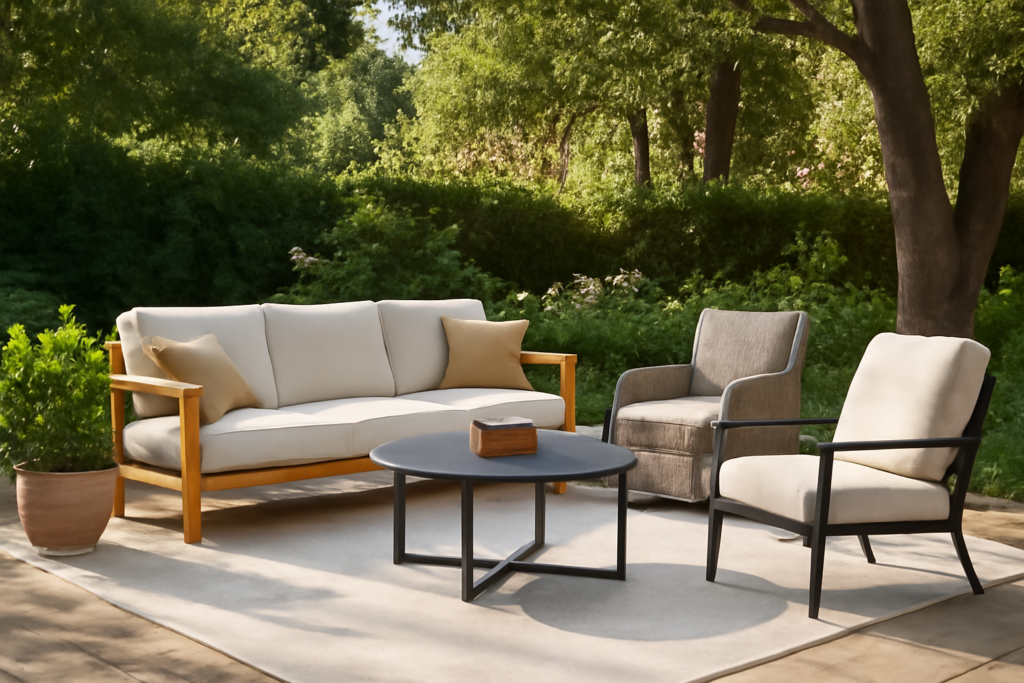
“All-weather” is the least regulated claim in the furniture business — it appears on $99 steel bistro sets that rust through in eighteen months and on $4,000 poly dining sets that genuinely shrug off two decades outside. Choosing all weather patio furniture is really a materials decision, and the right material depends on which weather you actually have. A chair that thrives through Phoenix UV can fail fast in a Minnesota freeze, and Florida salt air kills furniture that would last decades in Denver. This guide breaks the decision down by climate threat, scores the six major materials, covers the cushion problem everyone forgets, and tells you the truth about covers and storage.
- Know Your Enemy: The Five Climate Threats
- Material Scorecard
- The Materials in Detail
- Cushions and Fabric: Where "All-Weather" Claims Go to Die
- Covers and Storage: The Unglamorous Truth
- Matching Material to Your Climate
- Buying Checklist
- Budget Strategy: Where to Spend and Where to Save
- Red Flags on the Sales Floor
Know Your Enemy: The Five Climate Threats
Sun (UV): the universal destroyer. UV breaks polymer chains — it fades cheap plastics, chalks low-grade finishes, embrittles PVC wicker, and grays every wood. High-altitude and Sun Belt patios get double the dose of northern ones. Rain and humidity: constant moisture rots wood, rusts ferrous metal, and breeds mildew in cushion foam. Freeze-thaw: water that enters a seam, weld pinhole, or wicker weave expands 9% when it freezes, cracking joints, splitting wood, and popping finishes; this is the threat most “all-weather” marketing quietly ignores. Salt: coastal chloride accelerates corrosion on any steel component — including the hidden hardware on otherwise rustproof furniture — and etches unprotected finishes. Wind: not a materials problem but a mass problem; lightweight aluminum and hollow resin become projectiles where gusts top 40 mph.
Material Scorecard
| Material | Sun | Rain | Freeze | Salt | Wind (mass) | Typical Lifespan | Price Tier |
|---|---|---|---|---|---|---|---|
| HDPE poly lumber | Excellent | Excellent | Excellent | Excellent | Good (heavy) | 20+ yrs | $$$ |
| Powder-coated aluminum | Excellent | Excellent | Very good | Very good | Poor-fair (light) | 15-20 yrs | $$-$$$ |
| Teak | Very good (grays) | Excellent | Very good | Excellent | Good | 25-50 yrs | $$$$ |
| Resin wicker (HDPE weave) | Good-excellent | Very good | Good | Very good | Fair | 8-15 yrs | $$-$$$ |
| Steel / wrought iron | Very good | Fair (rust risk) | Fair | Poor | Excellent | 5-25 yrs (coating-dependent) | $-$$$ |
| Non-teak wood (acacia, eucalyptus) | Fair | Fair | Poor-fair | Good | Good | 3-8 yrs | $-$$ |
The Materials in Detail
HDPE poly lumber (Polywood, Berlin Gardens, Trex Outdoor Furniture) is the closest thing to weatherproof: solid boards colored through with UV-stabilized pigment, impervious to water, insects, and salt, unbothered by minus-30 winters. Weaknesses are comfort without cushions, heat absorption in dark colors, and price — quality Adirondacks start around $300 and dining sets around $2,500. Powder-coated aluminum cannot rust and carries a chip-resistant baked finish; buy 1.5 mm+ wall thickness or cast frames, and insist on stainless hardware near the coast. Teak earns its price with natural oils that repel water and insects; left alone it weathers to silver-gray without losing strength, and Grade A sets (Barlow Tyrie, Gloster, Kingsley Bate) routinely last 30+ years. Budget “teak” from unnamed grades and knotty stock does not perform the same.
Resin wicker quality hinges entirely on the fiber: HDPE weave (look for “high-density polyethylene” explicitly) lasts 10-15 years, while cheap PVC weave cracks and sheds in 2-4. The aluminum subframe underneath matters as much as the weave. Steel and wrought iron bring unmatched wind stability and low entry prices, but every chip is a rust site; in dry climates quality iron lasts generations, in wet or salty ones it is a maintenance commitment. Acacia and eucalyptus are the budget wood play — fine for covered porches and dry summers if oiled annually, a poor bet left exposed through freeze cycles, where checking and joint failure show up by year three.
Cushions and Fabric: Where “All-Weather” Claims Go to Die
Frames survive; cushions are what actually fail first on most patios. The fabric standard is solution-dyed acrylic — Sunbrella, Outdura, and equivalents — where color is locked into the fiber before weaving, delivering 5-10 years of fade resistance versus 1-2 seasons for printed polyester. Under the fabric, demand quick-dry reticulated foam or wrapped polyester fill with drainage; sealed foam turns into a mildew sponge after one wet spring. Olefin is the respectable budget fabric (good fade resistance, less refined hand). Even the best cushions are “weather-resistant,” not weatherproof: they want a deck box ($150-$400 for a quality resin one) or indoor storage through winter, and standing them on edge after storms halves drying time. When comparing sets, price replacement cushions before buying — a $1,200 set whose cushions cost $600 to replace in year four is not the bargain it appeared.
Covers and Storage: The Unglamorous Truth
Covers extend furniture life meaningfully — but only breathable, fitted ones. A quality 600-denier polyester cover with vents and buckles (Duck Covers, Classic Accessories Ravenna/Veranda lines, $30-$120 per piece) sheds rain while letting trapped humidity escape. Cheap non-vented tarps do the opposite, sweating condensation onto frames all winter and accelerating exactly the corrosion and mildew they were bought to prevent. Rules that pay off: never cover wet cushions, secure covers against wind flogging (the flapping abrades finishes), and in snow country either store frames in a garage or leave freely draining materials — poly, teak, quality aluminum — uncovered rather than wrapping them in plastic. Winter storage is the single biggest lifespan lever for wicker and cushioned pieces.
Matching Material to Your Climate
- Desert Southwest (extreme UV, heat, dry): powder-coated aluminum or teak; light-colored poly works but dark poly gets branding-iron hot. Fabric grade matters more than frame here.
- Gulf Coast / Florida (salt, humidity, hurricanes): HDPE poly or aluminum with stainless hardware; skip steel entirely; plan cushion storage for storm season and rinse salt monthly.
- Upper Midwest / New England (freeze-thaw, snow): poly lumber and teak are the winter-proof picks; aluminum is fine if water can drain from frames; store wicker and all cushions.
- Pacific Northwest (constant damp, moss): poly and aluminum win; teak works but mildews cosmetically without an annual wash; avoid budget woods.
- Windy plains and rooftops: cast aluminum, iron, or poly for mass; strap or cable lightweight pieces; skip sling-back lightweight aluminum.
Buying Checklist
Whatever the material, five checks separate true all weather patio furniture from marketing: stainless or coated-brass hardware, not plated steel; a frame warranty of 10+ years (the manufacturer’s own bet on lifespan); solution-dyed fabric named by brand; drainage — water must be able to leave every tube, seam, and cushion; and replacement-part availability, because a set you can re-cushion in year six is a set you keep for twenty. Buy the material your climate demands first, the style you love second, and the price will sort itself into perspective over the decades the right choice lasts.
Budget Strategy: Where to Spend and Where to Save
A smart all-weather budget is uneven on purpose. Spend on the pieces that live exposed year-round — the dining set and lounge frames — and on fabric grade, because cushions fail first everywhere. Save on accent pieces: side tables, plant stands, and the bar cart can be cheerful budget buys replaced without grief. Timing moves money too: patio inventory discounts 20-40% from late August through October, and the best sets sell out of clearance fast, so shop the end of the season for next year. Mixed-material patios are also a legitimate strategy, not a compromise — a poly dining set that shrugs off every winter, aluminum loungers light enough to chase the sun, and a teak coffee table aging to silver in the middle reads designed, and each piece is doing the job its material does best. What kills budgets is the opposite pattern: an impulse-bought matching 7-piece resin set of unknown fiber and plated hardware, replaced whole every four years. Two of those cycles cost more than the poly set that would still be under warranty.
Red Flags on the Sales Floor
Five tells identify furniture that will not survive its marketing: “all-weather wicker” with no HDPE claim (assume PVC); frames that flex when you lift one corner; cushions with sewn-shut covers and no zippers (unwashable, unreplaceable); hardware already showing white corrosion bloom in the showroom; and warranties under three years on frames — the manufacturer just told you the lifespan. Walk past all five, apply the climate scorecard above, and the set you buy will be the last one you think about for a long time.