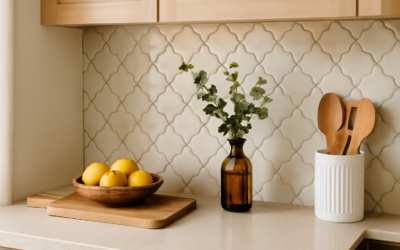
If you want a backsplash or accent wall with curves, movement, and old-world charm, arabesque tile delivers a look that ordinary squares and subway tiles cannot. Its interlocking lantern-shaped silhouette, sometimes called a Moroccan or pincushion shape, creates a soft, flowing pattern that draws the eye. This guide explains the materials available, how the pattern goes together, the installation considerations, and what it costs so you can plan a project with confidence.
Part of our Tile & Grout guide — explore the full guide →
What Makes Arabesque Tile Distinct
Arabesque tile is defined by its shape rather than its material. Each piece has gently concave and convex edges so the tiles nest into one another, forming a continuous curved lattice across the wall. The name comes from the flowing ornamental style of Islamic and Moorish art, and the shape carries that same sense of graceful repetition.
Because the pattern is built into the tile itself, you get a sophisticated geometric effect without complicated layout work. The tiles simply lock together, and the eye reads the curves as a single elegant field.
Materials and Finishes
Arabesque tile comes in a wide range of materials, each with its own personality.
- Ceramic and porcelain — the most common and budget-friendly; durable and easy to clean.
- Glass — reflects light for a bright, glossy backsplash that feels open.
- Natural stone — marble and travertine give a luxe, organic look but need sealing.
- Glazed terracotta and zellige-style — handmade-look surfaces with rich color variation.
- Metal and mixed mosaics — modern accents that add shine and texture.
Finish changes the mood. Glossy glazes feel fresh and contemporary, matte surfaces read calm and earthy, and crackle or reactive glazes add artisanal depth. Color choices span clean whites, soft grays, sea-glass blues, and dramatic blacks.
Where to Use Arabesque Tile
This tile shines in spots where its pattern can be appreciated up close. The most popular applications include kitchen backsplashes, bathroom walls and shower niches, fireplace surrounds, and accent walls. As a feature behind a range or vanity, a field of arabesque tile becomes the room’s focal point.
It is generally a wall tile. While some porcelain and stone versions can handle floors, the curved grout pattern and frequent joints make arabesque better suited to vertical surfaces where it stays cleaner and shows off its shape.
Layout and Design Tips
Because the shape is the star, a few choices control how dramatic the result looks.
- Grout color — a matching grout makes the field flow seamlessly, while a contrasting grout outlines each lantern shape for a graphic effect.
- Tile color — a single soft color reads timeless; bold colors make a statement.
- Scale — larger arabesque pieces feel modern; smaller mosaic versions feel intricate and traditional.
- Edges — plan how the curved tiles meet cabinets, counters, and corners, since the wavy edge needs trim or careful cuts.
Order a sample and lay a few pieces out before committing, so you can see how the curves and your grout choice work together in your own lighting.
Installation Considerations
Arabesque tile usually ships as mesh-backed sheets, which speeds installation because the spacing is preset. Even so, the curved edges demand some care.
- Start with a flat, clean, properly prepared surface and the right thin-set for your material.
- Dry-lay a section first to confirm the sheets align and the pattern stays continuous.
- Keep grout lines consistent where sheets meet so seams disappear.
- Cut edge and corner pieces carefully with a wet saw; the curves take patience.
- Seal natural stone and unglazed tiles before and after grouting.
The curved cuts at borders are the trickiest part, so budget extra tile, generally 10 to 15 percent, for waste and breakage.
What It Costs
Pricing depends heavily on material. Ceramic and porcelain arabesque tile generally runs roughly $8 to $20 per square foot. Glass and quality glazed mosaics land around $15 to $30. Natural stone and handmade or zellige-style versions can reach $25 to $50 or more per square foot. Professional installation adds labor, typically several dollars per square foot more than for a simple square tile because of the cutting and layout involved.
Cleaning and Care
Glazed ceramic, porcelain, and glass clean easily with a soft cloth and mild cleaner; the gloss resists staining and wipes free of grease. Natural stone needs a stone-safe cleaner and periodic resealing to prevent etching and stains. Because arabesque patterns have many grout lines, sealing the grout keeps those lines bright and makes routine cleaning faster.
Choosing Colors and Pairings
Color choice steers the entire mood of an arabesque installation. Soft whites and creams keep the look timeless and let the shape carry the design, which works in nearly any kitchen or bath. Sea-glass blues and greens bring a coastal, fresh feeling, while glossy black or deep navy creates drama and pairs strikingly with brass or matte-gold fixtures.
Pair the tile thoughtfully with surrounding finishes. A handmade, color-varied arabesque suits warm wood cabinetry and natural stone counters, while a crisp white glossy version complements modern flat-panel cabinets and quartz. Because the shape is already busy, let the rest of the palette stay relatively calm so the tile remains the focal point.
Arabesque vs Other Decorative Tiles
Compared with other statement shapes, arabesque has a softer, more romantic feel. Hexagon tile reads geometric and modern, picket tile feels crisp and contemporary, and fish-scale tile leans playful, while arabesque sits in a more classic, ornate territory thanks to its curves. If you want texture and movement without sharp angles, the lantern shape is the natural choice.
It also tends to feel more forgiving in traditional and transitional spaces, where its old-world roots add charm. In a strictly minimalist room, a simpler shape may suit better, but for a backsplash or feature wall with personality, arabesque delivers character that flat tile cannot.
Final Thoughts
For a backsplash or accent wall with personality, arabesque tile offers curves and craftsmanship that flat tiles cannot match. Choose a material suited to its location, use grout color to control the look, and account for careful edge cuts, and you will have a feature that feels both timeless and distinctive.
Prefer to explore on your own?
See how new flooring looks in your actual room in seconds — free, no signup.
Try the free Floor Studio →