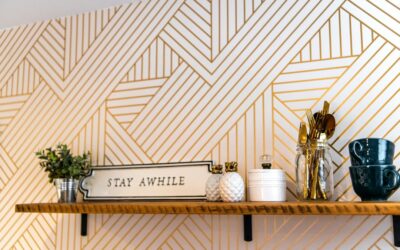
Homeowners scrolling design boards in 2026 are seeing two contradictory messages — half the influencers proclaim accent walls dead, the other half show stunning rooms anchored by a single bold wall. So are accent walls still in style, or are they a relic of HGTV’s 2010s peak? The honest answer is both yes and no. The single-wall-painted-burgundy approach that dominated a decade ago is genuinely out. But evolved versions — wood paneling, plaster, limewash, and architectural detail walls — are everywhere in current high-end interiors. The trick is knowing which form of accent wall reads fresh and which reads dated.
- The Death of the Painted Color Block
- What's Replacing Color-Block Walls
- Where Accent Walls Still Work With Paint Only
- Color Drenching: The Smart Alternative
- How to Update an Existing Accent Wall
- The One Place Accent Walls Always Make Sense
- Where Accent Walls Almost Never Work
- The Wallpaper Question
- Quick Verdict for 2026
The Death of the Painted Color Block
The accent wall that gets called out as outdated is specifically this: one wall in a room painted a contrasting color, often saturated (chocolate brown, deep red, eggplant), while the other three walls stay neutral. This trend peaked between 2010 and 2017 and is now firmly out of fashion.
The reasons:
- Reads as visual noise rather than intentional design
- Often chops up the room rather than enhancing it
- Makes the room feel smaller, not larger
- Common application errors (wrong wall selected, color too saturated) made the look feel cheap
If your home has a 2015-era painted accent wall in burnt orange or eggplant, painting it out is one of the highest-impact $50 updates you can make.
What’s Replacing Color-Block Walls
Today’s “accent walls” are textural, tactile, and architectural — not just color-based. Five evolved forms are dominating 2026 design:
1. Vertical Wood Paneling
Slat walls — thin vertical wood slats spaced 1/2 inch apart — are the single most popular accent treatment of 2026. Often white oak, walnut, or stained pine. Adds warmth and dimension without color commitment.
Cost: $8 to $20 per square foot DIY (with brands like Norse Wood Co., Bedrosians Woodgrove, or Acoustic Slat Wall panels), $25 to $40 installed.
2. Limewash and Roman Clay
Mineral-based wall finishes from Portola Paints, Bauwerk, or Pure & Original. Creates a subtle textured wash with cloudlike depth. Limewash runs $80 to $150 per gallon and covers about 200 sq ft.
3. Tongue-and-Groove Wainscoting and Board-and-Batten
Classic architectural detail that hasn’t gone out of style in 150 years. Works in any room, any color. Adds permanence and quality.
4. Stone or Brick Veneer
Real or quality faux stone on fireplace walls, kitchen accent walls, or behind beds. Brick veneer panels from Aspect or Z-Brick run $7 to $15 per sq ft.
5. Plaster and Venetian Plaster
Hand-troweled plaster finishes add sophistication and luxury. Pro application runs $10 to $25 per sq ft, but DIY-friendly versions exist (Portola Roman Clay).
Where Accent Walls Still Work With Paint Only
Painted accent walls aren’t completely dead — they’re just narrower in application. The current rules:
- Use sophisticated colors: Deep moody greens (Farrow & Ball Studio Green), soft warm whites with subtle contrast, terracotta, soft black
- Skip the strongly contrasting saturated reds, purples, and oranges
- Paint architectural features, not random walls: A wall with a fireplace, an alcove, or built-ins
- Consider painting all four walls instead: Color drenching is the 2026 evolution — paint walls, trim, and ceiling the same color for depth
The right colors for a 2026 paint-only accent wall are mostly muted, complex, and slightly desaturated — not the high-contrast Sherwin-Williams pure red of 2014.
Color Drenching: The Smart Alternative
Instead of one accent wall, designers are now painting entire rooms — walls, trim, doors, ceiling — the same color. Color drenching creates a cocoon effect, makes small rooms feel intentional rather than cramped, and entirely sidesteps the “is this still in style” question.
Best rooms for color drenching:
- Powder rooms and small half baths
- Home offices and libraries
- Dining rooms (especially with deep greens or burgundy)
- Primary bedrooms in soft moody tones
If you’re asking the question “are accent walls still in style,” color drenching is the more forward-looking answer.
How to Update an Existing Accent Wall
If you have a painted accent wall from a previous decade, three update paths work well.
Option 1: Paint It Out
The cheapest fix. Two coats of the same color used on the other walls. Total cost under $50 for most rooms. Result: a calmer, larger-feeling space that lets furniture and art take center stage.
Option 2: Replace With a Textural Treatment
Skip color entirely and add a textural accent. Slat wood panels, board-and-batten, or grasscloth wallpaper transform the same wall into a sophisticated focal point.
- Slat panels: $300 to $1,200 for an average 10-foot wall
- Board-and-batten: $200 to $600 in materials, a weekend of work
- Grasscloth or textured wallpaper: $80 to $200 per roll, covers about 30 sq ft
Option 3: Update the Color
If you love the concept of a colored accent wall, switch to a current-feeling shade:
- Farrow & Ball Hague Blue (deep navy-green) — sophisticated, timeless
- Benjamin Moore Wrought Iron 2124-10 — soft black, modern
- Sherwin-Williams Evergreen Fog SW 9130 — muted green
- Benjamin Moore Cushing Green HC-125 — warm forest green
These desaturated, complex shades replace the saturated jewel tones of the 2010s.
The One Place Accent Walls Always Make Sense
Behind a bed remains the single most defensible spot for an accent treatment of any kind. The bed naturally anchors the wall, so adding visual interest there strengthens rather than disrupts the room.
2026-friendly options behind the bed:
- Upholstered headboard wall (full-width)
- Vertical slat wood paneling
- Limewash in a soft tone
- Single piece of oversized art (5 ft or larger)
- Color-drenched alcove if the headboard wall is recessed
Behind the bed is also the easiest place to test if accent walls work for your style — you’ll see it from the doorway every day.
Where Accent Walls Almost Never Work
Skip accent walls entirely in these locations:
- Hallways and stairwells: Already busy with doorways and traffic; an accent wall adds chaos
- Kitchens with upper cabinets: Cabinets are the focal point, not the wall
- Open-concept living-dining-kitchen: Painting one wall a different color in an open plan chops the space visually
- Tiny rooms under 80 sq ft: An accent wall makes small rooms feel smaller; color-drench instead
- Rooms with strong architectural features: Beams, large windows, or a fireplace are already the accent
The Wallpaper Question
Bold wallpaper on a single wall — once a darling of HGTV — is also evolving. Statement wallpaper on a single wall still works, but the pattern matters:
- Out: Damasks, geometric chevrons, large-scale chinoiserie florals on one wall while others stay white
- In: Tonal nature-inspired patterns (Hygge & West, Schumacher), textured grasscloth, and mural-style botanicals
If you do wallpaper one wall, use it on the most natural focal wall (behind the bed, behind the sofa, in an alcove) — and consider matching trim or ceiling colors to pull the look together.
Quick Verdict for 2026
So are accent walls still in style? Here’s the short answer in a few lines:
- Painted single-wall color blocks: out
- Textural accent walls (slat wood, plaster, paneling): in
- Color drenching (all four walls + trim + ceiling): in
- Single wallpapered focal wall with sophisticated pattern: still works
- Architectural detail (board-and-batten, wainscoting): timeless
The takeaway: accent walls aren’t dead — they’ve matured. If you love the concept of a focal wall, choose texture and architectural detail over a single bold paint color, and you’ll have a room that feels current for the next decade rather than dated by 2028.