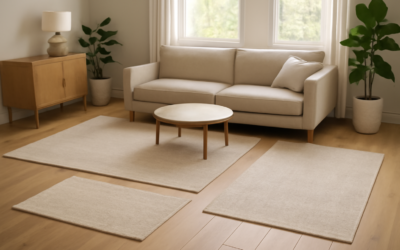
Buying a rug that is too small is the single most common decorating mistake in American homes, and it makes an otherwise beautiful room feel disjointed and cramped. A good area rug sizes chart takes the guesswork out of the decision by matching standard rug dimensions to the rooms and furniture arrangements they actually fit. Rugs anchor a space, define seating zones, and add warmth underfoot, but only when they are properly scaled. This guide gives you the standard sizes, the placement rules for each room, and a foolproof method for figuring out exactly what your space needs before you spend a dime.
Standard Area Rug Sizes
Rugs come in a set of common dimensions that most manufacturers produce, so knowing these standard sizes helps you shop efficiently. Here is the core lineup you will encounter almost everywhere.
- 2×3 and 3×5 feet: accent and scatter rugs for entryways, kitchen sink zones, and bedsides
- 4×6 feet: small rooms, reading nooks, and under small furniture groupings
- 5×8 feet: the most versatile mid-size, good for smaller living rooms and dining nooks
- 6×9 feet: medium living rooms and larger bedrooms
- 8×10 feet: the workhorse living room size for most homes
- 9×12 feet: large living rooms, open-concept spaces, and big dining rooms
- Runners (2.5×8 or longer): hallways, kitchen galleys, and alongside beds
- Round (4, 6, 8 feet): round dining tables, entry foyers, and reading corners
Living Room Sizing Rules
The living room is where rug size matters most, and there are three accepted approaches. In the ideal arrangement, the rug is large enough that all the legs of your sofa and chairs sit fully on it, which typically calls for an 8×10 or 9×12 in a normal room. The more common middle path places only the front legs of each seating piece on the rug, unifying the arrangement while using a slightly smaller size like an 8×10. The least ideal but sometimes necessary approach floats a small rug entirely under the coffee table with all furniture off it, which works only in compact spaces and can look undersized if the rug is too small.
Whichever you choose, aim to leave a consistent border of bare floor, roughly 8 to 24 inches, between the rug edge and the walls. That frame of visible floor is what makes the room feel intentional rather than wall-to-wall carpeted.
Bedroom Sizing Rules
In the bedroom, the goal is warmth underfoot when you step out of bed, so the rug should extend well beyond the sides and foot of the mattress. For a queen bed, an 8×10 rug centered under the lower two-thirds of the bed lets it project about 18 to 24 inches on the sides and foot. A king bed generally wants a 9×12 for the same effect. If a full-size rug is not in the budget, a common alternative is placing two runners on either side of the bed, or a single runner across the foot, so your feet always land on something soft.
Dining Room Sizing Rules
Dining rooms have one non-negotiable rule: the rug must be large enough that the chairs stay on it even when pulled out to sit down. Measure your table and add at least 24 inches on every side to keep the back legs from catching the rug edge as chairs slide. A standard six-seat rectangular table usually needs an 8×10 or 9×12, while a round table pairs naturally with a round rug at least 24 inches wider than the table on all sides. Getting this wrong means chairs constantly snagging and tipping, a daily annoyance that no amount of style makes up for.
Hallways, Entries, and Kitchens
Runners rule the narrow spaces. For a hallway, choose a runner that leaves a few inches of floor on each side and stops short of doorways, commonly 2.5 feet wide and anywhere from 6 to 14 feet long depending on the hall. Entryways often take a 3×5 or a round rug to greet guests and catch grit. In the kitchen, a runner along the main work aisle or in front of the sink adds comfort where you stand most, and low-pile washable options handle the inevitable spills.
How to Measure Before You Buy
Never trust your eye alone. The reliable method is to tape it out: use painter’s tape to outline the exact rug dimensions you are considering directly on the floor, then live with it for a day. Walk the room, pull out the dining chairs, sit on the sofa, and see whether the taped size looks generous or cramped. This costs nothing and prevents the expensive mistake of ordering a rug that arrives looking like a postage stamp in your space. Measure your furniture footprint too, and remember the rule of thumb across every room: when in doubt, size up. An oversized rug almost always looks better than an undersized one.
Layering and Non-Standard Sizes
Sometimes the standard sizes do not quite solve your space, and two techniques help. Layering places a smaller, colorful, or textured rug on top of a larger neutral one, which lets you add a bold accent without buying a huge statement rug and gives a room depth and warmth. A common approach layers a jute or sisal base rug with a smaller patterned rug centered on top of it. This also rescues a rug that turned out slightly too small; set it over a larger plain base and the scale problem disappears.
For rooms with unusual proportions, a very long narrow living room or an L-shaped open-concept space, you may need a custom-cut rug or two rugs to define separate zones. Many retailers will bind a remnant of broadloom carpet to any dimension you specify, giving you a made-to-measure area rug for oddly shaped rooms at a reasonable price. When you go custom, apply the same placement rules: leave a border of bare floor and keep furniture legs consistently on or off the rug.
Putting the Chart to Work
Use this area rug sizes chart as your starting reference, then apply the room-specific placement rules and the tape-it-out test to confirm. Nail the scale first, because the perfect color and pattern cannot rescue a rug that is the wrong size. Get the dimensions right and the rug will do its real job: pulling the furniture together, defining the space, and making the whole room feel finished.