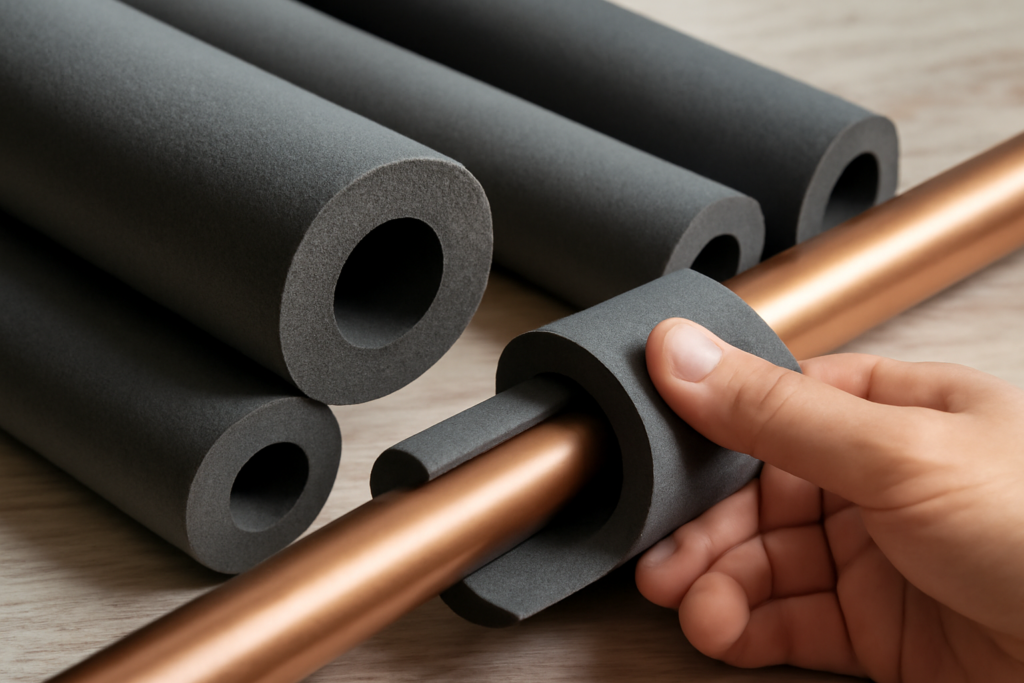
Armaflex insulation is the black rubbery pipe foam you see wrapped around air-conditioner line sets and chilled-water pipes — the brand-name flexible elastomeric insulation made by Armacell, so dominant in its category that “Armaflex” gets used generically the way “Kleenex” does. Unlike the gray polyethylene tubes at the hardware store, Armaflex is a closed-cell elastomeric foam engineered specifically to stop condensation on cold pipes, and the difference shows up the first humid week of summer. This guide covers what it is, its temperature limits, sizing, the glue-joint technique that makes or breaks the job, and when generic foam is actually fine.
Armaflex Insulation: What Armaflex Is
Armaflex is expanded nitrile rubber (NBR/PVC blend) with a fully closed-cell structure — millions of sealed bubbles that water vapor cannot migrate through. Key numbers:
- Thermal conductivity: about K = 0.25 BTU·in/hr·ft²·°F, roughly R-4 per inch — modest as pure R-value, but R-value is not the point.
- Water vapor permeability: 0.05 perm-inch or lower — the built-in vapor barrier that is the entire reason this material exists.
- Temperature range: standard Armaflex handles −70°F to +220°F continuous (the AP line is commonly rated to 220°F on the hot side; specialty HT versions reach 300°F for solar and high-temp lines).
- Fire rating: 25/50-rated (flame spread 25, smoke developed 50 per ASTM E84) through 1-inch wall thickness — approved for exposed use in air plenums where many plastics are not.
Why closed cells matter: on a 40°F refrigerant suction line in a 75°F/60%-humidity basement, any insulation that absorbs moisture (fiberglass wrap, open-cell foam) becomes a soggy condensation sponge that drips, grows mold, and insulates worse every year. Vapor cannot pass through Armaflex’s cell structure to reach the cold surface — as long as every seam is glued vapor-tight.
Sizes and Forms
- Tubes: 6-foot lengths, wall thicknesses of 3/8″, 1/2″, 3/4″, and 1″, sized to copper and iron pipe from 3/8″ ID up. Available unslit (slide over open pipe ends — always the better seal) and pre-slit self-seal with adhesive strips for retrofit over existing pipe.
- Sheet and roll: 1/8″ to 2″ thick sheets for tanks, ducts, large pipes, and fittings, plain or self-adhesive backed.
- Pipe wrap tape: 2-inch self-adhesive rolls for spot work and sealing.
- Thickness selection: 3/8″ wall suits mild spaces; 1/2″ is the residential line-set default; 3/4″ to 1″ is required in hot, humid, or unconditioned spaces (attics, vented crawlspaces) to keep the outer surface above the dew point. When in doubt, go thicker — condensation on the outside of too-thin insulation means the job failed.
- Cost: roughly $2 to $5 per 6-foot tube at 1/2″ wall for common sizes, two to three times the price of polyethylene — and worth it on any cold line.
The Glue Joint: Where Jobs Succeed or Fail
Armaflex insulates cold pipe only as well as its seams are sealed, because vapor exploits any gap and condenses behind the insulation. The contact-adhesive technique:
- Use the system adhesive — Armaflex 520 (solvent contact adhesive) — not silicone, not construction adhesive. Low-VOC and specialty versions exist; all work the same way.
- Clean and dry surfaces. Adhesive cleaner or isopropyl alcohol on dusty foam edges; the glue bonds foam to foam, so both faces must be bare.
- Butter both surfaces thin with the brush, then wait until tacky-dry — 3 to 5 minutes, the “dry touch” stage where it no longer strings to your knuckle. This is contact cement: it bonds instantly on touch, so dry-fit first.
- Press, don’t stretch. Compress joints slightly together; stretched foam pulls seams open as it relaxes. Seal butt joints between tube sections the same way.
- Never glue to an operating cold line. The pipe must be off and at ambient temperature — adhesive will not cure on a sweating 40°F pipe. Insulate before commissioning, or shut the system down for the job.
- Fittings: Miter elbows from tube stock (a sharp knife and a miter guide make clean 45° cuts) or wrap valves and odd shapes with sheet stock, fully glued. Every inch of cold metal left bare will drip.
Self-seal tubes speed retrofits, but treat the factory strip as one seam of several — butt joints and fitting joints still need glue or tape.
HVAC Line Sets: The Signature Application
On split-system AC and heat-pump line sets, code and manufacturer specs require the large suction (vapor) line insulated full length — it runs cold enough to sweat and uninsulated it robs capacity. Practical notes:
- Insulate the suction line completely, including through walls and inside the conditioned space; the small liquid line is normally left bare in residential practice.
- Minimum 1/2″ wall; 3/4″ in attics and hot crawlspaces. Energy codes (IECC) require insulation on refrigerant piping typically to R-3 or better — 1/2″ Armaflex qualifies; verify local amendments. The system-level rules live in our HVAC insulation guide.
- Outdoors, protect it from UV. Sunlight erodes bare nitrile foam at roughly 1/16″ per year. Paint exposed runs with water-based latex or Armacell’s WB finish, or jacket them (PVC line-set covers look cleaner and last longer).
- Replace crumbled line-set foam — the sun-rotted stub behind the condenser is one of the most common efficiency leaks on older systems; slit self-seal tube makes it a 20-minute fix.
Armaflex vs Generic Foam Tubes
| Armaflex (elastomeric) | Gray polyethylene tube | |
|---|---|---|
| Cell structure | Closed-cell rubber, ≤0.05 perm | Closed-cell PE, but stiff; seams gap |
| Cold-pipe condensation | Excellent when glued | Poor–fair; joints leak vapor |
| Temperature range | −70°F to 220°F | ~180–200°F max, embrittles in cold/UV |
| Flexibility | Bends around elbows without breaking | Kinks and splits at bends |
| Fire/plenum rating | 25/50 through 1″ | Generally not plenum-rated |
| Cost per 6-ft tube | $2–$5 | $1–$2 |
Verdict: on hot domestic water lines in a basement, cheap polyethylene is genuinely fine — the pipe is warm, condensation is not a threat, and the R-value is similar. On anything cold — AC lines, chilled water, cold supply pipes that sweat in humid summers — the elastomeric product and glued seams are the only approach that works long-term. (For freeze protection of outdoor spigots, insulation alone is not the fix — see our frost free faucet guide.)
Mistakes to Avoid
- Taping seams with duct tape instead of gluing — it peels in months and vapor walks right in.
- Leaving fittings, valves, and unions bare “for service access” — they become the drip points.
- Undersizing wall thickness in humid, unconditioned spaces.
- Leaving outdoor runs unpainted and unjacketed.
- Compressing the foam with zip ties or clamps — crushed cells lose R and can open seams.
Beyond Pipes: Other Jobs the Sheet Stock Handles
Elastomeric sheet is the quiet workhorse of the product family. Common residential uses: wrapping the uninsulated body of a cold-water pressure tank or well tank that sweats in summer (self-adhesive 1/2″ sheet, wrapped and seam-glued, ends the puddle permanently); lining the interior of window AC and mini-split condensate pans against drip noise; insulating ductboard plenum patches; and dampening vibration under condensate pumps and small compressors — the material’s rubber composition absorbs structure-borne noise that rigid insulation transmits. Boat and RV owners use the same sheets against hull and wall condensation. It cuts cleanly with a razor knife against a straightedge, and the self-adhesive versions bond aggressively to clean metal — position carefully, because repositioning is not really an option once pressed.
FAQ
Is Armaflex the same as the black foam on my AC lines?
Almost certainly the same material class — flexible elastomeric foam. Armaflex is Armacell’s brand; K-Flex and Aeroflex are equivalent competitors, and the guidance here applies to all of them.
Can Armaflex be used on hot pipes?
Yes, up to 220°F continuous for standard product — fine for domestic hot water (120–140°F) and hydronic heating; use HT variants for solar thermal.
Is Armaflex safe indoors?
Yes — it is fiber-free, dust-free, and 25/50 fire-rated for exposed and plenum use. The solvent adhesive needs ventilation while curing; low-VOC versions exist.
Does Armaflex mold?
The closed-cell rubber itself resists microbial growth; mold appears only when failed seams let condensation form behind it — an installation failure, not a material one.
Bottom line: for any pipe that runs cold, Armaflex-type elastomeric foam with properly glued seams is the difference between a dry, efficient line and a dripping one. Buy 1/2-inch wall minimum, use the contact adhesive correctly, protect outdoor runs from sun, and save the bargain gray tubes for hot water lines where they belong.