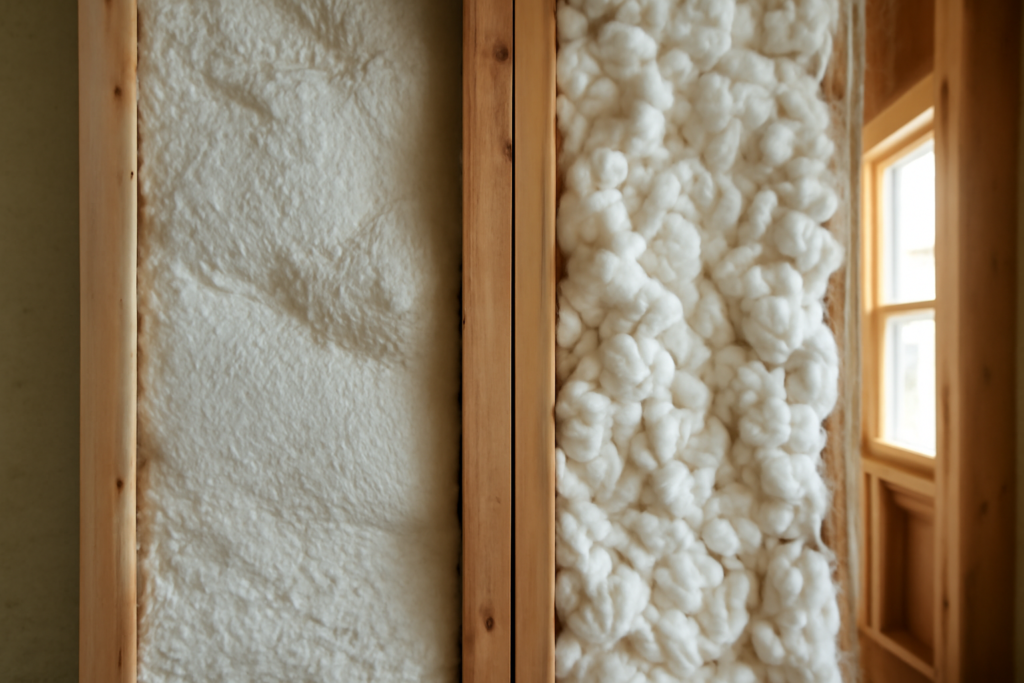
Spray foam comes in two species that share a name and almost nothing else. Closed cell foam insulation is dense, rigid, waterproof, and roughly twice the R-value per inch of its open-cell sibling — at twice the price. Open cell is soft, vapor-open, great at filling odd cavities and quieting rooms. Contractors tend to quote whichever their rig sprays best, so the homeowner’s job is knowing which chemistry belongs on which surface before the estimate arrives. This guide puts the two head to head, with numbers, then maps every common application to the right foam.
The Core Numbers
| Property | Closed cell | Open cell |
|---|---|---|
| Density | ~2.0 lb/cu ft | ~0.5 lb/cu ft |
| R-value per inch | R-6 to R-7 | R-3.5 to R-3.8 |
| Structure | ≥90% closed cells, gas-filled | Open bubbles, air-filled |
| Vapor permeability | ~1 perm at 2 in. (Class II retarder) | Vapor-open (~10+ perms at 3 in.) |
| Water behavior | Rejects bulk water; FEMA-accepted flood-resistant material | Absorbs and holds water |
| Air barrier | Yes, at ~1 in. | Yes, at ~3–3.5 in. |
| Rigidity | Adds racking strength to walls/roofs | None; soft to the touch |
| Expansion | ~30–40x, controlled | ~100x, fills everything |
| Sound damping | Poor–fair | Good |
| Installed cost | $1.25–$2.25 per board foot | $0.45–$0.85 per board foot |
(A board foot = 1 sq ft at 1 inch thick. A 2,000 sq ft wall job at 3 inches = 6,000 board feet.)
Read the table once and the pattern emerges: closed cell is a performance material — structural, waterproof, vapor-controlling, maximum R in minimum depth. Open cell is a volume material — cheap coverage that excels where depth is unlimited and moisture isn’t the enemy.
Why the Cells Matter
Closed-cell foam’s bubbles are sealed and filled with a low-conductivity blowing agent (modern HFO agents have near-zero global-warming impact, a big improvement over the HFC generation). Sealed gas cells are what push R past 6 per inch. They’re also why the foam stops water and vapor: there’s no connected pathway through the material.
Open-cell bubbles are burst and interconnected — the foam is basically a rigid sponge full of air. Air-filled insulation tops out near R-3.5–3.8 per inch no matter the material (fiberglass, cellulose, open foam all cluster there). The interconnection is also why it soaks up water and lets vapor sail through.
One aging note: closed cell’s blowing agent slowly diffuses out over decades, drifting R from ~7 toward ~6 per inch (the “aged R” on datasheets is the honest number). Open cell doesn’t drift — it starts lower and stays.
Where Each Type Wins
Closed cell territory
- Rim joists and sills. Air seal + vapor control + R in 2 inches. The application it was born for — full method in the rim joist insulation guide.
- Crawlspace and basement walls. Against concrete and in flood-prone zones, only closed cell tolerates the moisture. Sequencing and alternatives in the crawlspace insulation guide.
- Unvented roof decks in cold climates. Foam against the underside of the deck must keep the deck’s interior surface above dew point — closed cell’s vapor resistance is what makes zones 5+ unvented assemblies safe (either full closed cell or a closed-over-open flash-and-fill).
- Metal buildings and pole barns. Sticks to steel, stops the condensation drip, stiffens panels.
- Depth-limited framing. A 2×4 wall maxes at R-13–15 with fiber; 3 inches of closed cell hits R-19–21 in the same stud bay.
- Hurricane/flood country. FEMA lists closed cell among flood-damage-resistant materials; it also glues sheathing to framing (tested uplift improvements of 2–3x).
Open cell territory
- Attic rooflines in warm climates. Zones 1–3 unvented attics commonly use 6–10 inches of open cell — cheap volume across big rafter bays. (In humid coastal climates, watch for ridge moisture accumulation; some pros add a vapor-retarder paint.)
- Interior walls for sound. Open cell damps voices better per dollar than anything except dedicated mineral wool.
- Complex framing. The 100x expansion finds gaps around gables, dormers, and chases that closed cell’s slower expansion misses.
- Budget whole-house jobs in mild climates where depth is available and moisture loads are ordinary.
Cost Reality Check
Typical professionally installed pricing (2025–2026, varies by region and job size):
- 2×6 wall (5.5 in. open cell, ~R-20): $2.50–$4.50/sq ft of wall.
- 2×6 wall (3 in. closed cell, ~R-20): $3.75–$6.75/sq ft.
- Roof deck, 5.5 in. open cell (R-20): $2.50–$4.70/sq ft.
- Roof deck, 5 in. closed cell (R-30+): $6–$11/sq ft.
- Rim joist perimeter only: $800–$1,500 flat for most homes.
Minimum job charges of $1,500–$2,500 are standard — small closed-cell jobs like rims often ride cheapest as add-ons or via DIY two-part kits ($400–$700 per 600 board feet). Where the cavity is deep and dry, hybrid “flash and batt” — 1–2 inches of closed cell for air/vapor control, then cheap fiber for volume — beats either foam alone on cost per R; the fiber options are covered under attic insulation.
Health, Fire, and Quality Notes
- Both foams are polyurethane sprayed from isocyanate + polyol. Occupants must stay out during spraying and for the re-occupancy window (typically 24 hours closed cell, 24–72 open cell). Cured foam is inert.
- Bad batches — wrong ratio, cold substrate, too-thick lifts — cause lingering odor and shrinkage. Closed cell must be sprayed in lifts of ~2 inches max; a sprayer rushing 4-inch passes is the #1 quality failure. Ask how many lifts your bid includes.
- Exposed foam in living space or attics accessed for storage needs an ignition/thermal barrier per code (intumescent coating or drywall). Bids that omit the coating look artificially cheap.
- Closed cell hides framing leaks — roof leaks travel invisibly along it. Fix the roof first, always.
Decision Cheat Sheet
- Touching concrete, soil-adjacent, or floodable → closed cell.
- Cold-climate roof deck, unvented → closed cell (or flash-and-fill).
- Depth-limited cavity needing max R → closed cell.
- Warm-climate attic, big open bays, budget matters → open cell.
- Sound control between rooms → open cell (or mineral wool).
- Deep, dry cavity, tight budget → flash of closed + fiber fill.
Vetting a Spray Foam Contractor: Six Questions
Foam quality is 20 percent chemistry and 80 percent the person holding the gun, so interview accordingly. Ask, first, what product line they spray and request the technical datasheet — a pro names the manufacturer (BASF, Huntsman, Gaco, Johns Manville, Carlisle) without hesitation, and the datasheet gives you the aged R-value and perm ratings to hold the bid against. Second, how many lifts for your specified thickness: 3 inches of closed cell should be two passes with cooling time between, and “we do it in one” is your cue to keep shopping. Third, what substrate temperature range they’ll spray in — cold framing causes adhesion failure, and honest contractors reschedule around it. Fourth, whether the bid includes the ignition or thermal barrier where code requires it, priced as a line item. Fifth, how they verify thickness: depth gauges and a probe check across the field, not eyeball. Sixth, what their remediation policy is for off-ratio foam — lingering odor or soft, friable texture within the first weeks is a redo, not a deodorizing visit. Add the practical checks: proof of insurance, a jobsite ventilation plan, and your family’s re-occupancy window in writing. A contractor who answers all six crisply is worth $0.15 more per board foot than the one who answers none of them; bad foam is nearly impossible to remove once it’s on your framing.
FAQ
Is closed cell foam worth the extra cost?
Where its unique properties are load-bearing — moisture, vapor, depth, structure — yes, decisively. Where they aren’t (a dry 2×12 rafter bay in Georgia), you’re paying double for R you could buy cheaper as volume.
Does closed cell need a vapor barrier?
No — at 1.5–2 inches it is a Class II vapor retarder. Adding poly sheeting over it is redundant and can trap moisture in adjacent materials.
Can I DIY spray foam?
Two-part kits handle rims, small walls, and patch work well. Whole-house spraying is a pro job — chemistry, temperature, and lift control are unforgiving at scale.
What about shrinkage and pulling away?
Properly mixed closed cell bonds tenaciously and doesn’t shrink meaningfully. Pull-away gaps signal an off-ratio spray day — document and demand remediation while the contractor’s warranty is fresh.
Match the chemistry to the surface: closed cell where water, vapor, or inches are the constraint; open cell where volume is cheap and dry. Get that one sorting rule right and every spray-foam quote becomes easy to judge.