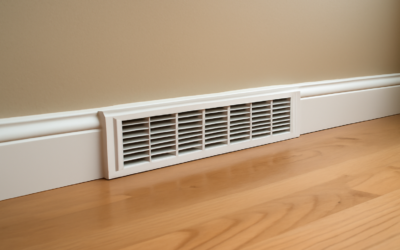
Most homeowners never give a thought to the vents running along the bottom of their walls until one gets dented, rusts, or simply looks dated. That low-profile grille is doing real work, and baseboard register covers are the part you actually see and touch. Choose the wrong size or material and you choke airflow, collect dust, or end up with a cover that rattles every time the furnace kicks on. Get it right and the vent disappears into the room while quietly moving the air your HVAC system paid to heat or cool.
What a Baseboard Register Cover Actually Does
A register is the trim piece that sits over a supply or return air opening near the floor line. On baseboard systems, the opening runs horizontally where the wall meets the floor, so the cover is long and short rather than the square or rectangular grilles you see in ceilings and floors. Many baseboard covers include a damper — a movable plate behind the louvers that lets you throttle airflow into a specific room.
Do not confuse these with hydronic baseboard heater covers, which enclose copper fin-tube convectors and have no connection to forced-air ducting. If your system blows air, you want a forced-air baseboard register. If hot water runs through a finned element, that is a baseboard heater enclosure, and the sizing rules are different.
Common Sizes and How to Measure
Register sizing is one of the few areas where homeowners reliably get tripped up. The size printed on a register refers to the duct or wall opening, not the outer faceplate. A “10 x 6” register fits a 10-inch-wide by 6-inch-tall hole, and the visible frame will be roughly an inch larger on each side.
To measure correctly, pop off the old cover and measure the rough opening — width first, then height. Common baseboard register sizes include:
- 10 x 6 inches
- 12 x 6 inches
- 14 x 6 inches
- 24 x 6 inches for long supply runs
- 30 x 6 inches in older homes with wide trunk drops
If your opening falls between standard sizes, order the next size up and trim the wall opening, or look for an adjustable cover with an extendable frame. Forcing a too-small register over an opening looks sloppy and leaks conditioned air into the wall cavity.
Material Choices and What They Cost
Steel is the workhorse. Powder-coated steel registers resist dents, take paint well, and run roughly $8 to $20 for standard sizes. They are the default in most homes for good reason — durable and cheap. The downside is corrosion in damp spots like bathrooms and laundry rooms.
Aluminum costs a bit more, around $15 to $35, and shrugs off rust, which makes it the smarter pick near plumbing or in basements. Wood and faux-wood covers, generally $25 to $70, blend into stained baseboards and traditional interiors but warp if they get wet and are harder to clean. Brass and bronze finishes lean decorative and can climb past $80 for designer lines.
Damper or No Damper
A built-in damper earns its keep in rooms you want to fine-tune. Closing the damper in a rarely used guest room nudges more airflow toward the spaces you actually occupy. That said, never close more than a third of your registers at once — sealing too many drives up static pressure and can damage the blower motor over time.
Return-air registers should never have dampers. Returns pull air back to the system, and restricting them starves the furnace. If you are replacing a return grille, buy a plain louvered cover with no moving parts.
Installation Step by Step
Swapping a baseboard register is genuinely a ten-minute job with a screwdriver. Here is the order I follow on a service call:
- Remove the old cover. Most use two or four screws through the faceplate into the wall or duct boot.
- Vacuum the duct boot. Years of dust, pet hair, and the occasional Lego live in there.
- Dry-fit the new cover and confirm the louvers point the right way — angled up and into the room for supplies.
- Drive the screws snug, not crushing. Overtightening warps thin steel faceplates.
- Test the damper lever, if present, to confirm it swings freely.
If the old screw holes are stripped, bump up to a slightly longer screw or add a plastic anchor. For drywall openings with no wood behind them, spring-clip registers grip the duct from the inside and need no screws at all.
Keeping Them Clean and Quiet
Dust buildup on louvers is the most common complaint, and it is also the easiest fix. Vacuum the face monthly with a brush attachment, and once a season pull the cover and wipe it with a damp cloth. Painted steel covers can be repainted with a spray enamel rated for metal — just sand lightly and prime first so the new coat does not peel.
Rattling usually means a loose screw or a damper plate vibrating in the airflow. Snug the fasteners first. If it persists, a small strip of adhesive felt along the back edge of the faceplate dampens the buzz without affecting airflow.
Choosing the Right Cover for Your Room
For a clean modern look, low-profile aluminum in a matte finish reads almost invisible against the wall. Traditional homes with stained trim do better with wood-tone covers that match the baseboard. In high-traffic hallways and kids’ rooms, stick with heavy-gauge steel that can take a vacuum cleaner bump without denting.
When you shop for replacement baseboard register covers, bring your opening measurements, decide on supply versus return, and match the finish to the trim already in the room. A $12 part installed correctly does more for a room’s finished feel than most homeowners expect, and it keeps your HVAC system breathing the way the installer intended.