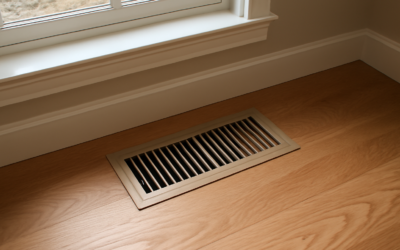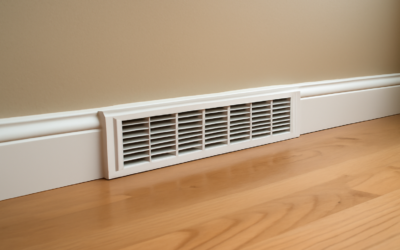
They sit in nearly every room, get stepped on daily, and yet most people never think about them until one rattles or a room won’t warm up. HVAC floor registers are the grilles that cover your floor supply ducts, and they do more than look decorative: they direct heated and cooled air into each room and, with a built-in damper, let you fine-tune the airflow. Choosing the right register affects comfort, energy balance, and how finished your floors look. This guide breaks down register types, sizing, materials, dampers, cost, and installation.
Registers vs. Grilles vs. Diffusers
The terms get used interchangeably, but they are not the same, and knowing the difference prevents ordering the wrong part.
- Register: A vent cover with an adjustable damper behind the faceplate, used on supply ducts (where conditioned air blows out). The damper lets you open, close, or throttle airflow to that room.
- Grille: A faceplate with fixed louvers and no damper, typically used over return-air openings, where air is pulled back to the system.
- Diffuser: Directs airflow in a specific spread pattern, more common in ceilings than floors.
For floor supply vents in living spaces, you generally want registers so you can balance temperatures room to room. Return-air openings take grilles, since you never want to close off a return.
How to Size a Floor Register
Sizing is the number-one source of ordering mistakes, so get this right. Floor registers are sold by their duct opening (the hole in the floor), not the outer faceplate. Measure the length and width of the actual duct opening, then order that nominal size. The faceplate will be roughly 1.5 to 2 inches larger on each side so it overlaps the hole and rests flat on the floor.
Common residential floor register sizes include 4×10, 4×12, 6×10, 6×12, and 2.25×10 or 2.25×12 for narrow toe-kick and baseboard runs. To find your size, remove the old register and measure the opening it covered, or measure the sheet-metal duct boot below the floor. If your listing offers both “duct size” and “overall size,” always match the duct size to your opening.
Materials and Durability
Because floor registers get walked on, material matters more than for a wall or ceiling vent. Your main options:
- Steel: The most common and affordable, usually powder-coated in white, brown, or black. Sturdy enough for foot traffic but can dent and eventually rust in damp areas.
- Cast iron: Heavy, extremely durable, and classic for period homes, though prone to surface rust if not finished.
- Aluminum: Lightweight and rust-proof, a good choice for bathrooms and other humid rooms.
- Brass and bronze: Premium, corrosion-resistant, and decorative, ideal where the register is a visible design element.
- Wood: Oak, maple, and other species can match or stain to blend with hardwood floors, popular for seamless looks (avoid in wet areas).
For a busy hallway or kitchen, choose a heavier steel, cast, or metal register rated for floor use. Avoid flimsy stamped covers that flex and rattle underfoot.
Understanding Dampers and Airflow
The damper is what makes a register a register. It is a set of movable blades behind the faceplate, operated by a lever or thumbwheel, that opens and closes the airflow. Homeowners use dampers to balance a home: closing or partially closing registers in seldom-used or over-conditioned rooms nudges more air toward rooms that run too hot or cold. That said, closing too many registers at once raises static pressure in the ductwork and can strain the blower, so keep the majority open and adjust only a few.
Look for a smooth, sturdy damper mechanism when buying, since cheap dampers stick, warp, or fail to hold their position. A quality steel or metal damper opens and closes cleanly for years.
HVAC Floor Register Cost
Registers span a wide price range. Basic powder-coated steel registers in standard sizes run $8 to $25 each. Aluminum and better steel models with quality dampers land around $20 to $45. Decorative cast iron, brass, and hardwood registers range from $40 to $150 or more, with ornate designer and antique-reproduction patterns at the top. Since a home has many vents, most people upgrade the visible, high-traffic rooms and keep budget registers elsewhere. Factor in that larger sizes cost more, and specialty finishes command a premium.
Installation Made Simple
Replacing a floor register is one of the easiest home upgrades there is, usually taking a couple of minutes with no tools. Most floor registers are drop-in: you lift out the old one, vacuum the duct opening and boot to clear dust and debris, and set the new register in place with the damper hanging down into the duct and the control lever within reach. Confirm it sits flush and does not rock.
A few pointers improve the result. In walkways, choose a low-profile register so it does not snag toes or furniture. In rooms where furniture may sit over a vent, avoid blocking supply registers entirely, which starves that room of air and unbalances the system. If your register screws down rather than dropping in, use the existing holes and avoid overtightening into the subfloor.
Maintenance and Air Quality
Floor registers double as collection points for dust, pet hair, crumbs, and the occasional small toy, all of which get pulled toward the ductwork. Twice a year, lift each register and vacuum both the grille and as far into the duct boot as you can reach; this improves airflow and reduces the dust recirculated into your rooms. Wipe painted steel registers with a damp cloth, and clean metal finishes per the material. If a register rattles when the system runs, it usually just needs reseating or a small felt pad to dampen the vibration.
Choosing the Right Register for Each Room
Match the register to the room’s demands. Use rust-proof aluminum or brass in bathrooms and other humid spaces, heavy-duty steel or cast iron in high-traffic halls and kitchens, and wood or decorative metal where appearance leads in living and dining rooms. Always confirm the duct size before ordering, favor a solid damper mechanism, and pick a finish that complements your flooring. Get those choices right and your HVAC floor registers will deliver balanced comfort and a clean, finished look for the life of the floor.