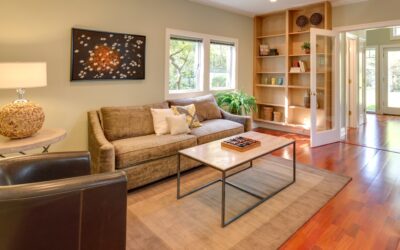
For years, beige was the color you painted to sell the house, not the color you chose for yourself. That changed somewhere around 2022, when warm neutrals overtook gray as the dominant residential paint trend. A well-executed beige accent wall now reads as intentional, layered, and quietly luxurious rather than builder-grade. The catch is that beige has more undertones than almost any other color family. Pick wrong, and your feature wall fights every other surface in the room.
- Why Beige Returned to the Accent Wall Conversation
- Best Beige Paint Colors for an Accent Wall
- Rooms Where a Beige Accent Wall Works Best
- Coordinating With the Other Three Walls
- Finish Choices and Their Impact
- Texture and Material Pairings
- Lighting That Flatters Beige Tones
- Common Mistakes to Avoid
- Cost and Timeline
Why Beige Returned to the Accent Wall Conversation
Designers spent a decade chasing cool grays like Repose Gray and Agreeable Gray. By 2021, those tones started reading dated and slightly cold under LED lighting. The pendulum swung hard toward warm neutrals. Sherwin-Williams named Urbane Bronze and later Redend Point as colors of the year, signaling a clear shift.
Beige works as an accent because it adds depth without competing visually. A deep beige wall behind a sofa or bed grounds the room the way a navy or charcoal once did, but with a softer, more livable feel that photographs beautifully in morning and evening light.
Best Beige Paint Colors for an Accent Wall
Not all beiges accent well. Light beiges blend into adjacent walls and lose impact. Aim for medium-depth tones with a Light Reflectance Value between 35 and 55.
- Sherwin-Williams Accessible Beige SW 7036 — slight gray undertone, balanced
- Benjamin Moore Shaker Beige HC-45 — warm yellow base, classic
- Farrow and Ball Oxford Stone No. 264 — pink-leaning, sophisticated
- Sherwin-Williams Latte SW 6108 — coffee with cream warmth
- Benjamin Moore Manchester Tan HC-81 — green undertone, calming
Always sample on poster board and tape it to the intended wall for 48 hours. Beige shifts dramatically between morning daylight and incandescent evening light.
Rooms Where a Beige Accent Wall Works Best
Bedrooms top the list. A medium beige behind the headboard adds warmth without the energy of a saturated color, which keeps the room sleep-friendly. Living rooms are the second-best fit, particularly when the accent runs behind a TV or fireplace rather than across a sofa wall.
Home offices benefit too. A beige accent wall on the camera-facing surface reads professional on Zoom calls without the harshness of pure white or the moodiness of dark green. Dining rooms can work if your trim is bright white and your floors are warm wood. Skip beige accents in bathrooms, where the color reads bland under daylight bulbs and competes with tile.
Coordinating With the Other Three Walls
The simplest rule is to drop two to three shades lighter on the surrounding walls. If your accent is Accessible Beige, paint the others Alabaster SW 7008 or Natural Choice SW 7011. Avoid pairing beige with a stark cool white like Decorator’s White, which exposes the accent’s warmth and makes it look orange.
For a more dramatic effect, pair a deep beige accent with a complementary warm white plus a creamy ceiling. Benjamin Moore Swiss Coffee on three walls with Shaker Beige as the feature pulls the eye without overwhelming a small room.
Finish Choices and Their Impact
Sheen changes how a beige accent wall photographs. Flat or matte hides drywall imperfections and reads modern, but scuffs more easily. Eggshell is the standard middle ground at around $40 to $65 per gallon for premium lines. Satin reflects too much light for most accent walls and can highlight roller texture.
Limewash and Roman clay finishes have surged in popularity for beige accents. Portola Paints Roman Clay runs about $90 per gallon, applies with a stainless trowel, and gives a velvety variation impossible to fake with rolled paint.
Texture and Material Pairings
Beige walls beg for tactile contrast in the rest of the room. Bouclé, linen, leather, and aged brass all complement a warm beige accent. Cool chrome, polished glass, and pure white furniture can leave the wall feeling out of place.
- Oak or walnut flooring with visible grain
- Cream or off-white bedding with a natural fiber throw
- Aged brass picture lights and sconces
- Black metal frames in odd-number gallery groupings
Lighting That Flatters Beige Tones
Beige is highly susceptible to lighting temperature. Under 2700K incandescent or warm LED, it glows. Under 5000K daylight bulbs, the same beige reads chalky and yellow-green. Stick with 2700K to 3000K bulbs in lamps and ceiling fixtures near the accent wall.
Picture lights mounted above artwork add a soft wash that emphasizes the beige tone. A Hudson Valley or Visual Comfort brass picture light runs $180 to $420 and transforms a flat wall into a focal point after dark.
Common Mistakes to Avoid
The biggest error is choosing a beige with strong pink undertones in a room with cool gray flooring. The clash is impossible to fix without repainting one or the other. Another frequent misstep is making the accent wall the longest wall in the room, which can shrink the perceived square footage. Use the shortest wall or the one with the strongest architectural feature.
Skipping primer over a previously cool-gray surface is another costly shortcut. Cool tones will bleed through a single coat of warm beige, leaving a grayish cast that no amount of recoating fully fixes without a tinted primer base.
Cost and Timeline
Painting one accent wall in a standard 12-by-14-foot bedroom takes 4 to 6 hours including taping, two coats, and cleanup. Material cost runs $55 to $110 for one gallon of premium paint plus rollers, tape, and drop cloth. Hiring a pro to paint a single accent wall typically costs $250 to $450 depending on ceiling height and prep needs. Even at the upper end, it remains one of the cheapest decor updates that delivers a noticeable transformation.