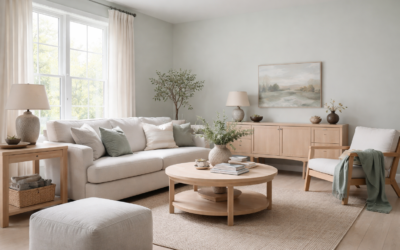
Beige went out of style for a decade, then came back once people tired of cold gray rooms. Benjamin Moore Shaker Beige is one of the classic shades that never really left. It is color HC-45 in the brand’s Historical Colors collection, it has a light reflectance value (LRV) of 53.53 on the maker’s color page, and Benjamin Moore describes it as a quintessential beige neutral that exudes simple elegance.
On the wall it reads as a true, medium-light beige: warmer and more saturated than a greige, deeper than a cream. That gives it a cozy, traditional feel that suits older homes, warm wood trim and rooms that need softening. In warm light it can show a slight peach or rosy side, and in cool light it calms down toward a sandy tan.
- Benjamin Moore Shaker Beige Specs at a Glance
- Undertones in Different Light
- Rooms Where Shaker Beige Shines
- Coordinating Trim and Accent Colors
- Shaker Beige vs Manchester Tan and Edgecomb Gray
- How to Test and Paint Shaker Beige
- Troubleshooting
- Is Benjamin Moore Shaker Beige Right for Your Home?
- Cost and When to Hire a Painter
- Frequently Asked Questions
Because the LRV sits in the low 50s, it is more of a mid-tone than a light neutral. Rooms with good daylight wear it well. Small, dim rooms may feel darker than expected, so sample it there before you commit to a whole-house plan.
Benjamin Moore Shaker Beige Specs at a Glance
These values come from the Benjamin Moore color page for Shaker Beige HC-45. Confirm the code at the counter when you order, since collection listings change from time to time.
| Spec | Value | What it means |
|---|---|---|
| Color code | HC-45 | Ask for this exact code so the right formula is tinted |
| Collection | Historical Colors | The maker’s palette of classic, traditional shades |
| Color family | Neutral (beige) | A warm beige rather than a greige or off-white |
| LRV | 53.53 | Mid-light; reflects a little over half the light that hits it |
| Maker’s description | Quintessential beige neutral | Warm and traditional, with a soft, earthy character |
| Maker’s similar colors | Bleeker Beige HC-80, Wheeling Neutral HC-92, Hush AF-95, Crisp Khaki 234 | Close cousins to sample side by side |
| Maker’s color combinations | White Dove OC-17, Mountain Peak White OC-121, Bone White OC-143, Tate Olive HC-112 | Suggested trim and accent partners |
LRV runs from 0 (black) to 100 (white). A value around 50 is the midpoint where a color stops reading as light and starts reading as a definite color. Shaker Beige sits just above that line, so expect it to look richer on four walls than on a small chip.
Undertones in Different Light
Beiges are mixed with yellow, red and a touch of black or gray, and the balance of those tints decides whether they lean yellow, pink or green. Shaker Beige is a warm beige, and most people see a gentle red-orange warmth rather than a strong yellow. That warmth comes and goes with light and surroundings.
North-facing rooms
Cool northern light mutes the warmth and can make Shaker Beige look like a deeper sandy tan, sometimes a little gray. It stays warm overall, which is why beige is often recommended for north rooms that feel cold in gray.
South-facing rooms
Warm southern light boosts its warmth. In strong sun it can look golden or faintly peachy. If you want it to stay calm, use daylight-balanced bulbs around 3000K to 3500K and pair it with cleaner whites.
East and west exposures
East rooms show its warm side in the morning and its muted side later. West rooms do the reverse, glowing warm at sunset. Check samples at several times of day.
Next to flooring and finishes
Pinkish travertine, rosy granite or red-toned cherry can pull out pink in Shaker Beige. Green-leaning tile can make it look slightly olive. Neutral-toned oak, walnut, cream tile and oil-rubbed bronze fixtures are easy partners.
Rooms Where Shaker Beige Shines
- Living and dining rooms: a warm, enveloping neutral for traditional and farmhouse interiors.
- Bedrooms: cozy and calm; works with cream bedding and wood furniture.
- Dens and libraries: pairs naturally with stained wood trim, bookshelves and leather.
- Kitchens: suits cream or white cabinets and warm wood; avoid it next to strongly pink counters.
- Hallways in sunny homes: a classic whole-house neutral where daylight is plentiful.
- Exteriors: a traditional body color on colonial and craftsman homes with white trim and a deep green or black door.
Rooms that may struggle include small dark bathrooms and windowless halls, where the mid-tone can look heavy, and modern spaces built around cool gray finishes.
Coordinating Trim and Accent Colors
Trim and ceilings
White Dove OC-17 is the maker’s top-listed white partner and gives a soft, warm contrast that suits the beige. Mountain Peak White OC-121 and Bone White OC-143 are the other suggested whites; they keep the scheme warm and mellow. Avoid very stark, blue-leaning whites on trim if you do not want the beige to look dingy next to them.
Accent colors
Tate Olive HC-112 is the maker’s suggested accent and pairs beautifully with beige on doors, cabinets, islands or built-ins. Deep greens, navy, warm charcoal and muted brick reds also sit well beside it.
Finishes and decor
Brass, bronze and black hardware, natural linen, rattan, wool rugs and medium-to-dark wood all suit Shaker Beige. Chrome works too, but warmer metals feel more at home with it.
Shaker Beige vs Manchester Tan and Edgecomb Gray
These three are often sampled together when a homeowner wants a warm neutral. Numbers and descriptions come from each color’s Benjamin Moore page.
| Color | Code | LRV | How it compares |
|---|---|---|---|
| Manchester Tan | HC-81 | 63.24 | Lighter, softer beige; maker likens it to sandstone |
| Edgecomb Gray | HC-173 | 63.09 | Lighter greige; warm but more gray than beige |
| Shaker Beige | HC-45 | 53.53 | Deepest of the three; a classic, richer beige |
Manchester Tan is the closest in character but about ten LRV points lighter, so it is the easier choice for a dim room or a whole-house color where you want brightness. Edgecomb Gray carries less beige and more gray, which suits homes mixing warm and cool finishes or anyone who wants a more current look. Choose Shaker Beige when you want a definite, warm beige that reads as a color and pairs with traditional trim and furniture.
How to Test and Paint Shaker Beige
- Sample big. Paint two boards at least 12 by 12 inches, or use peel-and-stick samples.
- Test on more than one wall. Put samples on a bright wall and a shaded wall, framed by white paper to remove the old color’s influence.
- Compare against neighbors. Hold Manchester Tan and Edgecomb Gray samples beside it, plus your flooring and counter samples.
- Check day and night. Look in morning light, afternoon light and with your actual bulbs after dark.
- Prep. Patch holes, sand rough spots, clean grease, and spot prime patches.
- Cut in and roll. A paint roller and tray kit with a 3/8-inch nap cover suits smooth walls; use 1/2-inch on light texture.
- Apply two coats. Mid-tone beiges usually need two coats for full, even color.
Sheen choices
Matte or eggshell on living room and bedroom walls; eggshell or satin in kitchens, halls and kids’ rooms; satin or a humidity-rated product in bathrooms; semi-gloss or satin on trim and doors.
Troubleshooting
- Looks pink or peachy: warm sun, warm bulbs or red-toned stone nearby. Try cooler bulbs, or switch to Edgecomb Gray.
- Looks too dark: low light. Manchester Tan gives a similar warmth with more brightness.
- Looks dated: often the trim white or heavy matching decor. Fresh white trim, black hardware and green accents modernize it.
- Looks yellow: often reflected from honey oak floors. Rugs and darker furniture balance it.
- Blotchy finish: uneven coats or unprimed patches; spot prime and recoat the full wall.
Is Benjamin Moore Shaker Beige Right for Your Home?
Benjamin Moore Shaker Beige is a strong fit if your home has stained wood trim, warm flooring, traditional furniture or plenty of natural light. It brings warmth to rooms that feel cold or sterile and makes a reliable backdrop for art and antiques. It is a weaker fit for small, dim rooms, for homes built around cool gray tile and chrome, and for anyone who wants a light, airy look.
A practical way to decide is to tape three samples side by side: Shaker Beige, Manchester Tan and Edgecomb Gray. If the room still looks good with the deepest of the three in the afternoon and at night, Shaker Beige is a safe choice. If it looks heavy, step up to one of the lighter neighbors. Keep the trim white soft rather than stark so the beige does not look dull next to it, and repeat the wall color or a related neutral in adjoining rooms so the flow feels intentional.
Cost and When to Hire a Painter
Premium interior paint usually costs in the mid to upper range per gallon, and an average 12 by 14 foot room needs about 2 gallons for two coats on the walls. Professional interior painting typically runs about $2 to $6 per square foot of floor area depending on prep, ceiling height and region.
Bring in a painter for stairwells, high ceilings, extensive drywall repair or second-story exteriors. In homes built before 1978, test existing paint for lead before sanding or scraping and follow lead-safe practices.
Frequently Asked Questions
What is the LRV of Shaker Beige?
Benjamin Moore lists Shaker Beige HC-45 with an LRV of 53.53, a mid-light value that reads as a definite beige on the wall.
Does Shaker Beige have pink undertones?
It is a warm beige, and in warm light or next to red-toned stone or wood it can show a slight peach or rosy cast. In cool light it reads as a sandy tan.
What white goes best with Shaker Beige?
Benjamin Moore pairs it with White Dove OC-17, Mountain Peak White OC-121 and Bone White OC-143, all soft whites that keep the scheme warm.
Is Shaker Beige darker than Manchester Tan?
Yes. Shaker Beige has an LRV of 53.53 versus 63.24 for Manchester Tan, so it looks noticeably deeper and richer.
Is Shaker Beige good for exteriors?
It is a traditional exterior body color, especially with white trim and dark green or black doors. Benjamin Moore lists the color as available for exterior paint.