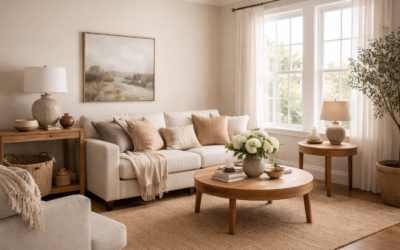
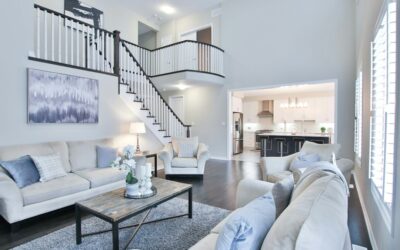
Benjamin Moore Bleeker Beige is a mid-tone neutral that sits right on the line between beige and greige. Its code is HC-80, it belongs to the brand’s Historical Colors collection, and the manufacturer lists its light reflectance value (LRV) at 51.66. Benjamin Moore describes it as a medium buff hue with gray undertones, which is the short answer to why it rarely turns yellow or pink on a wall the way older beiges can.
That LRV puts it squarely in the middle of the scale. It is noticeably deeper than the creamy off-whites people often pick for whole-house color, yet light enough to use in an average bedroom or living room without the space feeling closed in. In a bright south-facing room it reads as a soft, warm stone. In a north-facing room the gray side comes forward and it can look closer to a muted khaki.
- Benjamin Moore Bleeker Beige at a Glance
- What the Undertones Actually Look Like
- Is the LRV Right for Your Room?
- Rooms Where Bleeker Beige Works Best
- Trim, Ceiling and Accent Pairings
- Bleeker Beige Compared With Similar Colors
- How to Test Benjamin Moore Bleeker Beige Before Painting
- Painting Tips and General Costs
- Troubleshooting Common Problems
- When to Call a Pro
- Frequently Asked Questions
If you are deciding whether to put it on your walls, the most useful facts are its depth, its gray undertone and how it behaves next to white trim and wood floors.
Benjamin Moore Bleeker Beige at a Glance
Here are the core specs for Benjamin Moore Bleeker Beige, all taken from the manufacturer’s color page. Where a number could not be confirmed from the maker, it is left out rather than guessed.
| Spec | Value | What it means |
|---|---|---|
| Color code | HC-80 | Use this code at the paint counter so the right formula is tinted |
| Collection | Historical Colors | A palette built around traditional, time-tested hues |
| LRV | 51.66 | Mid-tone: reflects roughly half the light that hits it |
| Color family | Neutral | Works as a background color rather than a statement color |
| Undertone | Gray (maker describes a buff hue with gray undertones) | Reads as greige in cool light, warm stone in warm light |
| Coordinating colors | Chantilly Lace OC-65, Newburyport Blue HC-155, Dinner Party AF-300, Night Horizon 2134-10 | The maker’s suggested trim and accent partners |
| Similar colors | Shaker Beige HC-45, Hush AF-95, Crisp Khaki 234, Wheeling Neutral HC-92 | Shades to sample side by side before committing |
Sheen and product availability depend on the paint line you choose rather than the color itself. Most of the brand’s colors can be mixed in its interior and exterior lines, but check with the store that HC-80 is available in the exact product and finish you want, since base limitations sometimes apply to deeper or specialty lines.
What the Undertones Actually Look Like
Every beige has a hidden lean. Some lean pink, some lean yellow, some lean green. Bleeker Beige leans gray, and that is what gives it a more current look than the peachy beiges of the 1990s. The buff base supplies warmth, while the gray keeps it calm.
In practice you will see three different personalities depending on light:
- Warm afternoon light (south and west exposures): the buff comes forward and the walls look like warm sandstone or a light latte.
- Cool, indirect light (north exposures): the gray undertone strengthens, and the color can look slightly olive or khaki, especially next to bright white trim.
- Artificial light: warm-white bulbs (around 2700K) push it toward cozy beige, while daylight bulbs (5000K and up) make it read more like a true greige.
Because the undertone shifts, never judge it from a small chip under store lighting. Paint a large sample or use peel-and-stick paint samples, and look at them at morning, midday and night before buying gallons.
Is the LRV Right for Your Room?
LRV runs from 0 (absolute black) to 100 (pure white). A value of 51.66 means Bleeker Beige reflects about half of the light that reaches it. That has real consequences for how bright a room feels.
In rooms with good natural light, a mid-LRV color like this adds depth without making the walls feel heavy. In small, dim rooms (an interior hallway, a windowless powder room or a basement with tiny windows) it can feel darker than the chip suggests, because there is less light to bounce around in the first place. In those spaces, either commit to the cozier look on purpose or step to a lighter neutral and use Bleeker Beige somewhere with more sun.
A rough rule many designers use: colors in the 60 to 75 LRV range read as light, 40 to 60 as mid-tone, and anything under about 30 as deep. Bleeker Beige sits in that middle band, so it behaves like a gentle color, not a white.
Rooms Where Bleeker Beige Works Best
Living rooms and family rooms
This is the color’s natural home. It gives a room a finished, grounded feel and flatters wood furniture, leather and linen upholstery. It also hides fingerprints and scuffs better than a pale off-white, which is a real advantage in high-traffic family spaces.
Bedrooms
A medium buff with gray undertones is restful. In a primary bedroom with east or south light it produces a warm, enveloping feel without leaning yellow. Pair it with crisp white bedding and natural textures.
Dining rooms
Because it is from a traditional collection, it suits more formal dining rooms, especially with wainscoting or chair rail painted white with Bleeker Beige on the upper wall. A dark accent such as a deep navy on the ceiling or built-ins makes the room feel tailored.
Kitchens
Bleeker Beige can work on kitchen walls when cabinets are white or a soft off-white. With wood cabinets that have a strong orange tone, the gray undertone can look muddy next to them, so test first.
Exteriors
Outdoors, colors tend to wash out in full sun, so a mid-tone beige like this can look lighter on siding than on an interior wall. That can work well for a traditional home with white trim and a dark front door. Always test on the actual siding in full sun and in shade.
Trim, Ceiling and Accent Pairings
Benjamin Moore’s own coordinating list gives a good starting palette. Here is how each partner tends to function in a room:
- Chantilly Lace OC-65 (trim and ceilings): a clean, bright white that gives Bleeker Beige walls a crisp edge. Expect a stronger contrast that makes the beige look a little deeper.
- Newburyport Blue HC-155 (accent): a deep traditional blue. Use it on a front door, an island, cabinetry or a single feature wall. Blue and buff is a classic pairing.
- Dinner Party AF-300 (accent): a rich red that works on a dining room accent wall or a front door with a more traditional feel.
- Night Horizon 2134-10 (accent): an intense near-black with touches of brown and violet for doors, window sashes or built-ins when you want stronger contrast.
For a softer look than Chantilly Lace provides, many homeowners choose a creamier off-white for trim so the contrast between wall and trim is gentler. Sample two whites against the wall before deciding. The wrong white can make the beige look dingy, while the right one makes it look intentional.
Flooring that works with it
Mid-tone and darker wood floors are a natural match. Natural oak, walnut and medium brown luxury vinyl all sit comfortably under Bleeker Beige walls. Very orange or red-toned wood can fight with the gray undertone, so if your floors lean strongly orange, compare samples on the floor itself. Gray-washed floors are fine, but a too-cool gray floor can make the walls look slightly greenish by contrast.
Bleeker Beige Compared With Similar Colors
The manufacturer lists four similar shades. Comparing them side by side is the fastest way to find out whether Bleeker Beige is the right depth and undertone for your space. All LRVs below come from each color’s manufacturer page.
| Color | Code | How it compares in general terms |
|---|---|---|
| Bleeker Beige | HC-80 | Mid-tone buff with gray undertone, LRV 51.66 |
| Shaker Beige | HC-45 | Another Historical Colors beige, a touch lighter at LRV 53.53; a classic beige that reads warmer and less gray |
| Hush | AF-95 | From the Affinity palette; an understated cozy neutral and the lightest of the group at LRV 57.09 |
| Crisp Khaki | 234 | A Classics medium beige with gentle golden undertones, LRV 54.6 |
| Wheeling Neutral | HC-92 | A powdery Historical Colors beige at almost the same depth, LRV 51.56 |
The best method is simple: put large swatches of all candidates on the same wall, a foot or two apart, and look at them across a full day. One will usually stand out as too yellow, too gray or too dark for your light, which narrows the field quickly.
How to Test Benjamin Moore Bleeker Beige Before Painting
- Get a large sample. A sample of at least 12 by 12 inches, or bigger, gives a more honest read than a chip. Peel-and-stick paint samples are convenient because you can move them around without repainting.
- Place samples on several walls. Put one near a window and one on the darkest wall. Undertones show differently on each.
- Check at three times of day. Morning, midday and evening with lamps on.
- Hold trim and flooring samples next to it. A white trim sample and a flooring sample tell you more than the paint alone.
- Look from across the room. Color reads differently up close than from the doorway, which is how you will usually see it.
Painting Tips and General Costs
Bleeker Beige covers well over most light and neutral existing colors. Going over a dark or saturated color, use a tinted primer first so you do not need extra topcoats. On new drywall, a drywall primer is essential for even sheen.
For finish, flat or matte suits ceilings and low-traffic walls, eggshell is a common choice for living spaces, and satin or semi-gloss is better for kitchens, baths and trim. Higher sheens make imperfections more visible, so patch and sand walls well before using them.
Costs vary with paint line and region. As a general guide, premium interior paint typically runs in the mid to upper range per gallon, a gallon covers roughly 350 to 400 square feet per coat, and a typical 12 by 14 foot bedroom needs about 2 gallons for two coats of the walls. Hiring a painter for a room of that size generally costs a few hundred dollars up to around a thousand, depending on prep, ceilings and trim.
Troubleshooting Common Problems
- The walls look greenish. That is the gray undertone in cool light. Warmer bulbs or a warmer trim white help. If it still bothers you, sample a warmer neighbor.
- The room feels darker than expected. The LRV is mid-range. Add lighting or choose a lighter neutral for dim rooms.
- The trim looks dirty. Your white may be too creamy or too stark. Test two or three whites against the wall.
- Touch-ups show. Use the same batch and sheen, and feather touch-ups over a wider area rather than dabbing.
When to Call a Pro
Most homeowners can paint a room in Bleeker Beige themselves. Consider a professional painter for tall stairwells, two-story foyers, exterior siding or extensive trim work. If your home was built before 1978, test existing paint for lead before sanding or scraping, and use lead-safe practices or a certified contractor if it comes back positive. A color consultant can also help if you are coordinating a whole-house palette and want the flow between rooms to feel deliberate.
Frequently Asked Questions
What is the LRV of Benjamin Moore Bleeker Beige?
Benjamin Moore lists Bleeker Beige HC-80 at an LRV of 51.66, which makes it a mid-tone neutral rather than a light off-white.
Is Bleeker Beige warm or cool?
It is a warm buff base with gray undertones. It reads warm in sunny rooms and leans toward greige or khaki in cool north light.
What white trim goes with Bleeker Beige?
The manufacturer suggests Chantilly Lace OC-65 for a clean, crisp contrast. A creamier white gives a softer transition, so sample both.
Is Bleeker Beige a greige?
Many people treat it as a greige because of its gray undertone, though the maker describes it as a buff beige. It sits between the two families.
Does Bleeker Beige work on exteriors?
It can. Exterior light washes colors out, so it may look lighter on siding than inside. Test a large sample on the house in sun and shade.