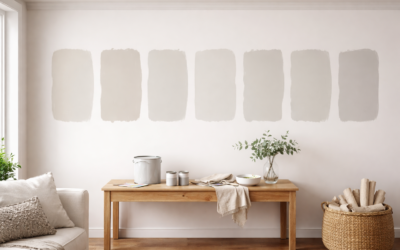
Plenty of grays are called “silver,” but few actually look it on the wall. Benjamin Moore Silver Gray (2131-60) is one that earns the name: the manufacturer describes it as a pale blue-gray that glistens with silvery undertones. That blue note is the first thing to understand, because it decides whether the color feels fresh and airy or cold in your space.
Here are the facts. Silver Gray carries the color number 2131-60 and a light reflectance value (LRV) of 60.27 on the Benjamin Moore color page. It sits in the neutral family and reads as a light-to-medium blue-gray. In bright, warm light it looks soft and silvery; in shaded or north-facing rooms the blue becomes more noticeable.
- Benjamin Moore Silver Gray Specs at a Glance
- Undertone and LRV Explained
- Rooms Where Silver Gray Works
- Trim, Ceiling and Accent Pairings
- Silver Gray vs Silver Mist, Silver Cloud and Gray Owl
- Pairing Silver Gray With Floors and Fixed Finishes
- How to Sample and Paint Silver Gray
- Troubleshooting
- Cost and When to Hire a Painter
- Frequently Asked Questions
It suits bathrooms, bedrooms, coastal-style living spaces and kitchens with white or gray finishes. It is a weaker match for rooms full of warm, orange-toned wood, where the blue can look stark by contrast.
Benjamin Moore Silver Gray Specs at a Glance
| Spec | Value | What it means |
|---|---|---|
| Color number | 2131-60 | Order by number; several Benjamin Moore colors include “silver” or “gray” in their names. |
| LRV | 60.27 | Light side of the middle: brighter than a mid-gray, deeper than an off-white. |
| Color family | Neutral | Reads as a gray rather than a true blue. |
| Undertone | Pale blue with silvery cast | Cool, airy look that turns bluer in shade. |
| Manufacturer pairings | Distant Gray OC-68, Steam AF-15, Wild Flower 2090-40, Kasbah AF-640 | Two soft whites plus two bold accents. |
| Interior or exterior | Both | Available in interior and exterior products; confirm finish options for your chosen line. |
These details come from the Benjamin Moore color page at the time of writing. Published data can change, so confirm the current spec sheet before ordering.
Undertone and LRV Explained
With an LRV of 60.27, Silver Gray reflects a little more than half of the light that hits it. On four walls it will look a shade or two darker than the chip, which is typical for any color around this level. In a room with good daylight it stays light and fresh.
The blue undertone is what separates it from flatter grays. Surroundings change how strongly you see it:
- With crisp white trim, marble and chrome: it reads as a clean, silvery gray.
- With warm wood floors and cream trim: the blue stands out, and the color can look noticeably blue-gray.
- With navy, charcoal and black accents: it reads as a coordinated cool gray.
How light changes it
North light emphasizes the blue and deepens the color slightly. South light warms it toward a soft silver. Warm bulbs around 2700K tone the blue down; daylight bulbs at 5000K or higher make it crisper and cooler.
Rooms Where Silver Gray Works
Bathrooms
Silver Gray is a natural fit with white tile, gray stone, chrome and polished nickel. Its cool cast keeps small baths feeling clean. Use a moisture-resistant finish.
Bedrooms
A pale blue-gray is calm and restful. Balance it with white bedding, soft textiles and a few warm wood or brass accents.
Living rooms and coastal spaces
In bright rooms it gives a breezy, beach-house feel. It pairs well with white slipcovers, rattan and weathered gray woods.
Kitchens
Silver Gray walls with white cabinets and stainless appliances look crisp. On cabinets or an island it reads as a soft, silvery blue.
Exteriors
Outdoors it tends to lighten, giving a pale blue-gray body color that works with white trim and a dark front door. Test a large sample in full sun and in shade.
Trim, Ceiling and Accent Pairings
Benjamin Moore suggests Distant Gray (OC-68), Steam (AF-15), Wild Flower (2090-40) and Kasbah (AF-640) as coordinating colors. That gives you two soft whites for trim or ceilings and two stronger accents for doors, furniture or a feature wall.
- Trim: a soft white such as Distant Gray or Steam keeps the look gentle. A bright white such as Chantilly Lace (OC-65, LRV 90.04) sharpens contrast and emphasizes the silver.
- Ceilings: a flat white works in most rooms; a soft white keeps transitions subtle.
- Accents: the suggested Wild Flower and Kasbah add bolder color. Navy, charcoal and deep teal also sit comfortably beside it.
- Materials: white marble-look surfaces, chrome, brushed nickel and light gray or whitewashed wood.
Silver Gray vs Silver Mist, Silver Cloud and Gray Owl
These four are often compared because their names and looks overlap. All LRVs here come from Benjamin Moore color pages.
| Color | Code | LRV | How it compares |
|---|---|---|---|
| Silver Cloud | 2129-70 | 73.93 | Noticeably lighter; a soft, sheer light blue-gray. |
| Gray Owl | OC-52 | 64.51 | Slightly lighter; a use-anywhere light gray with a cool, crisp cast and less obvious blue. |
| Silver Mist | 1619 | 62.21 | Similar depth; described as a light misty blue with a silver cast, so it can read bluer. |
| Silver Gray | 2131-60 | 60.27 | Pale blue-gray with silvery undertones; the deepest of the four. |
Pick Silver Cloud if you want the same mood in a much lighter version. Pick Gray Owl if you want a more neutral, all-purpose light gray. Silver Mist is the closest in depth but leans more toward blue. Silver Gray sits between a clear gray and a soft blue, with a bit more depth than the others.
Pairing Silver Gray With Floors and Fixed Finishes
Fixed finishes are the things you cannot easily change, so plan Benjamin Moore Silver Gray around them rather than the other way around. Flooring is the biggest factor. Gray, white-oak and whitewashed floors keep the color looking silvery and balanced. Medium oak works if you add white trim and a few cool accents. Strong orange or red-toned floors tend to push the blue forward, which some people like for a coastal contrast and others find too cold.
Countertops and tile follow the same logic. White or gray quartz, white subway tile and marble-look porcelain all sit comfortably with a blue-gray. Creamy granite and beige travertine can make the blue look stronger, so hold a sample right against them before you buy paint.
Metal finishes are easier. Chrome, polished nickel and brushed nickel echo the silvery cast. Matte black gives a modern edge. Brass and gold can work too, adding warmth that balances the cool undertone, as long as you repeat them in a few places so they look intentional.
How to Sample and Paint Silver Gray
- Sample large. Use peel-and-stick swatches or painted boards at least 12 by 12 inches.
- Test against fixed finishes. Hold samples next to floors, counters, tile and trim, where undertones show most.
- Observe for 48 hours. Check morning, afternoon, evening and with your lamps on.
- Prepare the walls. Patch holes, sand smooth, wipe dust and prime patches or bare drywall.
- Gather your tools. A paint roller and tray kit with a 3/8-inch nap cover suits smooth to lightly textured walls, plus an angled brush for cutting in.
- Cut in first. Brush along ceilings, corners and trim, then roll the walls while the edges are still wet.
- Apply two coats, allowing the drying time on the can between coats.
- Choose the right sheen. Matte or eggshell on walls, satin or semi-gloss on trim and cabinets.
Troubleshooting
It looks too blue. Switch to warmer bulbs, use a softer white trim and add warm accents. If it is still too blue, test Gray Owl.
It looks darker than expected. Colors deepen on four walls. Try Silver Cloud for a lighter version, or brighten the room’s lighting.
Visible roller marks or lap lines. Keep a wet edge, load the roller evenly and avoid rolling over partially dry paint.
Color mismatch between cans. Box (mix) all gallons together in a bucket before starting and confirm 2131-60 on every label.
Cost and When to Hire a Painter
Premium interior paint commonly costs about $50 to $100 per gallon, and an average bedroom takes around 2 gallons for two coats. A basic roller and tray kit is inexpensive. Professional painting for a single room usually falls between a few hundred dollars and around $1,000 or more, depending on size, ceiling height and repairs.
Most homeowners can paint interior walls themselves. Hire a professional for high ceilings, stairwells, cabinet refinishing or upper-story exterior work that needs tall ladders or scaffolding. If your house was built before 1978, test old paint for lead before sanding or scraping.
Frequently Asked Questions
What is the LRV of Benjamin Moore Silver Gray?
Benjamin Moore lists Silver Gray (2131-60) with an LRV of 60.27, placing it on the light side of medium.
Is Silver Gray blue?
It is a gray with a pale blue undertone and a silvery cast. The blue shows more in north light and next to warm finishes.
Is Silver Gray darker than Gray Owl?
Yes, slightly. Silver Gray has an LRV of 60.27 compared with 64.51 for Gray Owl, and it leans more blue.
What is the difference between Silver Gray and Silver Mist?
They are close in depth. Silver Mist (1619, LRV 62.21) reads more like a misty light blue, while Silver Gray reads more like a blue-tinged gray.
What white trim goes with Silver Gray?
Soft whites such as Distant Gray or Steam give gentle contrast. A crisp white like Chantilly Lace makes the silver look sharper.