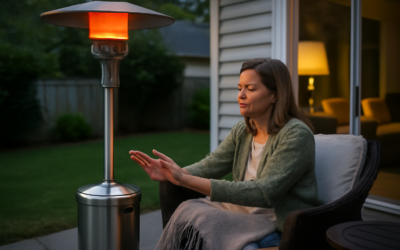
A single freestanding propane patio heater throws roughly 46,000 BTUs and warms an 18-foot circle, enough to keep a small gathering comfortable down to about 45°F. Choosing the best deck heater means matching that heat output to the size of your space, your fuel access, and how much of the season you want to reclaim. The right unit can add two to three months of usable outdoor time on each end of summer, which is real value for a deck that otherwise sits empty from October to April.
Part of our Decks & Outdoor guide — explore the full guide →
This guide compares the main heater types, the BTU math you need, and specific models worth buying in 2026.
The Three Fuel Types
Deck heaters run on propane, natural gas, or electricity, and your choice usually comes down to what is already available and how you use the space.
Propane Heaters
The most popular and portable option. A standard 20-pound tank powers a 40,000-to-48,000-BTU freestanding unit for about 8 to 10 hours. No installation required, just refill the tank for $18 to $25. The downside is hauling and storing tanks and refueling mid-season.
Natural Gas Heaters
Connect to your home’s gas line for a never-ending fuel supply at the lowest operating cost, often half the price of propane per hour. They require professional installation of a gas line, typically $300 to $800, but never need refueling. Best for a permanent deck setup you use often.
Electric Heaters
Infrared electric heaters warm objects and people directly rather than heating the air, so they work well in breezy spots and on covered decks. They produce no fumes, making them safe under a roof or pergola, and cost about $0.15 to $0.30 an hour to run. Most plug into a standard 120-volt outlet, though high-output models need 240 volts.
How Many BTUs Do You Need
For propane and natural gas heaters, a rough rule is to multiply your space in cubic feet by the desired temperature rise, but a simpler field method works for most decks. Plan on roughly 5,000 BTUs per 100 square feet you want to warm in mild conditions, and more in colder or windier climates.
- Small deck or bistro setup (up to 100 sq ft): 11,000 to 20,000 BTU tabletop or compact unit
- Medium deck (100 to 250 sq ft): 40,000 to 46,000 BTU freestanding heater
- Large patio (250 sq ft and up): Multiple freestanding units or a mounted natural gas heater
Electric infrared heaters are rated in watts, not BTUs. A 1,500-watt unit covers roughly 150 square feet of direct warmth.
Top Deck Heater Picks for 2026
- Best Overall Propane: Hampton Bay 48,000 BTU Stainless — Tall freestanding unit with a wheeled base and tip-over shutoff, around $180. Heats an 18-foot diameter.
- Best Electric Infrared: Bromic Tungsten Smart-Heat — Wall- or ceiling-mounted, weatherproof, ideal for covered decks, $700 and up.
- Best Tabletop: AmazonBasics 11,000 BTU Propane — Compact heat for a small balcony or table, about $90.
- Best Natural Gas: Sunglo PSA265 Permanent — Post-mounted, connects to your gas line, premium build for a fixed installation.
Safety Essentials
Never use a propane or natural gas heater in a fully enclosed space, since they produce carbon monoxide. They require open-air or well-ventilated covered areas only. Keep any heater at least 3 feet from walls, railings, furniture, and combustible materials, and always place freestanding units on a flat, stable surface.
Look for an automatic tip-over shutoff valve, which kills the gas if the unit falls, and a flame-failure device that stops fuel flow if the flame goes out. On a wood deck, set propane units on a fire-resistant pad. Store propane tanks outdoors, never in a garage or basement.
Covered Decks Need Electric
If your deck has a roof, pergola with solid cover, or low overhead clearance, choose electric infrared rather than open-flame gas. Infrared units mount overhead, free up floor space, and pose no combustion risk under a ceiling. They also start warming you instantly, with no preheat wait.
Match the heater to your fuel access, your coverage area, and whether the space is open or covered.
Operating Costs Compared
Running costs vary widely by fuel. A propane heater burns roughly half a pound of fuel per hour at full output, so a $20 tank of 20 pounds lasts about 8 to 10 hours, putting the cost around $2 to $2.50 per evening. Natural gas is the cheapest to run, often under $1 an hour, but carries the upfront install cost. Electric infrared sits in between at roughly $0.15 to $0.30 an hour.
If you only fire up the heater a handful of nights a month, propane’s low entry price wins. If you heat your deck several evenings a week through fall, natural gas or electric infrared pays back the higher setup cost in fuel savings within a season or two.
Mounting and Style Options
- Freestanding (mushroom) heaters: The classic tall propane units, portable and high-output, ideal for open patios.
- Tabletop heaters: Compact propane or electric units for a bistro set or small balcony.
- Wall- and ceiling-mounted infrared: Save floor space and work well on covered decks and porches.
- Fire-pit-style heaters: Double as ambiance and warmth, though they heat a smaller radius.
Wind and Weather Considerations
Wind is the enemy of any open-flame heater. A gusty deck can blow out a propane pilot and scatter the heat, so look for models with wind guards or choose electric infrared, which warms objects directly and is far less affected by breeze. In consistently windy spots, mounting an infrared unit on a wall and aiming it at the seating area delivers the most reliable warmth.
Always store propane heaters under a cover when not in use to keep moisture out of the burner, and bring tanks indoors only to a detached, ventilated structure, never a living space. Check the heater’s tip-over switch and pilot assembly at the start of each season, and replace the regulator hose if you notice any cracking, since a worn gas line is both inefficient and unsafe. With the right fuel, coverage, and weather match, the best deck heater for your setup will pull your outdoor living season well into the cold months.