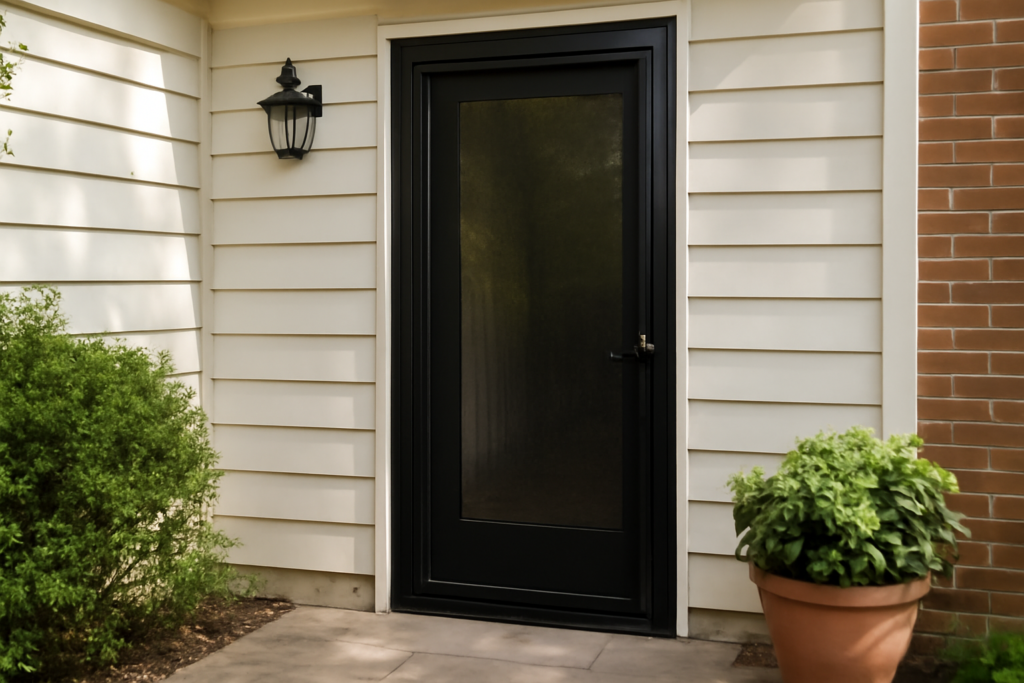
Nothing sharpens a front entry like a crisp black screen door against a painted door and light siding. Beyond the look, a screen door earns its keep — it lets you push air through the house on a mild day, keeps bugs out, and adds a layer of protection to the main door. Black hides road grime better than white and reads as modern rather than dated, which is why it has become the default color on new builds.
- Storm Door vs. Screen Door — Know the Difference
- Styles to Consider
- Materials and Why Black Holds Up
- Costs
- Measuring Your Opening
- Tools and Materials
- Installation Overview
- Getting a Clean Reveal
- Hardware and the Closer
- Matching a Black Door to Your Home
- Glass and Screen Panel Options
- Security Screen Doors
- Maintenance
This guide walks through the styles worth considering, how to size and measure your opening, real-world costs, and what it actually takes to hang one so it closes square and does not rattle in the wind.
Storm Door vs. Screen Door — Know the Difference
People use the terms interchangeably, but there is a real distinction:
- Screen door: Primarily mesh in a frame, sometimes with a lightweight bottom panel. Built for airflow and bug control. Simpler and lighter.
- Storm door: A heavier door with interchangeable glass and screen panels, so it works year-round — glass in winter for insulation, screen in summer for airflow. Most black exterior doors people buy today are technically storm doors with a screen option.
If you want a door you leave up all four seasons, buy a storm door with a black frame and a swappable glass/screen insert. If you only want warm-weather airflow, a dedicated screen door is cheaper and lighter.
Styles to Consider
- Full-view: One large glass or screen panel edge to edge. Cleanest modern look, shows off the main door behind it.
- Ventilating (high-low): Top and bottom sashes slide so you can open either half — good airflow control.
- Retractable screen: The mesh rolls into a slim black cassette on the jamb and disappears when not in use. Great for wide or tall openings and for people who dislike a fixed door.
- Sliding screen door: For patio and slider openings — a black aluminum frame that rides in the existing track.
- Traditional screen with kick panel: A solid lower panel resists dogs and kids; screen or glass up top.
Materials and Why Black Holds Up
Frames are typically:
- Aluminum: The most common. Lightweight, rustproof, powder-coated black. Mid-range durability.
- Steel: Heavier and more secure, often used on security screen doors. Powder-coated black resists rust if the coating stays intact.
- Fiberglass/composite: Won’t dent or corrode; premium price.
For the mesh, charcoal fiberglass is standard and nearly invisible from inside; aluminum mesh is more durable; pet-resistant screen is a heavier weave worth it if you have a dog. A quality powder-coat is what keeps a black door looking good — cheap paint chalks and fades in UV, so buy a door with a baked-on finish, not a spray job.
Costs
- Basic black storm/screen door: $120–$250 at a home center.
- Mid-range full-view with quality hardware: $250–$450.
- Retractable screen system: $150–$500 depending on width.
- Security screen door (steel): $300–$900.
- Professional installation: $100–$300 on top, more for out-of-square openings.
Measuring Your Opening
Standard exterior door openings are 32, 34, or 36 inches wide. Storm and screen doors are sold to fit these and usually ship with an adjustable frame kit.
- Measure the width inside the door casing (the trim) at top, middle, and bottom. Use the smallest number.
- Measure the height from the sill to the top of the opening on both sides.
- Note which side your main door is hinged — the storm door usually hinges on the same side so the handles line up.
- Check the casing depth: you need at least 3/4 inch of flat trim for the mounting flange to land on.
Buy the door size that matches your rough opening width; the included Z-bars and expander sweep take up the small differences.
Tools and Materials
- Cordless drill/driver and bits
- Hacksaw or aluminum-cutting blade to trim the Z-bars and sweep
- Level, tape measure, pencil
- Exterior-grade screws (usually included)
- Silicone caulk to seal the hinge-side Z-bar
- A helper to hold the door while you fasten it
Installation Overview
- Dry-fit the hinge-side Z-bar. Most kits have you attach the hinge-side rail to the door first, then set the assembly in the opening.
- Set the door in the opening against the hinge-side casing, hold it plumb with a level, and mark or drive the top screw.
- Plumb and fasten the hinge side. Get it dead vertical, then run the rest of the hinge-side screws.
- Trim and install the top Z-bar so it caps the opening and sheds water.
- Fit the latch-side rail, adjusting for an even reveal down the whole door so it closes without binding.
- Cut and set the bottom expander/sweep so it seals to the sill without dragging.
- Install the closer and safety chain — the pneumatic closer keeps wind from flinging the door open, and the chain stops it from over-swinging.
- Caulk the hinge and top Z-bar against water intrusion; leave the bottom open for drainage.
Getting a Clean Reveal
A screen door that binds or shows an uneven gap almost always got racked during install. Keep the hinge side dead plumb before you commit screws, and adjust the latch-side rail so the gap is consistent top to bottom. On an out-of-square opening, split the difference rather than forcing the door to match one crooked side.
Hardware and the Closer
Match the handle and hinges to your entry hardware — black-on-black looks intentional. The pneumatic closer has an adjustment screw on the end; turn it to slow or speed the close. Set the hold-open washer if you want the door to stay propped. In high-wind areas, add a second closer to keep gusts from ripping the door off its hinges.
Matching a Black Door to Your Home
Black is versatile but it is not automatically the right call for every facade. It looks sharpest against light siding — white, gray, greige, or pale brick — where the dark frame reads as a crisp graphic line. Against a dark house it can disappear, so consider a satin rather than flat finish to catch some light, or pick a bronze-black over a true jet black. Coordinate the door with your other black exterior details: gutters, light fixtures, house numbers, and window frames. When two or three of those elements share the same black, the screen door looks planned rather than tacked on. If your main entry door is a bold color, a black screen door frames it without competing; if the entry door is also dark, add contrast with hardware in a brushed or aged finish.
Glass and Screen Panel Options
On a storm-door version, the interchangeable insert is where you tune the door to your climate. Full-view models let you swap a tempered glass panel in for winter insulation and a screen panel in for summer airflow — some use a retractable screen built into the frame so you never store a loose panel. Ventilating models have fixed glass on top and bottom with sliding sashes and integral screens, so you change airflow without swapping anything. For a house with kids or a dog that leans on the door, a low-E glass insert cuts heat gain and a heavy pet-grade screen resists claws. Match the panel choice to how you actually use the door: constant airflow favors ventilating or retractable, while four-season insulation favors a full-view with a good glass insert.
Security Screen Doors
If security is the priority, step up from an aluminum screen door to a steel or heavy-aluminum security screen door. These use a welded frame, a stainless or perforated-steel mesh you cannot easily cut, three-point or deadbolt locking, and non-removable hinge pins. In black powder-coat they look like a standard modern screen door but function as a locked outer barrier, letting you leave the main door open for airflow while staying secure. They cost more and weigh more, so the opening’s framing and the hinge screws have to be solid — lag the hinge side into the studs, not just the casing.
Maintenance
- Wipe the powder-coat with mild soap and water; avoid abrasives that scratch the finish.
- Re-screen a torn panel with a spline roller and a $15 roll of charcoal mesh — a 20-minute fix.
- Oil the hinges and closer pivot annually.
- Touch up any chips in the black coating promptly so corrosion cannot start under it.
A black screen door is one of the highest-payback exterior upgrades you can do in an afternoon: better airflow, fewer bugs, a sharper entry, and real four-season use if you go with a storm-door version. Measure your opening carefully, buy a door with a baked-on powder-coat finish, and hang the hinge side plumb — the rest of the install falls into place.