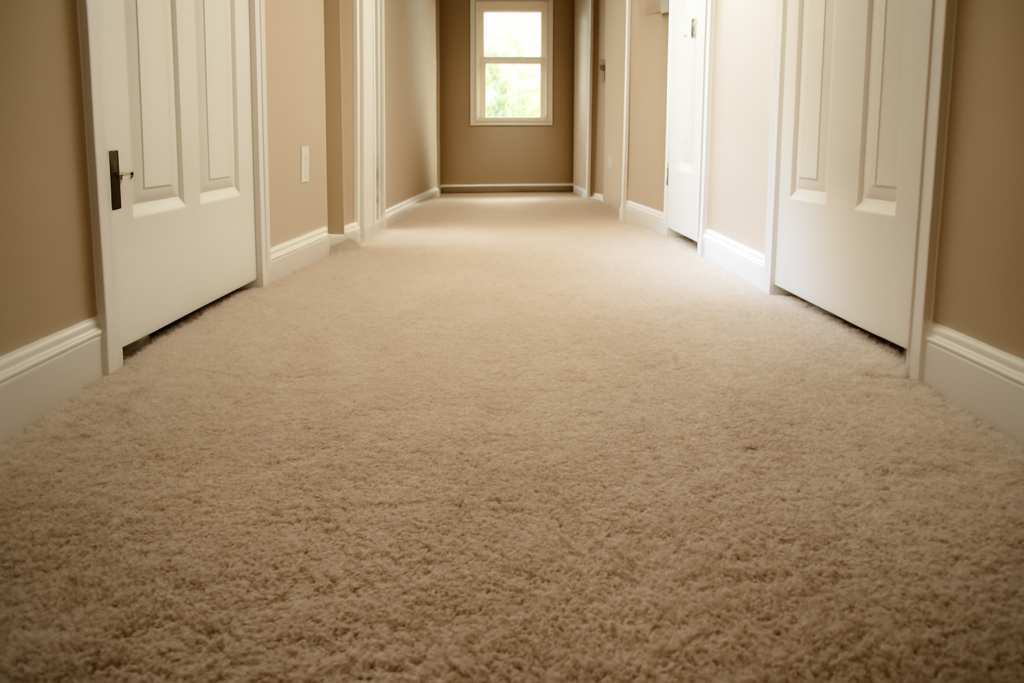
A 4-foot-wide hallway sees more concentrated foot traffic per square foot than any other space in a typical home. Every trip from bedroom to bathroom, kitchen to garage, or front door to family room funnels through the same narrow strip — and that compression is why hallway carpet wears out two to three times faster than living room or bedroom carpet at the same price point. Carpet hallway selection demands a different mindset than picking carpet for any other room: durability beats softness, dense low-pile beats luxury plush, and pattern beats solid color every time. This guide covers what actually works in hallways, what it costs, and the design tricks that make a narrow hallway look better while standing up to a decade of daily traffic.
Why Hallway Carpet Fails Faster
The math is simple. A 4-by-12-foot hallway covers 48 square feet but absorbs traffic from every other room in the house. If a 250-square-foot living room gets 1,000 footsteps per day, the hallway connecting four bedrooms, two bathrooms, and a stairway might see 4,000 to 6,000 footsteps in the same 48 square feet. Per-square-foot traffic intensity runs 8 to 15 times higher.
That concentrated traffic causes three failures: matting (fibers crushed flat), abrasion (visible wear paths), and soiling (dirt ground deeper into pile than vacuum can reach). All three accelerate when soft, plush carpet styles meet hallway-level traffic.
The Right Fiber for Hallway Carpet
For carpet hallway applications, fiber selection matters more than color or pattern. The right options:
- Solution-dyed nylon — most durable, best stain resistance ($4-7 per sq ft)
- Wool or wool blend — premium feel, natural stain resistance ($9-18)
- Triexta (Mohawk SmartStrand) — excellent stain release, soft feel ($5-8)
- Solution-dyed PET — budget-friendly, durable, fade-resistant ($3-5)
Avoid: standard polyester (matts quickly), low-density olefin (crushes under traffic), and any acrylic blends. These work fine in low-traffic bedrooms but fail in 12 to 18 months of hallway use.
Pile Height and Construction
The shorter the pile, the longer hallway carpet lasts. Standard recommendations:
- Berber or level loop — 1/4 inch pile, hides traffic patterns
- Tight twist (frieze) — 3/8 to 1/2 inch, durable cut-pile
- Patterned cut-and-loop — varied pile hides wear and dirt
- Commercial-grade loop — under 1/4 inch, near-permanent appearance
Skip plush saxonies, shag, and friezes over 5/8 inch pile in hallways. They feel luxurious initially but show foot traffic patterns within weeks and look matted within a year.
Pattern Choice — The Smart Trick
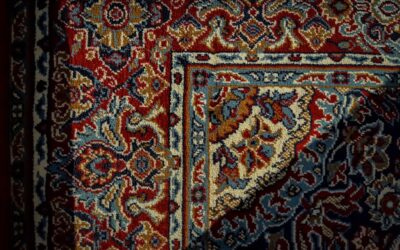
The single most effective design choice for hallway carpet is pattern over solid color. Solid carpets show every spill, dust speck, and traffic line. Patterned and heathered carpets hide normal soiling for years longer.
Multi-color patterns work especially well — small geometric prints, subtle stripes, or heathered marled fibers each disguise dirt and wear that solid carpet would highlight. The pattern does not need to be obvious; even a subtle heather (mixed-color tufts) hides 50% more soiling than the same product in solid color.
Wall-to-Wall vs. Runners
Two main approaches work for hallway carpet. Wall-to-wall installation covers the entire floor with carpet — most common in carpeted homes. Runners place a long narrow rug down the center of an otherwise hard-floor hallway.
Wall-to-wall costs $4 to $9 per square foot installed. For a 4 by 16-foot hallway (64 sq ft), expect $250 to $580 total. Runners cost $80 to $400 for typical sizes (2.5 by 12 feet) but require an existing finished hallway floor underneath.
For homes with hardwood throughout, runners are the easier and lower-commitment option — easily replaced when worn or for design changes. For homes with carpeted bedrooms, wall-to-wall hallway carpet provides visual continuity that runners cannot match.
Cost Realities
A typical 4 by 12-foot hallway uses 48 square feet of carpet, but actual ordering should account for waste, seam alignment, and pattern matching. Order 65 to 75 square feet for a typical hallway:
- Material — $3 to $9 per sq ft ($195 to $675)
- Pad — $0.50 to $1.25 per sq ft ($30 to $80)
- Installation — $1 to $2.50 per sq ft ($60 to $160)
- Stair carpet (if continuous) — $40 to $75 per stair tread
- Old carpet removal — $0.50 to $1.50 per sq ft
For a typical hallway plus 13 stairs, total project cost runs $700 to $2,200 depending on product tier.
Seam Strategy
Carpet rolls come in 12-foot and 15-foot widths. A 12-foot wide roll covers most hallways without lengthwise seams; you only need cross-seams at room transitions. For longer hallways (over 12 feet), plan seam locations at room transitions or doorways where the visual line breaks naturally.
Avoid seams in the middle of a long hallway. Even with professional heat-welded seams, they become visible as traffic patterns develop over the carpet’s life. Seams at thresholds where carpet color or material changes anyway are nearly invisible.
Pad Selection for Hallways
Hallway pad should be firmer than living room or bedroom pad. The standard is 6 to 8 lb density rebond at 3/8 inch thickness — slightly thinner and firmer than the 7/16 inch typically used elsewhere. Firmer pad supports the carpet under concentrated foot traffic, preventing matting and extending appearance retention.
Skip “premium plush” or memory foam pads in hallways. They feel luxurious but allow the carpet to compress unevenly, creating wear patterns faster.
Color Selection Tips
For hallways specifically, mid-tone colors hide soiling best. Pure white shows every footprint within hours. Black shows lint, dust, and pet hair clearly. Mid-tone gray, beige, or tan in a heathered pattern hides daily wear remarkably well.
If the hallway has limited natural light (most do), choose carpet on the warmer side of neutral. Cool grays read as cold and dingy in dim light, while warm beige and taupe look inviting under standard incandescent or warm LED lighting.
Maintenance Schedule
High-traffic hallway carpet benefits from a different cleaning schedule than other rooms. Vacuum at least 2 to 3 times per week (versus weekly elsewhere). Schedule professional hot-water extraction every 6 to 9 months (versus annually for low-traffic spaces). Spot-clean immediately when spills happen — soaked-in stains in heavy-traffic areas grind into the fiber within days.
Walk-off mats at entry points reduce 70 to 80% of dirt entering the hallway. Place 4 to 6-foot mats inside every exterior door and rotate or clean them weekly.
Final Thoughts
For a carpet hallway that lasts, choose solution-dyed nylon or wool in a low-pile loop or tight-twist construction with a subtle pattern or heather. Spend slightly more on fiber and slightly less on plush feel. Use firm pad, install with seams at natural transitions, and add walk-off mats at every entry point. Done right, the hallway carpet looks new for 8 to 12 years. Done wrong with the wrong fiber and pile height, the same hallway needs replacement in three. The premium for the right product is small; the savings in extended carpet life are significant.