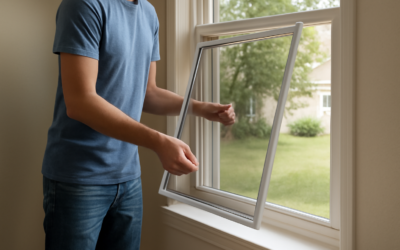
Casement window screens work differently from the screens on double-hung or sliding windows, and that difference trips up a lot of homeowners when it comes time to replace or repair one. Because a casement window swings outward on a hinge like a door and is operated by a crank, its screen must mount on the interior of the window, where it stays put while the glass sash swings out into the fresh air. This guide explains how casement screens fit, the types available, materials, sizing, and how to replace or rescreen one yourself.
Part of our Windows & Doors guide — explore the full guide →
- How Casement Window Screens Work
- Types of Casement Window Screens
- Why Fit Matters So Much
- Screen Mesh Materials
- Measuring for a Replacement Screen
- How to Rescreen a Casement Screen
- Understanding Casement Screen Hardware
- Seasonal Care and Storage
- Solar and Specialty Screens for Casements
- Common Problems and Fixes
- Cost of Casement Window Screens
- Keeping Your Casement Screens in Shape
How Casement Window Screens Work
A casement window is hinged on the side and opens outward when you turn a crank operator. Because the sash swings out, the screen cannot sit on the outside the way it does on a sliding window. Instead, casement screens mount on the inside of the window frame, covering the opening from within the room. When you crank the sash open, air flows in through the interior screen. This interior mounting is the defining characteristic of casement screens and the reason they are not interchangeable with other window screen types.
Types of Casement Window Screens
There are a few common mounting styles depending on your window brand and age:
- Full-frame interior screens: a rigid aluminum or vinyl frame with screen mesh that fits into the interior opening and secures with clips, springs, or turn tabs.
- Snap-in or clip-in screens: held by spring-loaded plungers or clips that let you remove the screen easily for cleaning.
- Retractable casement screens: a roll-up screen housed in a cassette, useful where you want the option to hide the screen when the window is closed.
- Manufacturer-specific screens: brands like Andersen, Pella, and Marvin use proprietary frames and clip systems that fit only their windows.
Why Fit Matters So Much
Casement screens must fit precisely because they mount inside the frame and often interact with the crank hardware. A screen that is even slightly oversized will not seat, and one that is undersized lets bugs slip through the gaps. Many casement screens have a cutout or clearance for the operator crank and lock handles, so you cannot simply substitute a generic rectangular screen. When ordering a replacement, note the window brand, the model, and the exact interior opening dimensions, and identify whether the original used clips, springs, or plungers.
Screen Mesh Materials
The mesh itself comes in several materials, each with trade-offs:
- Fiberglass: the most common, affordable, and forgiving. It will not crease or dent and offers good visibility, though it is less durable than metal.
- Aluminum: stronger and longer-lasting, but it can dent and may oxidize over time. It resists sagging.
- Pet-resistant screen: a heavier polyester or vinyl-coated mesh built to withstand clawing and pushing.
- Solar screen: a denser weave that blocks a large share of incoming heat and UV, cutting cooling costs and glare in sunny climates.
- No-see-um mesh: a tighter weave that keeps out tiny biting insects like gnats and sand flies, popular in coastal and southern areas.
Measuring for a Replacement Screen
To order a correct replacement, measure the interior opening the screen fits into, not the glass. Measure the height and width in multiple spots and use the smallest dimensions, then account for the frame thickness and any hardware clearance. If you still have the old screen frame, measure it directly and note the corner style and how it attaches. For proprietary windows, the fastest route is often to contact the manufacturer with your window’s model and size, since they can supply an exact-fit replacement.
How to Rescreen a Casement Screen
If the frame is intact but the mesh is torn or sagging, you can rescreen it yourself in under 30 minutes with inexpensive tools:
- Remove the screen from the window and lay the frame on a flat surface.
- Pry the rubber spline out of the groove with a screwdriver and remove the old mesh.
- Lay new mesh over the frame with a couple of inches of overhang on all sides.
- Use a spline roller to press new spline into the groove, working slowly and keeping the mesh taut but not overstretched.
- Trim the excess mesh with a utility knife along the outer edge of the spline.
The main tools you need are a spline roller and the correct spline diameter for your frame’s groove, both inexpensive at any hardware store. Keeping the mesh straight and evenly tensioned is the key to a professional-looking result.
Understanding Casement Screen Hardware
The clips, springs, and plungers that hold a casement screen in place are as important as the screen itself, and knowing your hardware type saves frustration when ordering. Older casement screens often used simple turn tabs or thumbscrews that rotate to hold the frame against the interior stops. Many mid-range and modern windows use spring-loaded plungers, small pins on the sides of the screen frame that retract when you squeeze them and pop into holes in the window jamb to hold the screen. Others rely on formed clips that hook over a lip in the frame. When a screen keeps falling out, the culprit is usually worn or broken retaining hardware rather than the screen frame, and replacement clips, springs, and plunger pins are inexpensive and easy to swap. Take the old hardware to the store or match the manufacturer’s part number so the replacement seats correctly.
Seasonal Care and Storage
Because casement screens are interior-mounted, they are easy to remove for cleaning and off-season storage, which extends their life considerably. In climates with harsh winters, some homeowners take the screens out during the cold months when windows stay closed, both to let in more light and to protect the mesh from being crushed or torn while nothing is gained from having them installed. To clean a screen, remove it, lay it flat, and gently wash the mesh with mild soapy water and a soft brush, then rinse and let it dry fully before reinstalling. Store removed screens flat or hung vertically, never stacked with heavy objects on top, since a dented frame or creased aluminum mesh is hard to straighten. Labeling each screen with the room and window it belongs to makes reinstallation painless, because casement screens are often subtly different sizes even within the same house.
Solar and Specialty Screens for Casements
Casement windows are a great candidate for upgraded screen mesh because the interior mounting keeps the mesh protected and easy to swap seasonally. In hot, sunny climates, replacing standard fiberglass with a solar screen mesh can block a large share of incoming solar heat and glare, noticeably reducing cooling costs and protecting furnishings from fading, all while still allowing ventilation when the window is cranked open. In buggy coastal and lakeside regions, a tighter no-see-um mesh keeps out the tiny biting insects that slip right through standard screening. Because rescreening a casement frame is a quick, inexpensive job, you can tune each window’s mesh to its exposure, putting solar screen on the sun-blasted west side and no-see-um mesh on the windows you open most for evening air.
Common Problems and Fixes
- Screen will not stay in place: worn clips or springs; replace the retaining hardware.
- Gaps letting bugs in: wrong size or a bent frame; re-measure and order an exact fit.
- Crank hits the screen: you have the wrong screen without the operator cutout; get the correct model.
- Sagging mesh: rescreen with fresh spline and proper tension, or step up to aluminum mesh.
Cost of Casement Window Screens
A do-it-yourself rescreen costs just a few dollars in mesh and spline. A replacement full-frame casement screen typically runs $25 to $75 for standard sizes, while proprietary manufacturer screens for Andersen, Pella, or Marvin windows can run $50 to $150 each. Retractable casement screens are pricier at $100 to $300 per window. Having a pro measure and install replacements adds labor, but casement screen swaps are among the most DIY-friendly window jobs.
Keeping Your Casement Screens in Shape
Casement window screens are a small but important part of a comfortable, bug-free home, and understanding their interior-mount design makes maintenance and replacement far less confusing. Measure the interior opening precisely, match the brand and hardware style, and choose a mesh material suited to your needs, whether that is pet resistance, solar heat blocking, or keeping out tiny no-see-ums. With the right fit and an occasional rescreen, your casement screens will keep the fresh air flowing and the insects out for years.