The screen is the most-operated, worst-maintained part of any patio door — cycled thousands of times a season and blamed for problems that are really a $12 roller’s fault. Whether your patio screen door drags, derails, or has been shredded by the dog, the fix is usually cheaper than people assume: rollers run $8 to $20, rescreening costs about $15 in materials, and even a full replacement slider is a $50 to $200 part. This guide sorts the types, walks the repairs worth doing yourself, and covers when replacement beats another round of fixes.
Part of our Decks & Outdoor guide — explore the full guide →
- Types of Patio Screen Doors
- Why Sliding Screens Drag — and the 20-Minute Fix
- Rescreening: Cheaper Than It Has Any Right to Be
- Aligning, Latching, and Pet-Proofing
- When to Replace the Whole Screen Door
- Retractable and Specialty Upgrades
- Cost Cheat Sheet: Repair vs. Replace vs. Upgrade
- Seasonal Care in Five Minutes
Types of Patio Screen Doors
Four formats cover nearly every patio opening. Sliding screens — an aluminum or vinyl frame rolling in a track alongside a glass slider — are the standard partner to sliding patio doors and the focus of most repairs. Retractable screens (Phantom, Larson, Brisa) live rolled in a slim housing beside the jamb and pull across on demand, running $150 to $400 per door installed as DIY kits or $600 to $1,500 professionally fitted; they’re the answer for French doors and openings where a fixed screen would intrude. Hinged screen doors suit single swinging patio doors, $50 to $150 in aluminum or wood. Magnetic mesh curtains ($15 to $40) hang in the opening and self-seal behind you — genuinely useful for renters and pet traffic, honestly flimsy for daily long-term use. If the glass door itself is the problem rather than the screen, that’s a different project — our vinyl patio doors guide covers the door units themselves.
Why Sliding Screens Drag — and the 20-Minute Fix
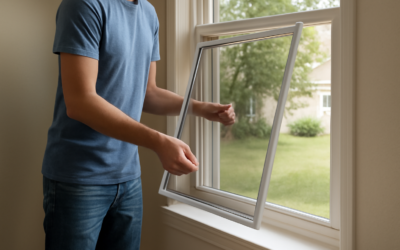
A dragging, jumping, or derailing slider is almost always worn rollers, not a bent door. Each corner of the screen frame holds a small spring-loaded wheel assembly, and after years of grit the wheels flatten, seize, or shed their treads.
- Remove the door: find the adjustment screws at the bottom corners, back them out to retract the rollers, then lift the door up into the top track and swing the bottom free
- Pop out a roller and match it — take it to the hardware store or match brand/profile online; Prime-Line covers most doors, $8 to $20 per pair
- Vacuum the track, scrub it with a stiff brush, and wipe it clean; then lubricate with silicone spray only — oil and WD-40 collect grit and make everything worse within a month
- Install new rollers, rehang, and set roller tension so the door glides without daylight at either stile
While the door is off, check the track itself. Flattened or gouged track lips can be straightened with pliers or capped with a snap-on stainless track cover ($15 to $30) — the cover trick also rescues tracks worn shiny-thin by decades of use, which no roller can fix — the same repair logic that applies at the sill, which our patio door threshold guide covers in detail.
Rescreening: Cheaper Than It Has Any Right to Be
Torn mesh is a $15, 30-minute repair. You need a replacement screen roll, a spline roller tool ($5), new vinyl spline (measure the old diameter — .140 and .160 inch are common), and a utility knife. Lay the frame flat, pry out the old spline, position new mesh with 1 inch of overhang, and roll the spline into the channel starting at one corner, pulling the mesh just taut as you go — drum-tight bows the frame inward. Trim the excess along the spline channel and rehang. Work on a large flat table or the garage floor, clamp or weight the frame corners so the channel stays straight, and cut with a fresh blade angled away from the mesh — the classic rookie error is slicing the brand-new screen on the final trim pass.
Mesh choice matters more than people think. Standard fiberglass is the default and easiest to work. Pet-resistant polyester screen (PetScreen) costs about three times more and shrugs off claws — buy it the second time the dog goes through, if not the first. Aluminum mesh dents but resists punctures; solar mesh blocks up to 65 to 90 percent of heat gain on west-facing doors; and “invisible” fine-weave mesh (like Phifer UltraVue) improves the view at a slight airflow cost.
Aligning, Latching, and Pet-Proofing
Beyond rollers and mesh, three small fixes handle most remaining complaints. A screen that latches poorly usually needs the strike adjusted — loosen its screws, close the door, mark where the hook actually lands, and remount; replacement latch kits run $10 to $25. A door that rattles in wind wants the top guide adjusted down and new pile weatherstripping ($8 a roll) in the stiles. For pets and kids who blast through the screen, add a screen-door grille or push-bar guard ($15 to $40) at nose height, or fit a screen-mounted pet door ($30 to $80) so traffic stops going through the mesh entirely.
When to Replace the Whole Screen Door
Replace rather than repair when the frame is bent (sight down the stiles — a bowed extrusion never tracks right again), corners have cracked, or the door predates its parts availability. Universal replacement sliders cost $50 to $150, adjustable in height and cut-to-width; OEM doors matched to your patio door brand run $100 to $250 and fit their tracks better. Measure the opening height track-to-track and the width of the old door, and note which side the latch lands. Installation is fifteen minutes: retract the rollers, angle the door into the top track, drop it onto the bottom rail, and tension the corners. If the glass slider’s own rollers, track, or seals are failing at the same time, weigh a full door replacement instead — screen problems that keep returning are often symptoms of a racked main frame.
Retractable and Specialty Upgrades
For openings that never had a screen — French doors, oversized sliders, garage patio conversions — retractables are the clean retrofit. DIY kits from Larson and Brisa ($40 to $150 per door) handle standard openings; dual-door kits meet magnetically in the middle for French pairs. The honest caveats: the spring-loaded mesh retracts fast enough to startle, small dogs learn to nose through, and cheap kits’ tracks clog with debris, so budget tier matters here more than with fixed screens. Motorized large-opening screens ($1,500 to $4,000) turn a covered patio into a screened room at the push of a button — worth considering alongside a structure project if bugs are the main reason you’re inside.
Cost Cheat Sheet: Repair vs. Replace vs. Upgrade
Here’s the money picture in one place. Roller pairs, $8 to $20 and 20 minutes. Rescreen with fiberglass, about $15 DIY or $25 to $50 at a hardware store’s screen shop; pet mesh adds $10 to $20. Latch kits, $10 to $25. New universal sliding screen, $50 to $150; OEM-matched, $100 to $250; hinged screen door, $50 to $150 plus an hour of fitting. Retractable kits, $150 to $400 per opening DIY or $600 to $1,500 installed; motorized patio-scale screens, $1,500 to $4,000. A handyman charges $75 to $150 to handle any of the small jobs if tools aren’t your thing — still cheaper than living with a door you have to shoulder open. The general rule: put money into the screen while the frame is straight, and into a new door the moment it isn’t.
Seasonal Care in Five Minutes
Twice a year: vacuum both tracks, silicone-spray the rollers, wash the mesh with a soft brush and soapy water (it doubles airflow through a pollen-clogged screen), and check spline corners for creep. In hail and blizzard country, pull screens for the winter and store them flat in the garage — screens age far faster in storms than in use. That five-minute routine, plus a $12 roller swap every few years, keeps a patio screen door gliding for the life of the door behind it.