From a doorway, herringbone and chevron floors look almost identical. Walk to the center of the room and the difference snaps into focus — one creates a continuous zigzag line of perfect points, the other offsets staggered rectangles into a broken zigzag. The chevron pattern vs herringbone debate has driven design decisions in European parquet floors for 400 years, and the answer still depends on the architectural style of your home, your installation budget, and how the room is shaped. Both patterns are gorgeous. Picking the wrong one for your space is an expensive mistake to live with.
How Each Pattern Is Built
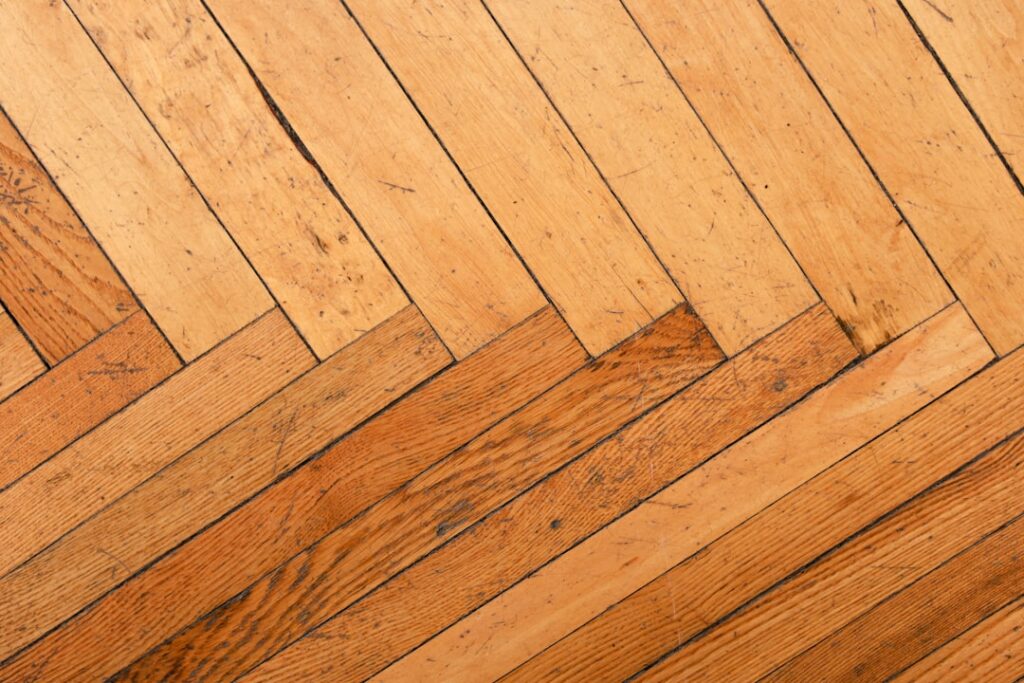
Herringbone uses standard rectangular planks laid at 90 degrees to each other. Each plank butts into the long edge of the next, creating an L-shape that repeats across the room. The ends of the planks form a staircase line, never quite continuous, which gives herringbone its characteristic broken zigzag.
Chevron uses planks cut at 45 or 60-degree angles on both ends. When two pieces meet, their angled ends form a perfect V. Each row of Vs aligns with the next, producing an unbroken zigzag with razor-sharp points down the center. The angled cuts mean chevron planks are not standard product — they are typically milled to order, which is the first reason chevron costs more.
Visual Effect and Room Suitability
Herringbone reads as a textured, busy pattern. Your eye picks up the broken lines and reads movement everywhere. It pairs well with traditional homes — Cape Cods, Colonials, English Tudors — where the busyness echoes the architectural detail. It also shrinks rooms visually, which is why decorators rarely specify it for spaces under 200 square feet.
Chevron reads as cleaner and more modern. The continuous V lines create directional flow that pulls the eye through the room. It works in transitional and contemporary homes, in long hallways, and in rectangular living rooms where the zigzag lines emphasize length. In small powder rooms or square spaces, chevron can feel forced.
Material and Cost Comparison
The cost difference is real and consistent across product lines. Expect to pay these material premiums over standard plank flooring:
- Herringbone hardwood: 15 to 25% over standard plank
- Chevron hardwood: 35 to 60% over standard plank
- Herringbone LVP: 10 to 20% over standard plank
- Chevron LVP: 30 to 50% over standard plank
- Herringbone porcelain tile: 0 to 10% — uses standard rectangular tile
- Chevron porcelain tile: 25 to 40% — requires angle-cut tile
For a 400 square foot living room in red oak, herringbone runs roughly $3,200 in material against $2,600 for standard plank. Chevron in the same space runs $4,000 to $4,200. The labor adds another $4 to $7 per square foot regardless of pattern.
Installation Difficulty
Herringbone goes down faster than chevron because the planks are standard sizes and the only critical alignment is the 90-degree corner. A skilled installer can do 200 to 300 square feet of herringbone in a day. The same installer might only complete 150 to 200 square feet of chevron because every joint is a 45-degree miter that has to align perfectly across the room.
Chevron also has zero tolerance for measurement error. A 1/16-inch gap at one V multiplies into a misaligned row by the time you cross the room. This is why most flooring contractors quote a 25 to 40% labor premium for chevron over herringbone, even though the materials look similar from a distance.
Wood Species and Finish Choices
Both patterns work with any species, but the visual impact changes. Light oak and white oak emphasize the geometry while staying calm — the pattern is visible without overwhelming the room. Dark walnut or stained oak makes the pattern dominant and works better in larger spaces where it has room to breathe.
Matte and satin finishes show off the geometric cuts. High-gloss finishes amplify reflections and can make a chevron floor look chaotic from the wrong angle. For a balanced look, specify a satin or low-sheen polyurethane.
Subfloor Requirements
Both patterns are unforgiving of subfloor flatness because every joint is visible. The industry standard for plank flooring is a maximum 3/16 inch deviation over 10 feet. For herringbone, target 1/8 inch over 10 feet. For chevron, get to within 1/16 inch over 10 feet — that is professional-grade flat.
Achieving that flatness usually requires self-leveling compound on concrete or new plywood underlayment over an existing subfloor. Skipping this step shows up later as squeaky planks and visible gaps at miters.
Resale Value Impact
Both patterns add resale appeal in homes priced above the regional median. Real estate listing data shows herringbone-floored homes selling roughly 1 to 3% above comparable plank-floored homes. Chevron tracks similarly but with a wider variance — buyers either love it or feel the room is too busy.
For a home you plan to sell within five years, herringbone is the safer investment. For a long-term home or a luxury market property, chevron’s distinctiveness pays off in showings and showcases. Either way, both beat standard parallel plank in mid-range and luxury price segments.
How to Choose for Your Space
Choose herringbone if your home is traditional, your room is medium-sized, your budget tilts conservative, or you want the safer resale call. Choose chevron if your home is contemporary, your room is large or rectangular, you want a statement floor, and you have professional installation lined up. There is no wrong answer between the two — only a wrong fit for the room.
Common Misconceptions
Two myths come up constantly during showroom visits. First, that herringbone is “old-fashioned” and chevron is “modern.” Both patterns appear in 17th-century European palaces — neither is intrinsically traditional or contemporary. The architectural context drives the read more than the pattern itself. Second, that you cannot DIY either pattern. With patience and a good miter saw, herringbone in click-lock LVP is genuinely achievable for a determined DIYer in a small room. Chevron is much harder because of the angled cuts, but a confident woodworker with a quality flooring nailer can manage it in a 100 square foot space.
Prefer to explore on your own?
See how new flooring looks in your actual room in seconds — free, no signup.
Try the free Floor Studio →