Here is the fact that surprises every first-time repairer: new concrete does not stick to old concrete. Cured concrete is chemically finished — pour fresh material against it and you get two separate objects touching, with a cold joint between them that pops apart under the first winter’s freeze-thaw. A concrete bonding agent is the adhesive bridge that turns that cold joint into a fused repair, and knowing which type to use — and the one situation where you should skip it — separates patches that last decades from patches that shale off in a season.
Why Cured Concrete Rejects Fresh Concrete
Concrete hardens by hydration: cement crystals grow and interlock while the mix is wet. Once cured, those crystals stop growing; fresh concrete placed against the old surface has nothing to knit into, so it relies on weak mechanical grip against a typically smooth, dusty, or laitance-coated face. Worse, dry old concrete sucks water out of the new material’s contact layer, starving that critical first millimeter of the moisture it needs to cure, leaving a chalky, weak interface. Bonding agents attack both problems: they glue the surfaces chemically and control the moisture exchange at the joint.
The Three Families of Bonding Agents
- Acrylic/polymer latex (the homeowner standard): milky liquids such as Quikrete Concrete Bonding Adhesive, Sakrete Bond-It, and SikaLatex — $15 to $40 per gallon, covering 100 to 200 square feet. Brush or roll on, or fortify the mix by substituting for part of the mix water. Ideal for patches, toppings under 2 inches, stucco, and resurfacing work. SBR (styrene-butadiene) latex is the heavier-duty cousin used the same ways with better water resistance.
- Epoxy bonding agents (the structural option): two-part products like Sika Sikadur 32 and Armatec 110 EpoCem, $60 to $150 per unit. These achieve bond strengths exceeding the concrete itself and are specified for structural repairs, doweling, and bonding fresh structural concrete to existing members. Overkill for a step corner; correct for a load-bearing repair.
- Cement slurry / scratch coat (the old-school method): a brushed-in paste of portland cement and water — dramatically improved by mixing it with acrylic bonder instead of plain water. Scrubbed into a damp substrate immediately before placing repair mortar, this remains the technique many pros trust most for cementitious patches, at nearly zero cost.
When You Need One
Reach for a bonding agent whenever fresh cementitious material must adhere to cured concrete in a thin or unrestrained layer: crack and spall repairs (the prep sequence in our concrete patch guide depends on it), rebuilding chipped edges on concrete steps, bonded toppings and overlays from 1/4 inch to 2 inches, setting a new stoop cap on an old base, tying a sidewalk section extension to existing work, and skim coats — though note that purpose-made products like those covered in our concrete resurfacing guide arrive polymer-modified, with the bonder already in the bag, and want only a damp, profiled substrate.
When to Skip It
Bonding agents are not universal primer, and there are real cases where they are wrong or unnecessary:
- Full-thickness new slabs: a slab poured beside or replacing another is designed to move independently — you want an isolation joint there, not adhesion. Structural connection across pours is achieved with rebar dowels, not glue.
- Unbonded overlays: some overlay designs deliberately float on a separation layer.
- Under sealers, paints, and epoxy coatings: those systems specify their own primers; a latex bonder underneath can cause failure.
- Polymer-modified products that prohibit it: many modern repair mortars and resurfacers explicitly say no additional bonding agent — the wrong film underneath becomes a bond breaker. The bag wins every argument.
How to Apply It Correctly
Application technique causes most bonding-agent failures, and the rules are simple:
- Prep the substrate. Sound, clean, dust-free concrete with some texture — scarify or acid-etch slick surfaces. No sealer, paint, oil, or laitance; a bonding agent over a curing compound bonds beautifully to something that is itself about to let go.
- Get the moisture state right. Most acrylic bonders and slurry coats want saturated surface-dry (SSD) concrete: damp throughout, no standing water. Epoxies typically want dry concrete. Check your product.
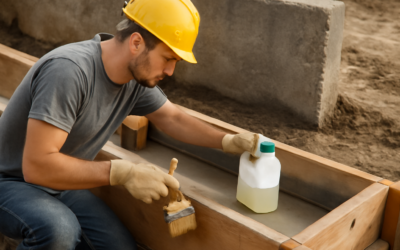
- Apply a thin, even film. Brush or roll one coat into the surface — puddles and thick films weaken the joint.
- Respect the open-time window — the step everyone botches. Wet-on-wet products (most slurries, Sikadur 32, and many acrylics in repair service) need the new concrete placed while the bonder is still tacky, typically within 30 minutes to 2 hours. Let it dry to a shiny cured film and it repels the repair instead of bonding it. A minority of acrylic products are engineered to be placed on after drying — the label states which type you hold. Read it twice.
- Place, finish, and cure the repair normally, keeping cementitious work damp for 24 to 72 hours.
Fortifying the Mix: The Other Way to Use Latex
Acrylic and SBR bonders double as mix fortifiers: replace roughly a third to half of the mixing water in a patch, topping, or stucco batch (per label ratios) and the polymer cures within the cement matrix, adding flexural strength, adhesion, and freeze-thaw resistance throughout the material rather than only at the joint. Belt-and-suspenders practice for exposed exterior repairs is both — fortified mix placed over a scrubbed-in bonding slurry. The cost is a few dollars per batch; general mix design context lives in our concrete mix guide.
Shopping Guide: What to Buy for Common Jobs
Matching product to project saves both money and returns to the store:
- Step edge or sidewalk spall repair: a quart of Quikrete Concrete Bonding Adhesive ($10 to $14) brushed on wet-on-wet under a rapid-set repair mortar. One quart covers several repairs; it keeps for a couple of years sealed.
- Skim coat or thin topping over a patio: a gallon of SikaLatex or Sakrete Bond-It ($25 to $40), used both as a scrubbed-on bond coat and as partial mix water in the topping.
- Stucco and vertical mortar work: an SBR latex admixture, which improves hang and water resistance on vertical surfaces.
- Structural crack or dowel work: Sikadur 32 two-part epoxy (about $70 to $90 per unit) — and at this level, consider whether the repair deserves an engineer’s eye rather than a bigger tube.
- Basement leak plugging: skip the bonder entirely; hydraulic cement is its own system and bonds by expansion.
Check dates when buying: latex bonders are water-based emulsions that die if stored frozen, and a jug that has wintered in a hardware store’s unheated shed pours lumpy and bonds poorly. Shake the jug hard before purchase; if the liquid will not smooth back to uniform milk, exchange it for fresher stock. Store your own leftovers indoors, tightly capped, and stir before each use.
The Bottom Line
One test settles doubts before they cost you: the coin-scratch check, a week later. A properly bonded patch scratched hard at its edge with a quarter behaves like one material — the scratch crosses the joint without catching. A failing bond shows a hairline shadow at the perimeter within days as the patch dries and shrinks independently; catch it then and you can cut losses early, re-prepping and re-placing a fist-sized repair in twenty minutes instead of discovering the whole patch loose under a snow shovel in February.
For a typical homeowner repair, the playbook is: clean and profile the old concrete, wet it to SSD, scrub in acrylic bonding agent or a bonder-rich slurry, and place a stiff polymer-modified patch while everything is still tacky. That $20 jug and ten extra minutes are the cheapest insurance in concrete work — the difference between a repair that becomes part of the slab and one that becomes a loose puzzle piece lying in the driveway three winters from now.