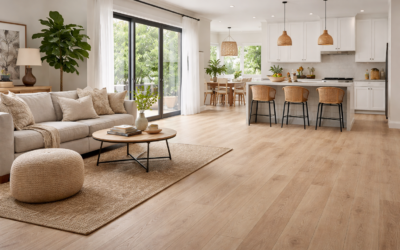
Coretec Ravenswood Oak is a light, neutral oak look on a long, wide rigid plank, and it sits in the COREtec Pro Premium collection under style code VV488-2091A. COREtec describes the color as clean and modern, raw and light in character, and notes it is a bit greyer and more neutral in brightness and warmth than its sister colors Cairo Oak and Calypso Oak. In plain terms: it is a pale, slightly cool natural oak that avoids both the yellow cast of older honey floors and the flat grey of trendy washed planks.
The plank itself is built for busy homes. It measures 9 x 72 inches, uses a solid polymer (SPC) rigid core, has a 20 mil wear layer and an attached cork underlayment, and the manufacturer rates it for both residential and heavy commercial use. You will sometimes see it spelled Coretec Ravenwood Oak in listings and searches, but the manufacturer’s name is Ravenswood.
Specs and pricing are drawn from the manufacturer’s product page. Check the current spec sheet before you order, because product details and lineups change over time.
Coretec Ravenswood Oak Specs and Price Range
Here is the core data in one place, with a quick note on why each figure matters when you are comparing floors.
| Spec | Value | What it means |
|---|---|---|
| Collection | COREtec Pro Premium (VV488-2091A) | Rigid core line built for heavy traffic |
| Color | Light, neutral oak, slightly grey | Brightens rooms without reading cold |
| Plank size | 9 x 72 in. | Wide, long boards with fewer end joints |
| Total thickness | 5.2 mm | Low profile; easier transitions to tile |
| Wear layer | 20 mil | Suits kitchens, entries and pets |
| Core | Solid polymer core (SPC) | Dense, dent resistant, stable in temperature swings |
| Underlayment | Attached cork | Quieter and a little warmer underfoot |
| Edges and finish | Enhanced painted bevel | Defined board edges, matte-leaning look |
| Carton coverage | 36.64 sq ft | Divide room area plus waste by this |
| Typical price range | Roughly $5 to $8 per sq ft for material | Mid to upper range for rigid vinyl |
Dealer spec listings show a 15-year heavy commercial limited warranty for this style, plus a long residential limited warranty; confirm the exact residential term on the current COREtec warranty document before you buy. Installation can be floating or direct glue, and the plank is approved on any grade level, including basements over concrete.
The Swatch: Undertones and Grain
On a sample, Ravenswood Oak shows a light oak base with soft, straight to gently cathedral grain and modest knot detail. The surface carries a light wood-grain texture over the printed visual, so raking window light reads more like real wood than a flat, smooth print.
The undertone is neutral with a slight grey pull. It is not a beige floor and not an ash-grey floor. Against stark white walls it reads natural and fresh. Next to warm cream walls it can look a little cooler than you expect. Compared side by side, Cairo Oak and Calypso Oak look warmer and a touch brighter, which is why some homeowners who find those too golden settle on Ravenswood.
How lighting shifts the color
- North light: the grey undertone shows more; the floor feels calm and Scandinavian.
- South or west light: warmth comes forward and the floor reads like natural white oak.
- Warm LED (2700K): the floor reads beige-neutral in the evening.
- Cool LED (4000K and up): the floor can look noticeably grey; consider warmer bulbs.
Matching Trim, Cabinets and Walls
Light neutral floors are forgiving, but a few combinations work especially well with this color.
Baseboards and door trim
Crisp white or soft white painted trim is the safest choice. It frames the floor and keeps the room bright. Stained trim in medium brown can work in a traditional home, but avoid orange-toned oak trim, which makes the floor look grey by comparison. For stair nosing, reducers and T-moldings, use the coordinating trim made for this color so the transition pieces match the plank.
Kitchen cabinets
- White and off-white: a classic light kitchen; add brass or black hardware for contrast.
- Sage, olive or deep green: the neutral floor lets colored cabinets stand out.
- Navy or charcoal: strong contrast that looks modern.
- Walnut-tone wood: a warm, mid-century feel; keep the counters light.
- Avoid: very light, cool grey cabinets close to the floor’s value, which can make the room look washed out.
Wall colors
Warm whites, soft greige and pale mushroom tones look good with Ravenswood. Cool blue-grey walls lean the whole room cold, so use them with warm textiles and wood furniture. Test paint samples on the wall at floor level, where the paint and plank will be seen together.
Where Ravenswood Oak Works Best
The combination of a rigid core, 20 mil wear layer and heavy commercial rating makes this plank a strong choice for kitchens, mudrooms, open living areas and basements. The 72-inch length shows off in long rooms and hallways, where fewer end joints make the floor look calmer. In very small rooms, a wide 9-inch plank can feel oversized, though most people find a light color offsets that.
The plank is a sensible option for pet owners because the surface resists scratches better than thin-wear-layer vinyl, and spills will not swell the core. Large dogs can still leave marks, so keep nails trimmed.
Installation Basics
Ravenswood Oak can be floated using its click joint or glued down. Floating is the common DIY choice. The SPC core is stiff, which helps it bridge minor subfloor flaws, but it still needs a flat surface.
Tools you will need
- A vinyl plank flooring cutter, or a utility knife and straightedge for score-and-snap cuts
- Jigsaw or oscillating tool for notches around door casings and vents
- Tapping block, pull bar and rubber mallet
- Spacers for the perimeter expansion gap
- Six-foot straightedge for flatness checks
- Moisture test kit for concrete slabs
A plank cutter is especially handy with a 72-inch board, since long planks are awkward to score on the floor. It gives straight, square cuts quickly and keeps dust out of the house.
Step-by-step overview
- Prep the subfloor. Clean, dry and flat to the tolerance in the installation guide. Fill dips and grind ridges.
- Check moisture. Test concrete slabs and follow the guide’s requirements for vapor protection.
- Plan the layout. Run planks parallel to the longest wall or the main light source. Calculate the last row so it is not a sliver.
- Leave the expansion gap. Spacers at every wall, cabinet base and doorway.
- Install row one. Keep it straight with a chalk line; the whole floor follows it.
- Stagger end joints. Keep joints well offset between rows to avoid repeating patterns.
- Finish. Add baseboard or quarter round, transitions and stair parts, leaving the floor free to move.
Care and Troubleshooting
Daily care is simple: sweep or vacuum (with the beater bar off), then damp mop with a cleaner made for vinyl. Skip steam mops, wax and oil soaps. Use felt pads on chair legs and a mat at exterior doors to catch grit.
Light floor shows dust: a pale neutral floor hides pet hair and dust better than dark floors, but crumbs show. A quick daily sweep in the kitchen keeps it looking clean.
Joints peaking or separating: usually caused by a tight expansion gap or uneven subfloor. Check that trim and cabinets are not pinning the floor.
Hollow sound in spots: a sign of a low spot under the plank. Minor hollow areas are normal with floating floors; large ones should be fixed before they stress the joints.
Color looks greyer than the sample: large areas amplify undertones. Changing bulbs to a warmer color temperature often solves it.
Costs and When to Call a Pro
Material for Ravenswood Oak typically runs in the roughly $5 to $8 per sq ft range, plus trim. Professional installation often adds about $2 to $5 per sq ft depending on prep work and region. For a 500 sq ft open kitchen and living area, plan on roughly $2,800 to $4,500 for materials with waste and trim, and about $4,000 to $6,500 with professional installation.
Bring in a flooring pro if the subfloor needs significant leveling, if you plan to glue the floor down, if stairs are involved, or if the slab has a history of moisture. A pro install can also matter for warranty claims, so keep receipts and follow the installation guide closely.
Frequently Asked Questions
What color is Coretec Ravenswood Oak?
It is a light, neutral oak with a slight grey pull. The manufacturer describes it as clean and modern, raw and light in character, and a bit greyer and more neutral than Cairo Oak and Calypso Oak.
Is Ravenswood Oak the same as Ravenwood Oak?
Yes. Coretec Ravenwood Oak is a common misspelling. The manufacturer’s name is Ravenswood Oak, style code VV488-2091A.
What is the wear layer on Ravenswood Oak?
It has a 20 mil wear layer, which is suitable for busy residential rooms and is backed by a heavy commercial wear rating.
Is Ravenswood Oak SPC or WPC?
It uses a solid polymer core (SPC), which is denser and more dent resistant than foamed WPC cores, with an attached cork underlayment for sound and comfort.
Can I install Ravenswood Oak in a basement?
Yes. It is approved on any grade level, including basements, and the core is waterproof. Test the concrete for moisture first and follow the installation guide’s vapor protection requirements.
What trim color goes with Ravenswood Oak?
White or soft white painted trim is the easiest match. Use the coordinating moldings and stair nosing made for this color for transitions.
Prefer to explore on your own?
See how new flooring looks in your actual room in seconds — free, no signup.
Try the free Floor Studio →