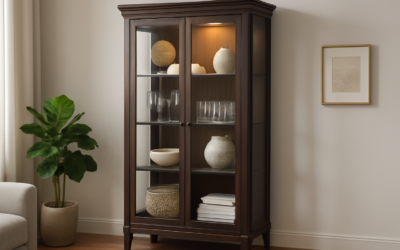
An empty corner is wasted square footage, and a corner curio cabinet with glass doors turns that dead 90-degree angle into a lit display for china, figurines, sports memorabilia, or family heirlooms. These cabinets tuck into a room where a rectangular piece never fits, giving you three or five viewing sides behind glass while stealing almost none of your usable floor. Before you spend $250 to $1,200, it pays to understand the sizing math, the glass options, and the lighting that separates a showpiece from a dusty box in the corner.
Part of our Kitchen Remodeling guide — explore the full guide →
- Why a Corner Design Beats a Flat-Wall Curio
- Standard Sizes and What Fits Inside
- Glass Door and Panel Options
- Lighting Makes or Breaks the Display
- Materials, Finishes, and Build Quality
- Safety and Anti-Tip Anchoring
- Assembly, Placement, and Care
- What to Budget and Where to Buy
- Styling the Interior for Maximum Impact
- Common Buying Mistakes to Avoid
Why a Corner Design Beats a Flat-Wall Curio
A standard flat-back curio needs a full run of wall, and in a dining room or living room that wall is usually already claimed by a buffet, a sofa, or a window. A corner unit exploits the triangular footprint most furniture ignores. A typical five-sided corner curio occupies a footprint of roughly 26 to 30 inches along each wall but projects only about 16 to 18 inches into the room at the deepest point.
That geometry matters when you have a tight traffic path. Because the cabinet pulls back into the angle, you keep the walking lane open while still gaining four to five glass shelves of display height. Most corner curios stand 70 to 80 inches tall, so you get vertical real estate without a wide horizontal reach. For small dining rooms and apartment living rooms, that trade is hard to beat.
Standard Sizes and What Fits Inside
Corner curios come in a fairly consistent range of dimensions, which makes planning straightforward once you measure your corner. Here are the sizes you will encounter most often:
- Petite / apartment: about 60 to 68 inches tall, 22-inch wall span, three to four shelves
- Standard: 72 to 76 inches tall, 26 to 28-inch wall span, four to five shelves
- Grand: 78 to 84 inches tall, 30-inch-plus wall span, five to six shelves with a mirrored back
Shelf spacing usually runs 10 to 12 inches, which comfortably holds standard teacups, wine glasses, and figurines up to about 9 inches tall. If you collect taller pieces such as vases or trophies, look for a model with adjustable shelf pins so you can pull one shelf and create a 20-inch bay. Weight capacity per glass shelf is typically 15 to 25 pounds, so keep heavy stoneware low and light glass up high.
Glass Door and Panel Options
Not all glass is equal, and the type you choose affects clarity, weight, and safety. When you shop a corner curio cabinet with glass doors, check the spec sheet for these terms:
Tempered vs. Standard Glass
Tempered glass is heat-treated to be roughly four times stronger than annealed glass, and when it breaks it crumbles into blunt pebbles instead of long shards. If you have kids or pets, pay the small premium for tempered doors and shelves. Many cabinets under $300 still ship with standard float glass, so read carefully.
Beveled and Curved Fronts
Higher-end units feature a beveled edge on the door glass or a fully curved front pane. Curved glass reads as more traditional and eliminates the vertical frame line, but a replacement pane can cost $80 to $200 and is not something a big-box store keeps in stock. Flat glass with a wood mullion is easier and cheaper to repair.
Lighting Makes or Breaks the Display
An unlit curio is just a shelf. Interior lighting is the single feature that transforms your collectibles, and there are three common systems. Older cabinets use a single incandescent or halogen puck at the top, which throws warm light down but leaves lower shelves dim. Mid-range units add a mirrored back that bounces light and doubles the apparent depth of your display.
The best current option is an LED strip or a top-mounted LED can rated around 3000K to 4000K. LEDs run cool, sip about 5 watts, and will not fade or yellow delicate fabrics and photos the way a hot halogen bulb can over years. Look for a cabinet with a touch dimmer or a simple rocker switch on the frame so you can set a soft evening glow. If your model only has one top light, adding a battery-powered LED puck under each shelf lip is a $15 fix that dramatically evens out the lighting.
Materials, Finishes, and Build Quality
Frame construction ranges from solid hardwood to veneered MDF, and the difference shows up in both price and longevity. Solid oak, cherry, or maple frames run $600 and up and will survive decades of moves. Most sub-$400 cabinets use an MDF or particleboard core with a printed or veneer finish, which looks fine but does not tolerate humidity swings or repeated disassembly.
Popular finishes include espresso, cherry, black, and white, with white and gray trending in modern rooms. Check the hinge quality and the door catch. A magnetic catch or a simple friction ball keeps the door shut; cheap plastic catches wear out and let the door drift open. Also confirm the back panel is fastened, not just stapled, since a loose mirrored back rattles every time you close the door.
Safety and Anti-Tip Anchoring
A tall, top-heavy cabinet loaded with glass is a genuine tip hazard, especially with young children or in earthquake-prone regions. Nearly every quality curio ships with an anti-tip strap or bracket, and you should install it every time. Drive the wall screw into a stud, not just drywall, and cinch the strap so the cabinet cannot rock forward.
For extra security, museum putty or removable earthquake gel holds individual pieces to the glass shelves for a few dollars. This is worth doing for anything irreplaceable, because a slammed door or a bumped frame can walk a figurine right off a smooth shelf over time.
Assembly, Placement, and Care
Most corner curios arrive partially assembled, requiring you to attach the top, base, and doors, a job that takes one person about 45 to 90 minutes. Keep the glass shelves in their packaging until the frame is upright and anchored. Set the cabinet on a level floor; if your corner has a heat register or baseboard, plan the placement so airflow is not blocked and the base sits flush.
For cleaning, use a microfiber cloth with a vinegar-and-water mix or a streak-free glass cleaner sprayed onto the cloth rather than directly onto the glass, which keeps liquid out of the frame joints. Dust the interior every few weeks with the door open, and check the anti-tip strap once a year. With reasonable care, a well-built corner curio cabinet with glass doors will display your collection cleanly for 15 to 20 years or more.
What to Budget and Where to Buy
Expect to pay according to materials and lighting rather than size alone. Entry-level MDF units with a single light run $180 to $300, mid-range cabinets with tempered glass and LED lighting land at $350 to $650, and solid-wood heirloom pieces climb past $900. Watch for these value signals before you check out:
- Tempered glass on both doors and shelves
- LED lighting with a dimmer or multiple pucks
- Adjustable, not fixed, shelf positions
- Included anti-tip hardware
- A mirrored, securely fastened back panel
Buy where returns are easy, since glass items ship poorly and a cracked pane on arrival is common. Inspect every panel the day the box lands so you stay inside the return window. Get those details right and your once-empty corner becomes the most-admired spot in the room.
Styling the Interior for Maximum Impact
Owning a beautiful cabinet is only half the job; how you arrange the contents decides whether it reads as a curated display or a cluttered shelf. The rule interior designers follow is negative space. Resist the urge to fill every inch. A greens-keeper’s eye for restraint applies here too: leave breathing room around your best pieces so each one draws attention on its own.
Group items in odd numbers, typically threes and fives, and vary the height within each shelf so the eye travels up and across rather than scanning a flat row. Place your tallest or most dramatic piece slightly off-center on the middle shelf, which sits at natural eye level around 55 to 60 inches. Save the top shelf for lighter, smaller objects that will not look precarious, and anchor the bottom shelf with your heaviest stoneware or a stack of collectible books.
Color coordination pulls a mixed collection together. If you display china in several patterns, unify them by keeping a consistent background, which is where a mirrored back or a painted interior panel earns its keep. A pale, neutral interior lets colorful figurines pop, while a dark interior makes crystal and metallic pieces sparkle under the LED lighting.
Common Buying Mistakes to Avoid
Shoppers make the same handful of errors, and every one is avoidable once you know to watch for it. The most frequent is measuring only the corner angle and forgetting to check that the assembled cabinet will clear a doorway or hallway on the way in. Measure your narrowest passage before ordering a 76-inch unit.
Other pitfalls worth flagging before you buy:
- Ignoring the glass type and ending up with fragile standard glass in a home with kids or pets
- Overlooking lighting and buying an unlit cabinet that leaves your collection dim and flat
- Assuming shelves are adjustable when many budget models have fixed spacing that will not hold tall pieces
- Skipping the anti-tip anchor because the cabinet feels stable empty, before it is loaded with glass
- Buying an unfinished back when a mirrored back nearly doubles the visual depth of the display
Take fifteen minutes to confirm dimensions, glass, lighting, and shelf adjustability against the product listing, and you sidestep the returns and disappointments that trip up most first-time buyers.