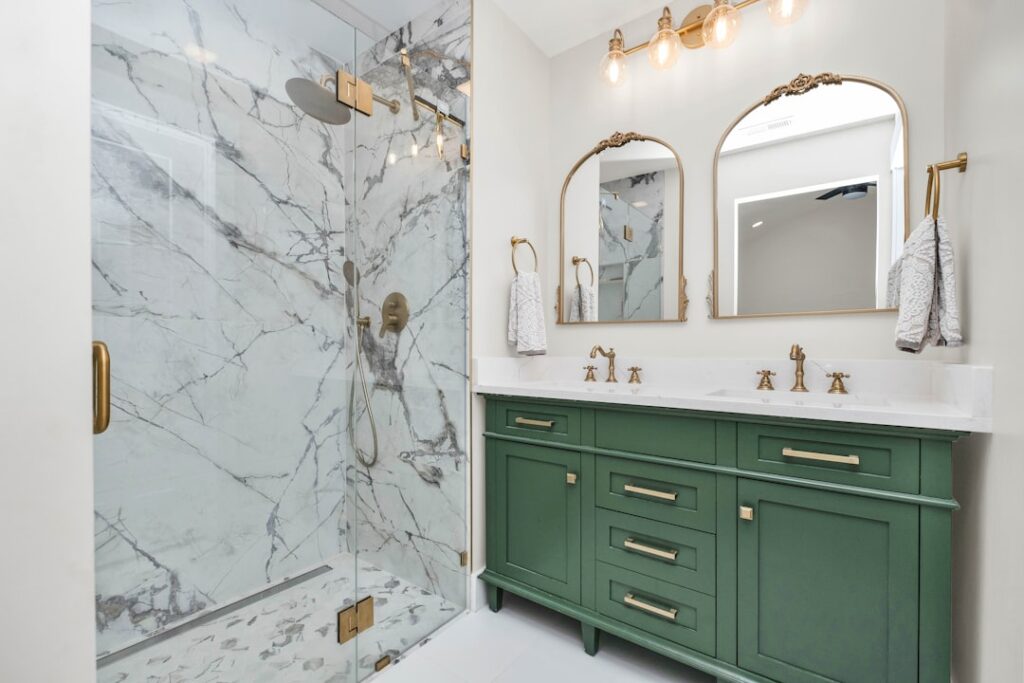
A corner shower claims the most useless real estate in a small bathroom and turns it into a functional wet zone. Done well, it can feel as spacious as a walk-in. Done poorly, it’s a cramped fiberglass box that dates the bathroom by 20 years. These corner shower ideas cover layouts, materials, and door types from budget DIY to high-end custom, so you can match ambition to budget before the plumber shows up.
- Neo-Angle for Maximum Elbow Room
- Curbless Corner Walk-In
- Pivot-Door Corner Shower
- Sliding Glass Corner Enclosure
- Tile Pattern Ideas That Elevate the Space
- Built-In Storage That Actually Helps
- Shower Heads and Controls
- Lighting the Corner
- Budget Breakdown by Build Level
- Waterproofing the Corner Right
- Drain Selection Matters
- Glass Thickness and Hardware
- Common Mistakes to Avoid
Neo-Angle for Maximum Elbow Room
The neo-angle has a five-sided footprint with a 45-degree cut corner holding the door. It gives you a usable 36 x 36-inch interior in less total floor space than a square shower. Pre-fab kits run $550 to $1,400, custom tile builds $3,500 to $7,500. Best for bathrooms under 50 sq ft.
Curbless Corner Walk-In
Zero-threshold entry, linear drain, continuous tile from bathroom floor into shower. Looks spa-like, adds resale value, and meets aging-in-place codes. Requires dropping the subfloor by 1 to 1.5 inches or building up the rest of the bathroom. Budget $4,500 to $9,500 installed.
Pivot-Door Corner Shower
A square or rectangular footprint with a single pivot glass door on one face. Simpler than a neo-angle, works well in 36 x 48-inch footprints. Semi-frameless glass door runs $450 to $900, frameless $900 to $1,800.
Sliding Glass Corner Enclosure
Bypass sliding doors on two tracks. Great for larger 42 x 60-inch corners where a swing door would block the toilet or vanity. Look for 3/8-inch tempered glass with stainless steel hardware. Cost: $700 to $1,600.
Tile Pattern Ideas That Elevate the Space
- Large-format 24 x 48-inch porcelain: fewer grout lines, feels bigger
- Vertical subway tile: draws the eye up, makes 8-foot ceilings feel taller
- Penny round or 2 x 2 mosaic floor: adds grip and visual texture
- Accent niche in herringbone or picket: breaks up the wall without overwhelming
- Single slab porcelain walls: modern, seamless, $1,800 to $3,500 per wall
Built-In Storage That Actually Helps
Plan the niche during rough-in, not after. Standard niche sizes are 12 x 24 inches or 14 x 30 inches, set 42 to 48 inches off the finished floor. Double niches (one high for adults, one low for kids or leg-shaving) are smart in family baths. A corner soap shelf built from cut tile pieces costs $40 in materials and $150 in install time.
Shower Heads and Controls
Center the shower valve on the wall opposite the door so you’re not walking through cold spray to turn it on. Rain head above, handheld on a slide bar, and a third body spray is the spa trifecta. Budget $400 to $900 for a mid-range Delta or Moen trim kit, $1,500 to $3,500 for a high-end Hansgrohe or Kohler system.
Lighting the Corner
A wet-rated recessed can directly above the shower head is non-negotiable. Add LED strip lighting inside the niche for a high-end feel ($60 to $120 for waterproof strip and driver). If the shower has a window, keep the glazing obscure or frosted to maintain privacy.
Budget Breakdown by Build Level
Entry-level DIY with an acrylic kit: $800 to $1,500. Mid-range tile with pre-made pan and clear glass: $3,500 to $6,000. High-end curbless with custom linear drain and slab walls: $8,000 to $15,000. Labor typically runs 40 to 55 percent of the total on custom builds.
Waterproofing the Corner Right
Corners are where 90 percent of shower leaks start. Use a full sheet membrane like Schluter Kerdi or Wedi instead of brush-on RedGard on corners, or layer both for belt-and-suspenders protection. The curb, if you have one, needs the membrane wrapped over the top and down both sides with no overlaps at the inside corner. Pre-formed inside corner pieces from Schluter run $8 each and eliminate the most common installer error: thinning out the membrane material where it has to bend 90 degrees.
Drain Selection Matters
A traditional 4-inch center drain works with any pan slope and matches standard plumbing rough-ins. Linear drains along one wall let you slope the entire floor in one direction, which works better with large-format 24 x 48-inch tile that can’t be cut into pie wedges. Schluter Kerdi-Line and Infinity Drain models run $250 to $600 and are worth it for tile sizes over 12 inches square. Make sure the drain body matches your DWV pipe material (ABS or PVC) before ordering.
Glass Thickness and Hardware
Frameless glass doors come in 3/8-inch and 1/2-inch tempered. The 1/2-inch is sturdier but needs more robust hinges and a reinforced wall anchor. Most residential showers do fine with 3/8-inch at about half the cost. Clips and hinges should be rated for the glass weight; Brass Pro and C.R. Laurence are the two brands I trust on custom installs. Budget $45 to $90 per hinge and $25 per clamp for good hardware.
Common Mistakes to Avoid
Skipping the waterproof membrane, using mastic instead of thinset, forgetting a pre-slope under the pan, placing the bench where the spray hits it directly, and choosing clear glass in a sunny bathroom where every water spot shows. Get the bones right and any of these corner shower ideas will serve you for 20+ years.