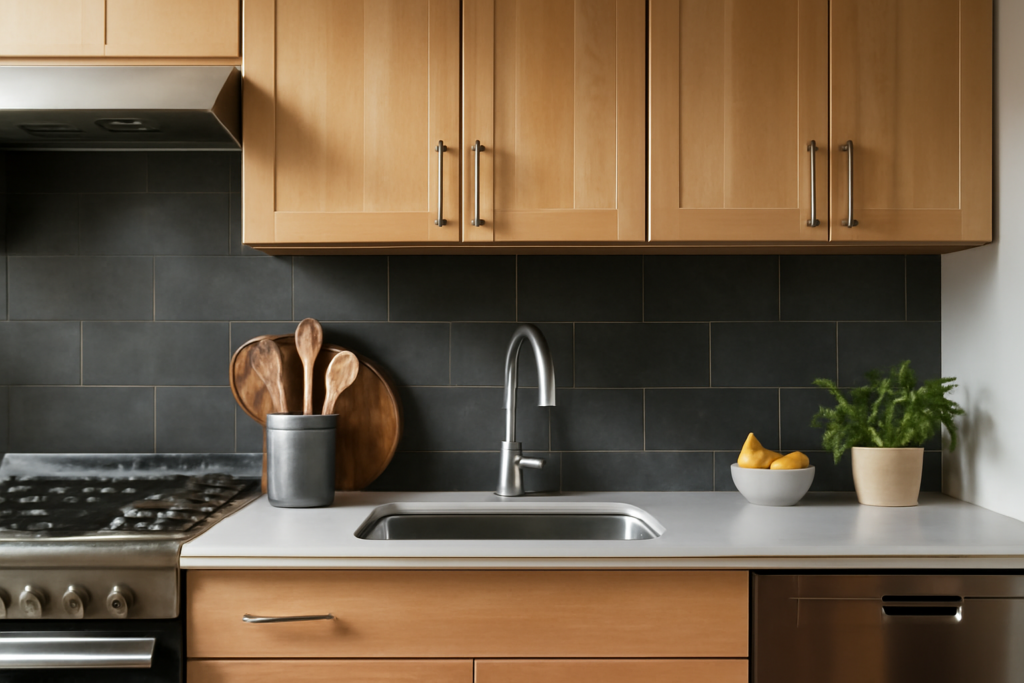
A well-chosen dark grey backsplash can turn a flat, forgettable kitchen wall into the anchor of the whole room. It reads as calm and architectural rather than loud, and it hides the daily grime that makes lighter tile look tired within a year. After installing dozens of these over the past decade, I can tell you the difference between a moody, high-end result and a cave-like mistake almost always comes down to three things: the undertone of the grey, the grout you pair with it, and the lighting you plan around it.
Part of our Kitchen Remodeling guide — explore the full guide →
The Moody, Modern Look and Who It Suits
Dark grey sits in a sweet spot between black and mid-tone neutrals. It gives you the drama of black without the harsh, absorbing quality that makes a small kitchen feel closed in. Charcoal, graphite, gunmetal, and slate all fall under this umbrella, and each one behaves differently depending on the light in your room.
This look pairs best with contemporary, transitional, and industrial kitchens, but I have used it in farmhouse spaces too when the homeowner wanted something less expected than white subway. If your kitchen gets strong natural light for most of the day, a dark backsplash will feel luxurious. If it is a north-facing galley with one small window, you will need to work harder on artificial lighting, which I cover below.
Warm vs Cool Dark Greys: Get the Undertone Right
The single biggest mistake I see is ignoring undertone. Grey is never truly neutral. Cool greys lean blue or green and feel crisp, clinical, and modern. Warm greys, sometimes called “greige” when they drift lighter, carry brown or taupe and feel softer and more inviting.
Match the undertone to your fixed elements. Cool greys sing next to stainless steel, white quartz with grey veining, and glossy white cabinets. Warm greys work with wood tones, brass hardware, and cream or off-white cabinetry. Always tape a full sheet of samples to the wall and look at them at 7 a.m., noon, and under your evening kitchen lights before you commit. A charcoal that looks perfect in the showroom can turn muddy or icy in your actual space.
Material Options
The material you choose sets the durability, the price, and the personality of the wall. Here are the ones I recommend most for a dark grey backsplash:
- Porcelain and ceramic tile: The workhorse choice. Dense, water-resistant, easy to clean, and available in every format. Porcelain is harder and better for heavy-use areas. Expect $8 to $25 per square foot installed.
- Glass tile: Reflective and luminous, which helps bounce light back into a dark kitchen. It resists stains completely but shows water spots and fingerprints. Runs $20 to $40 per square foot installed.
- Natural slate: Genuine texture and subtle color variation, from blue-grey to near-black. It needs sealing and has an irregular, cleft face that traps a little more grease. Roughly $15 to $30 per square foot installed.
- Soapstone-look and marble-look porcelain: Large-format slabs that mimic the soft grey of soapstone or the dramatic veining of grey marble, without the sealing and etching headaches of real stone. Often $18 to $35 per square foot installed.
- Zellige: Handmade Moroccan-style tile with a glossy, uneven glaze. In a deep charcoal it looks stunning and artisanal, but every piece varies and installation labor is higher. Budget $25 to $50 per square foot installed.
Tile Formats and Patterns
Format changes the mood as much as color does. A dark grey in one shape can feel sleek and minimal, and in another can feel busy or traditional.
- Large-format (12×24 and up): Fewer grout lines create a seamless, modern, slab-like wall. My default recommendation for a clean dark look.
- Subway (3×6 or 4×12): Timeless and budget-friendly. A dark grey subway with contrasting grout reads classic; with matching grout it turns quietly sophisticated.
- Hexagon: Geometric and playful, great for a feature strip or a full modern statement wall.
- Herringbone: Adds movement and a custom, high-end feel. It uses about 10 to 15 percent more tile due to cuts, so buy extra.
Pairing With Cabinets and Countertops
Dark grey is remarkably flexible, which is part of why it has stayed popular. With white or light cabinets, a charcoal backsplash provides bold contrast and becomes the visual anchor of the kitchen; this is the most forgiving combination for smaller spaces because the light cabinets keep everything from going too heavy.
With dark cabinets, a dark grey backsplash creates a rich, tonal, monochromatic scheme that feels expensive and intentional, but you must layer in lighter countertops, wood shelving, or metallic accents so the room does not collapse into one dark mass. For countertops, white or light-grey quartz is the safest partner. Butcher block warms the whole thing up, and a waterfall of grey-veined marble-look quartz ties directly back to the wall.
Grout Color: The Detail That Makes or Breaks It
Grout is not an afterthought. On a dark grey backsplash you have three strategies. Matching charcoal grout makes the wall read as one continuous surface, minimizing the grid and maximizing the modern, seamless effect. A slightly lighter grey grout gives subtle definition without harsh lines. High-contrast white or pale grout turns each tile into a graphic element, which suits subway and hex but can look busy across a big wall.
Whatever you choose, use a quality stain-resistant or epoxy grout in the kitchen. And skip pure white grout in a working kitchen unless you enjoy scrubbing it. A mid-grey grout hides splatters far better and still looks intentional.
Lighting Considerations
Dark surfaces absorb light, so plan for it. Under-cabinet LED strips are not optional with a dark grey backsplash; they are essential. They wash the wall with light, reveal the tile’s texture and sheen, and keep your prep zone bright. I install warm-white strips around 2700K to 3000K so the grey stays inviting rather than cold.
If your kitchen is naturally dim, lean toward glossy or glass tile that reflects available light, and keep the rest of the palette on the lighter side. In a bright, sunny kitchen you can push toward matte charcoal and soapstone-looks without the room feeling dark.
Cleaning and Everyday Maintenance
Here is the honest tradeoff with dark tile. Glossy dark greys show water spots, fingerprints, and dried splatter far more readily than matte finishes or lighter colors. Behind a faucet or cooktop you will notice mineral spots within days. The fix is simple: wipe with a microfiber cloth and a splash of white vinegar in water, and buff dry. Matte and honed finishes hide spots much better but can hold grease in their texture, so degrease them occasionally with a mild dish-soap solution.
Cost, Pros, and Cons
All in, a typical dark grey backsplash runs $10 to $35 per square foot installed for most tile choices, with premium zellige and specialty glass pushing higher. A standard 30-square-foot kitchen backsplash therefore lands somewhere between $300 and $1,000-plus depending on material and labor.
The advantages are strong: it hides grime, resists the dated look that plagues trendy colors, pairs with almost any cabinet, and delivers instant high-end drama. The drawbacks are real too: glossy versions show spots, it can shrink a dim kitchen visually, and it demands good lighting to look its best.
Choose the right undertone, commit to under-cabinet lighting, and pick a stain-resistant grey grout, and a dark grey backsplash will look as sharp in ten years as it does on install day. It is one of the few bold choices in a kitchen that reads as timeless rather than trendy, which is exactly why I keep recommending it.