The reason grey has quietly become the default backsplash color is that it does something no bold hue can: it goes with everything and dates slowly. A grey backsplash bridges warm woods and cool whites, hides splatter better than glossy white, and lets you change cabinet and countertop choices around it without clashing. But grey is a deceptively wide range, from soft greige to near-black charcoal, and the shade and finish you pick make the difference between a kitchen that feels serene and one that feels flat. Here is how to choose well.
Part of our Kitchen Remodeling guide — explore the full guide →
Why Grey Is the Safe-Yet-Smart Choice
Grey is the ultimate neutral. It pairs effortlessly with white, black, wood tones, brass, and stainless, which is exactly why designers reach for it when a kitchen needs to feel cohesive without committing to a trend that will look tired in five years. Unlike pure white, grey hides minor splatter and water spots between cleanings, a practical edge behind a busy cooktop or sink.
It also flatters whatever surrounds it. Against white cabinets it adds depth; against dark cabinets it lightens; against wood it cools the warmth. That chameleon quality means a grey backsplash keeps working even if you later repaint the walls or swap the hardware.
Understanding the Range of Grey
The single most important decision is the shade and undertone:
- Light dove and silver greys: Bright and airy, keeping a small kitchen open and reflecting light
- Greige: A grey-beige blend that warms the room and pairs beautifully with wood and warm whites
- Mid greys: The versatile middle, offering contrast without going dark
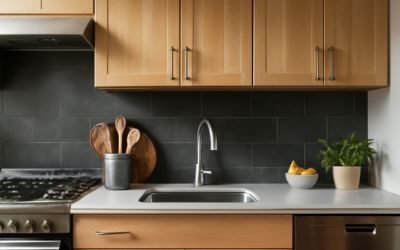
- Charcoal and slate: Dramatic and grounding, stunning against white counters but better in well-lit kitchens
Watch the undertone. Cool greys lean blue and pair with crisp whites and stainless, while warm greys lean taupe and suit cream cabinets and brass. A mismatch in undertone is what makes a grey feel off, so sample it against your actual cabinets and counters in your kitchen’s light.
Popular Tile Styles in Grey
Grey works in nearly every tile format, and the shape sets the personality:
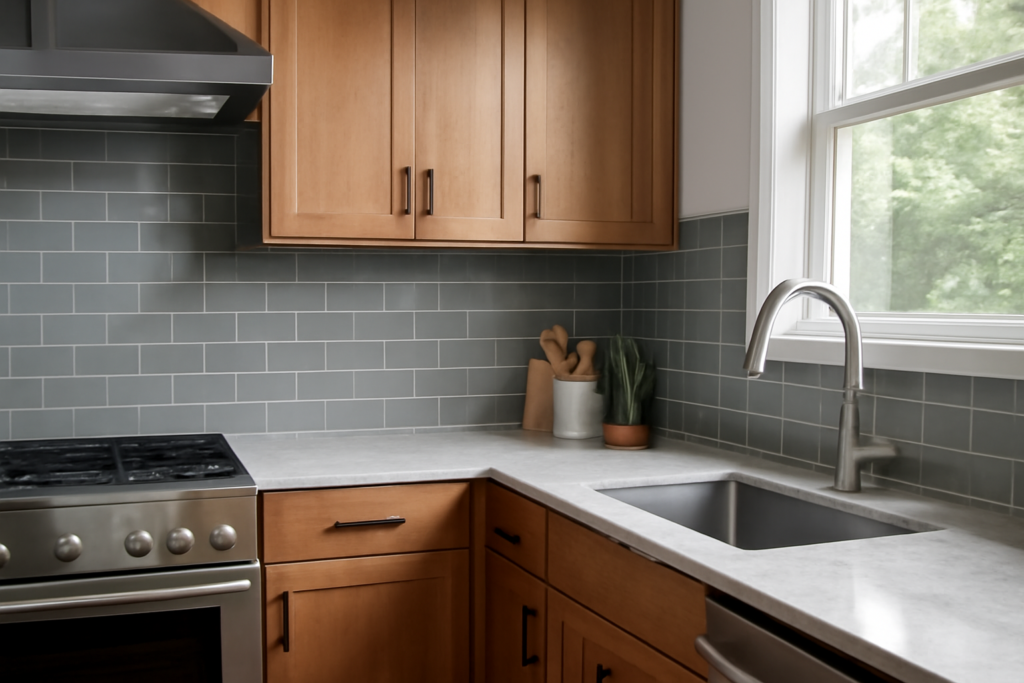
- Subway tile: The timeless classic; grey subway in a stacked or herringbone layout feels current
- Marble-look porcelain: Grey-veined slabs and tiles that mimic stone for a luxe look at a lower cost
- Hexagon and geometric: Adds modern texture while staying neutral
- Natural stone: Slate, marble, and travertine in grey tones for organic depth
- Large-format slabs: Minimal grout lines for a sleek, contemporary surface
For most kitchens, grey subway or a marble-look porcelain delivers broad appeal and easy resale value.
Pairing Grey With Cabinets and Counters
The backsplash never stands alone, so plan it as part of a trio with cabinets and countertops. A few combinations that consistently work:
- White cabinets, grey backsplash, white or grey quartz: Clean, bright, and timeless
- Navy or dark cabinets, light grey backsplash: The grey lightens and balances the dark cabinetry
- Wood cabinets, greige backsplash: Warm and organic, the greige bridging the wood and counters
- Grey cabinets, lighter grey backsplash: A tonal, monochrome look with subtle depth
Keep contrast in mind. If your counters are busy with movement, a calmer grey backsplash lets them shine. If counters are plain, a textured or patterned grey adds interest.
Grout: The Detail That Changes Everything
Grout color quietly transforms a backsplash. Matching grout to the tile creates a seamless, subtle field, while a contrasting grout, light grout on dark tile or dark grout on light, emphasizes the tile shape and pattern. Behind a stove and sink, a slightly darker grout hides staining better than bright white, which discolors over time.
For grey tiles, a grey grout in a close tone usually looks most refined. Whatever you choose, seal cement-based grout after installation so it resists grease and moisture in the splash zone.
Installation and Cost Basics
A backsplash is one of the more DIY-friendly tile projects because the area is small and not load-bearing. Still, a clean job depends on a flat wall, proper tile spacing, and patient grouting. Mesh-backed mosaic sheets speed up intricate patterns, while large tiles need careful leveling.
Cost depends heavily on the tile. Budget ceramic and porcelain run roughly $5 to $15 per square foot for materials, while natural stone and specialty glass climb higher. A typical kitchen backsplash covers around 30 to 40 square feet, so material costs often land in the few-hundred-dollar range, with professional installation adding labor on top.
Is a Grey Backsplash Right for You?
If you want a backsplash that looks intentional today and stays relevant for years, grey is hard to beat. It flatters nearly every cabinet and countertop, hides daily mess better than white, and gives you freedom to change other elements without a redo. Choose the shade and undertone to match your light and your cabinets, get the grout right, and a grey backsplash becomes the quiet, versatile backbone of a kitchen that always looks pulled together.