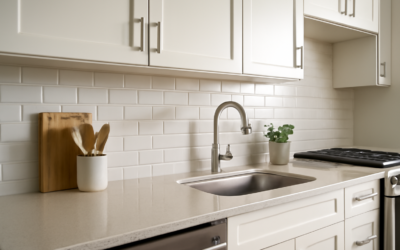
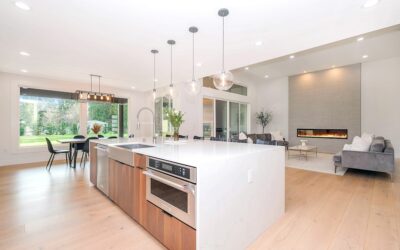
The single most common kitchen pairing in remodels today is a quartz countertop with tile backsplash, and for good reason. Quartz gives you a nonporous, low-maintenance work surface, while tile brings texture, color, and personality to the wall behind it. Together they cover the two most-touched, most-photographed surfaces in the whole kitchen. Get the combination right and the room feels finished; get it wrong and the two elements fight each other.
Part of our Countertops guide — explore the full guide →
This guide walks through how to choose, coordinate, and install the pairing so the counter and the wall read as one intentional design rather than two separate purchases.
- Why Quartz and Tile Work So Well Together
- Matching Colors and Undertones
- Popular Tile Choices for a Quartz Kitchen
- The Critical Detail: Where Counter Meets Wall
- Grout Color Changes Everything
- Handling Seams and Outlets
- What It All Costs
- Care and Maintenance
- Common Mistakes to Avoid
- Bringing It Together
Why Quartz and Tile Work So Well Together
Quartz is an engineered stone, roughly 90 to 94 percent ground natural quartz bound with resin and pigment. That resin is what makes it nonporous, stain resistant, and free of the yearly sealing that granite and marble demand. It is the ideal horizontal surface for a busy kitchen.
Tile, by contrast, shines on the vertical plane. A backsplash takes very little abuse compared to a countertop, so you can use delicate materials like glass, marble mosaic, or handmade zellige that would never survive as a work surface. The counter handles the punishment, the tile handles the beauty. It is a natural division of labor.
Matching Colors and Undertones
The most important rule is to coordinate undertones, not to match colors exactly. Quartz slabs carry a warm or cool undertone even when they read as plain white. A crisp bright-white quartz with cool gray veining pairs beautifully with a white subway tile that also leans cool. Put that same quartz next to a creamy, warm-white tile and the counter will suddenly look dingy by comparison.
A reliable approach is to pick the countertop first, since it is the larger investment and the harder element to swap later. Bring a sample of the quartz to the tile shop and hold candidates directly against it in natural light. Watch for these relationships:
- Busy, heavily veined quartz pairs best with a simple, quiet tile
- Plain solid quartz gives you freedom to use a bold patterned or textured tile
- Warm quartz (cream, beige, taupe undertones) wants warm-toned tile and grout
- Cool quartz (gray, blue-white undertones) wants cool tile and gray grout
Popular Tile Choices for a Quartz Kitchen
Almost any tile can sit above a quartz counter, but a few styles dominate for a reason.
Subway Tile
The 3 x 6 ceramic subway remains the value champion at roughly $2 to $8 per square foot for the tile itself. It reads clean and timeless, and it lets a dramatic quartz slab be the star. Vary the layout, running bond, vertical stack, or herringbone, to add interest without adding color.
Glass Tile
Glass mosaic reflects light and makes small kitchens feel brighter. It runs about $7 to $30 per square foot. Because glass is translucent, use a white thin-set so the color stays true rather than muddying.
Natural Stone and Marble Mosaic
Marble hexagon or basketweave mosaics bring a high-end, soft look. Expect $10 to $50 per square foot. Stone must be sealed, but on a backsplash away from constant water that is a minor chore.
Large-Format and Slab Backsplash
Some homeowners skip tile entirely and run a quartz slab up the wall for a seamless look. But a true tile backsplash paired with quartz counters gives you the texture many people want, at a fraction of the material cost.
The Critical Detail: Where Counter Meets Wall
The transition between the quartz and the first row of tile is where installs succeed or fail. There are two schools of thought.
The first leaves a small gap, about 1/8 inch, between the top of the quartz and the bottom row of tile, then fills it with color-matched silicone caulk rather than grout. This matters because the countertop and the wall move independently. Grout is rigid and will crack along that seam within a year or two; flexible caulk absorbs the movement and stays intact.
The second approach eliminates the traditional 4-inch quartz backsplash lip entirely and runs the tile all the way down to the counter surface. This full-height, no-lip look is cleaner and more modern, but it requires the tile setter to keep that bottom line dead straight since the counter is the reference edge.
Grout Color Changes Everything
Grout is a design decision, not an afterthought. A white tile with white grout reads as a soft, seamless field. The same white tile with dark gray grout turns into a bold grid that draws the eye. Neither is wrong, but the choice should complement the quartz.
For most quartz-and-tile kitchens, a grout that matches or slightly darkens the tile keeps things calm and hides the inevitable cooking splatter. Use a high-quality epoxy or a stain-resistant cement grout with a built-in sealer near the stove, where grease is relentless. Match the caulk at the counter seam to the grout so the whole assembly looks continuous.
Handling Seams and Outlets
Quartz counters longer than about 10 feet, or those that wrap a corner, will have a seam. A skilled fabricator places seams away from the sink and in less visible spots, and modern color-matched epoxy makes them nearly invisible. Discuss seam placement before the template is cut.
On the backsplash, plan your outlet locations early. Nothing looks worse than an outlet chopping a decorative tile in half. Many electricians can rotate outlets to horizontal or nudge them to land on grout lines. Consider under-cabinet outlet strips to keep the field of tile clean and uninterrupted.
What It All Costs
Budgeting the pairing means adding two line items. Installed quartz countertops typically run $50 to $120 per square foot depending on the brand and color, with Caesarstone, Silestone, and Cambria at the premium end. A tile backsplash, installed, generally lands between $25 and $60 per square foot including labor, thin-set, and grout.
For a typical kitchen with 40 square feet of counter and 30 square feet of backsplash, you are looking at roughly $2,000 to $4,800 for the quartz and $750 to $1,800 for the tile. Choosing a value tile like subway lets you splurge on the quartz, or vice versa.
Care and Maintenance
The beauty of this combination is how little it asks of you. Wipe the quartz with mild soap and water; skip abrasive pads and harsh solvents that can dull the resin. Keep hot pans on trivets, since extreme heat can scorch the binder. For the tile, a periodic wipe-down keeps grease at bay, and any natural stone should be resealed once a year. That is genuinely the whole routine.
Common Mistakes to Avoid
A few missteps show up again and again in kitchens that missed the mark. Watch out for these:
- Grouting the counter-to-tile seam. That joint moves; use color-matched flexible caulk instead so it does not crack within a year.
- Matching the tile and quartz to the exact same color. Coordinating undertones reads as intentional; an exact match often looks flat and can highlight any slight difference as a mistake.
- Pairing busy tile with busy quartz. Two loud patterns compete. Let one element be the star and keep the other quiet.
- Ignoring outlet placement. Outlets that chop decorative tile in half are a common regret; plan them on grout lines or use under-cabinet strips.
- Choosing the tile before the quartz. Pick the harder-to-swap, larger investment first, then bring a sample to the tile shop.
Avoiding these keeps the pairing looking deliberate and professional rather than pieced together, and it prevents the small failures that become glaring once the kitchen is in daily use.
Bringing It Together
A quartz countertop with tile backsplash is popular because it balances durability where you need it with beauty where you see it. Choose the quartz first, coordinate the tile’s undertone and grout to it, caulk rather than grout the counter seam, and plan your outlets and slab seams before installation day. Do that, and you end up with a kitchen that not only photographs well the day it is finished but keeps looking sharp for the next fifteen years with almost no effort.