
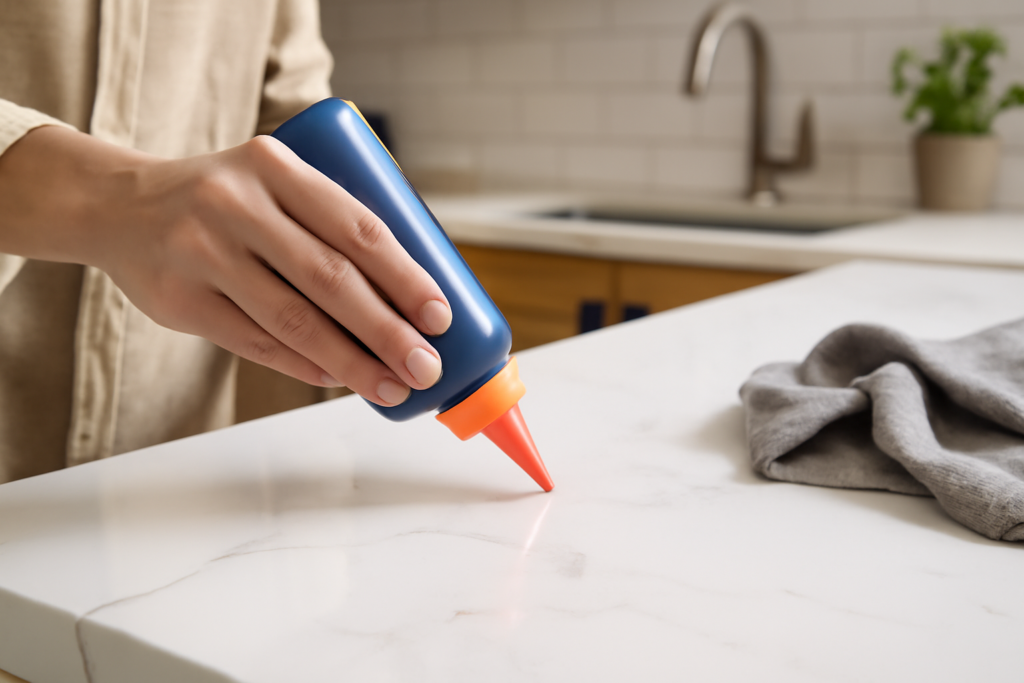
The answer to do quartz countertops need to be sealed is a flat no — not at installation, not annually, not ever. Engineered quartz is manufactured non-porous: the resin binder that holds the crushed stone together fills every void, so there’s nothing for a sealer to soak into and no pathway for wine or oil to penetrate. In fact, applying a stone sealer to quartz can leave a hazy, streaky film that’s a genuine pain to remove. Below is why quartz skips the ritual that granite owners live with, what confusion causes people to seal it anyway, and what quartz actually needs instead.
Part of our Countertops guide — explore the full guide →
- Why Quartz Is Non-Porous by Design
- What Happens If You Seal Quartz Anyway
- Why the Confusion Exists
- What Quartz Actually Needs Instead of Sealing
- How Quartz Compares on Sealing and Upkeep
- The Edge Cases People Ask About
- A Note on Seams, Edges, and the One Place Product Belongs
- Frequently Asked Questions
Why Quartz Is Non-Porous by Design
Natural stones like granite and marble are networks of mineral crystals with microscopic pores and capillaries between them. Liquids wick in, which is why an unsealed granite counter darkens under a water glass and why a lemon left on marble leaves a mark. Sealers work by soaking into those pores and clogging them with a repellent resin — a maintenance treatment you renew every one to three years as it wears.
Engineered quartz is built differently. Slabs are made by blending roughly 90 percent ground natural quartz with 7 to 12 percent polymer resin and pigments, then compacting the mix under intense vibration, vacuum, and pressure before curing it. The resin doesn’t just coat the particles — it fills the matrix completely. The cured slab has effectively zero absorbency; industry water-absorption tests on quartz typically measure under 0.05 percent, versus 0.1 to 0.4 percent or more for many granites. There are no pores to seal. That single manufacturing fact is the whole answer.
What Happens If You Seal Quartz Anyway
Since sealer can’t penetrate a non-porous surface, it has nowhere to go — so it dries on top as a film. The results, in ascending order of annoyance:
- Streaks and haze, especially visible on dark or glossy quartz under window light.
- A smeary layer that attracts grime and fingerprints, making the counter look perpetually dirty.
- Patchy sheen differences where the film wore unevenly under a dish rack or coffee maker.
Removal usually takes a dedicated sealer stripper or a lot of patient scrubbing with a non-abrasive pad and denatured alcohol — doable, but tedious, and abrasive shortcuts risk dulling the factory polish, which cannot be restored outside a fabrication shop. Some quartz manufacturers go further and note that applying topical treatments can void your warranty coverage for the affected damage. If a countertop salesperson or a handyman offers annual quartz sealing as a service, that’s a red flag about their stone knowledge in general.
Why the Confusion Exists
If the answer to do quartz countertops need to be sealed is so clearly no, why does the question keep coming up? There are three main sources. First, the name: “quartz” sounds like “quartzite,” and quartzite — the natural metamorphic stone — genuinely does need periodic sealing. Homeowners with quartzite are sometimes told they have “quartz,” and vice versa. Second, habit transfer: a family that owned granite for twenty years sealed it every spring, and the ritual carries over to the new quartz kitchen. Third, marketing: sealer brands sell “quartz-safe” polishes and protectants, which are largely cosmetic gloss products, not sealers in the impregnating sense — harmless-ish, but unnecessary and sometimes filmy.
Not sure which stone you own? Two quick tests
- The water test: pour a tablespoon of water on the counter and wait 15 minutes. If the stone visibly darkens under the puddle, it’s porous natural stone (granite, marble, quartzite) that wants sealing. If nothing changes, you almost certainly have quartz or another non-porous surface.
- Pattern check: quartz patterns repeat with factory regularity and often look “designed”; natural stone veining is irregular, with crystal sparkle and occasional pits or fissures on close inspection. Slab edges of quartz also look uniform through the thickness.
What Quartz Actually Needs Instead of Sealing
The honest maintenance list is short, which is exactly why people pay quartz’s premium:
- Daily: wipe with dish soap, warm water, and a microfiber cloth or soft sponge. That’s genuinely the whole regimen.
- Dried-on gunk: a plastic scraper or a non-scratch pad with a spray of all-purpose cleaner rated safe for quartz.
- Stubborn marks: a paste of baking soda and water, or an approved cleaner like Bar Keepers Friend Soft Cleanser used sparingly, then rinsed well.
- Avoid: bleach in sustained contact, oven cleaner, drain cleaner, paint stripper, trichloroethane-based solvents, and abrasive powders or steel wool. These attack the resin, and resin damage — unlike a stain on granite — is permanent.
- Heat discipline: trivets under hot cookware, always. Heat, not stains, is quartz’s real vulnerability, and no sealer would help with that anyway.
Notice what’s absent: waxing, polishing compounds, resealing appointments, and specialty stone soaps. The factory polish is the finish for the life of the counter. If your quartz looks dull, the cause is almost always residue — soap film, hard-water minerals, or a “protectant” someone applied — and the cure is cleaning, not coating. A 50/50 vinegar-water spray briefly used and rinsed will dissolve hard-water film on quartz (unlike on natural stone, mild acid contact is fine here), followed by a dry microfiber buff.
How Quartz Compares on Sealing and Upkeep
| Surface | Needs Sealing? | Frequency | Annual Upkeep Cost |
|---|---|---|---|
| Quartz (engineered) | No, never | — | $0 |
| Granite | Yes | Every 1–3 years | $20–$40 DIY / $150–$300 pro |
| Marble | Yes | Every 6–12 months | $25–$50 DIY |
| Quartzite (natural) | Yes | Every 1–3 years | $20–$40 DIY |
| Soapstone | No (optional mineral oil for looks) | Cosmetic only | $10–$20 |
| Butcher block | Oil, not sealer | Monthly to quarterly | $15–$30 |
| Solid surface (Corian) | No | — | $0 |
Over a 20-year kitchen, the sealing line item alone makes quartz a few hundred dollars cheaper to own than granite — modest, but it’s the convenience rather than the cash that owners cite. No spring resealing weekend, no anxiety when red wine sits overnight, no water-ring darkening around the faucet.
The Edge Cases People Ask About
“My installer said he sealed it — was that wrong?” Some fabricators wipe on a gloss enhancer at install for showroom shine. Unnecessary but not harmful if it was a quartz-specific product; just don’t renew it. “The area around my faucet looks different.” That’s mineral film from hard water, not penetration — vinegar-water, rinse, buff. “So do quartz countertops need to be sealed for heat or scratch protection at least?” No sealer on the market meaningfully changes heat or scratch behavior; those are resin-hardness properties, not surface-porosity properties. “What about honed or matte quartz?” Still non-porous, still no sealing — though matte finishes show fingerprints more and benefit from a dedicated matte-surface cleaner to avoid shiny buff spots.
A Note on Seams, Edges, and the One Place Product Belongs
While the slab surface never needs sealing, the installation around it does need occasional attention. The silicone caulk joints where quartz meets the backsplash, wall, and sink rim are wear items — inspect them yearly and recut and recaulk when they crack or pull away, because those joints, not the stone, are where water sneaks into cabinets. Seams between slab sections are filled with color-matched epoxy at install; they’re waterproof and permanent, but if a seam ever chips or opens after years of use, a stone repair tech can refresh it for $150 to $300. None of this is “sealing” in the granite sense — it’s ordinary joint maintenance that every countertop material shares, and it’s the only recurring task a quartz kitchen will ever put on your calendar.
The takeaway is refreshingly simple: quartz countertops need to be sealed exactly zero times over their entire life, and the best thing you can do for yours is put the sealer money toward good trivets and a stack of microfiber cloths. Clean it with soap and water, keep the harsh chemicals and hot pans away, and be politely skeptical of anyone selling you a quartz sealing service. If a water puddle ever darkens your counter, you own natural stone, not quartz — and that’s the only scenario in which the sealing aisle should ever see your face again.
Frequently Asked Questions
Do outdoor quartz countertops need to be sealed?
No, sealing does not help quartz outdoors either, because the slab is still non-porous. The real issue outside is sunlight: the resin in most engineered quartz can fade or yellow under prolonged UV exposure, and many manufacturers do not warranty standard quartz for outdoor use. For an outdoor kitchen, choose a product rated for exterior use or a natural stone suited to the climate.
Is quartz completely stain-proof?
Quartz is highly stain resistant but not indestructible. Because liquids cannot soak in, coffee, wine, and oil wipe off when cleaned promptly. Some substances can still mark the resin surface, such as permanent markers, strong dyes, and harsh chemicals like oven or drain cleaner. Wipe spills quickly, use a cutting board, and clean with mild soap rather than relying on any sealer.


