Most DIYers strip a bit or burn out a regular drill within ten seconds of trying to bore into a slab. To drill into concrete successfully, you need a hammer drill, a carbide-tipped masonry bit, and a slow, deliberate technique that lets the tool do the chipping rather than your shoulder. Get those three things right and a 1/4-inch hole takes less than 30 seconds.
- Why a Regular Drill Fails on Concrete
- The Right Tool: Hammer Drill vs Rotary Hammer
- Masonry Bits: Carbide Is Non-Negotiable
- Depth-Stop Technique That Saves Your Knees
- Step-by-Step: How to Drill Into Concrete
- Anchor Types and When to Use Each
- What to Do When You Hit Rebar
- Safety Gear You Actually Need
- Frequently Asked Questions
Why a Regular Drill Fails on Concrete
Concrete is roughly 3,000 to 5,000 PSI compressive strength once cured, which means twisting a steel bit against it gets you almost nowhere. A standard cordless drill rotates the bit, but concrete laughs at rotation alone. You need percussive impact combined with rotation, which is exactly what a hammer drill or a rotary hammer delivers.
A hammer drill pulses the chuck forward thousands of times per minute, fracturing the aggregate so the bit’s flutes can clear the dust. Try this with a wood drill and you will overheat the motor, glaze the bit tip, and walk away with a shiny dimple in the slab.
The Right Tool: Hammer Drill vs Rotary Hammer
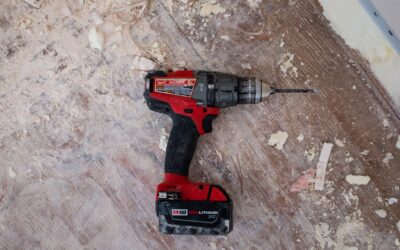
For typical homeowner work, hanging a TV mount, anchoring a shelf, fastening a baseplate, a corded or 18V/20V hammer drill is enough. The DeWalt DCD996 and Milwaukee 2804-20 both deliver around 25,000 BPM and handle holes up to 1/2 inch in standard concrete.
For anything bigger than 1/2 inch, or for hard old concrete with river rock aggregate, step up to an SDS-Plus rotary hammer like the Bosch GBH2-28L. SDS bits lock into the chuck and transfer far more energy per blow than a smooth-shank bit gripped in a keyless chuck.
Masonry Bits: Carbide Is Non-Negotiable
The cutting edge must be a brazed carbide tip. High-speed steel bits will dull on the first hole. Look for bits labeled “masonry,” “concrete,” or “SDS-Plus carbide.” Bosch Bulldog Xtreme and Milwaukee MX4 are reliable midrange picks at $4 to $12 per bit depending on diameter.
Match the bit diameter to your anchor. A 1/4-inch sleeve anchor needs a 1/4-inch hole. A 3/8-inch wedge anchor needs a 3/8-inch hole. The hole has to be the exact size, not oversized, or the anchor will spin instead of grip.
Depth-Stop Technique That Saves Your Knees
Every hole needs to be drilled slightly deeper than the anchor is long, usually anchor length plus 1/4 inch to leave room for dust. Eyeballing depth wastes time and causes anchors to bottom out before they seat. Two methods work well.
The cleanest option is the depth-stop rod that ships with most hammer drills. Slide it into the bracket on the side handle, set it to your target depth, and the rod hits the slab when you reach the line. If you lost yours, wrap a piece of bright masking tape around the bit at the target depth. When the tape brushes the surface, stop.
Step-by-Step: How to Drill Into Concrete
- Mark the spot with a pencil or masking tape X. Tape also reduces surface chipping at the bit entry.
- Start on rotation only at low speed for the first 1/8 inch to keep the bit from skating.
- Engage hammer mode once the bit bites. Hold the drill perpendicular to the surface with both hands.
- Apply moderate pressure, about 15 to 20 pounds. Let the hammer action do the work. Excessive pressure overheats the carbide.
- Pull out every few seconds to clear concrete dust from the flutes. Trapped dust is the number one cause of slow drilling and broken bits.
- Stop at depth, then vacuum or blow out the hole with a hand pump. Dust left in the hole reduces anchor holding power by up to 50 percent.
Anchor Types and When to Use Each
The fastener you choose dictates the hole and the holding strength. Picking the wrong anchor is how shelves end up on the floor at 2 a.m.
- Plastic conical anchors: Lightweight loads under 30 lb such as picture frames, smoke detectors, small shelves. Cheap and forgiving.
- Tapcon screws: Self-threading concrete screws for medium loads up to roughly 200 lb in shear. Great for furring strips, electrical boxes, and ledger boards.
- Sleeve anchors: Expanding sleeve grips the hole walls. Good for 100 to 500 lb in pull-out, depending on diameter.
- Wedge anchors: Heaviest-duty mechanical anchor. Use for handrails, gates, machinery, and structural baseplates. A 1/2-inch wedge anchor in solid concrete pulls out around 4,000 lb.
- Epoxy anchors: Two-part adhesive systems like Simpson SET-XP for cracked concrete or applications near edges. Highest holding capacity but require clean, dust-free holes.
What to Do When You Hit Rebar
If the bit suddenly stops advancing and the chuck whines, you have hit rebar. Do not push harder, you will burn the bit and possibly weaken the structure. Pull out, move the hole 2 to 3 inches over, and try again. If you must drill through rebar for the location to work, switch to a rebar-cutting bit such as the Bosch Rebar Cutter or DeWalt Rebar Demon, which has carbide teeth designed to slice steel inside concrete.
Safety Gear You Actually Need
Concrete dust contains crystalline silica, which is regulated by OSHA for a reason. Inhaling it long-term causes silicosis. For occasional homeowner use, an N95 mask, sealed safety glasses, and hearing protection (rotary hammers easily exceed 100 dB) are the minimum. Wear gloves with vibration dampening if you are drilling more than a few holes, hand-arm vibration syndrome is real.
Frequently Asked Questions
Can I drill into concrete with a regular cordless drill?
Only into very thin or very old, soft concrete using a sharp masonry bit, and even then it will be painfully slow. For any reliable result, use a hammer drill.
Why is my masonry bit not making progress?
The bit is dull, the hammer function is off, or dust is packing the flutes. Pull out, clear the hole, and check that the drill is set to hammer-and-rotate mode rather than rotation only.
How deep should I drill for an anchor?
Anchor length plus 1/4 to 1/2 inch to give dust somewhere to settle. Shorter and the anchor bottoms out before fully seating.
Do I need to wet the concrete while drilling?
No, water-cooled drilling is for diamond core bits on large holes. For standard masonry bits, drill dry and clear dust frequently.
Can I drill through a concrete foundation wall?
For full pass-through holes, you will likely need an SDS-Max rotary hammer or a diamond core bit and a contractor. DIY hammer drills generally top out around 4 to 6 inches of penetration.