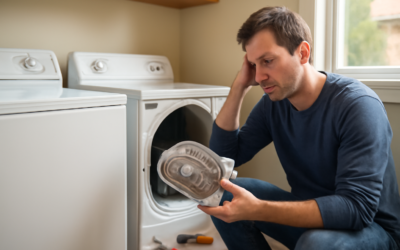
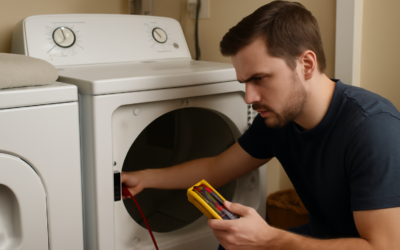
A dryer running but not heating is a very specific clue, and it works in your favor. When the drum tumbles normally, the timer advances, and the light comes on, but the clothes stay cold, you know the motor, belt and controls are healthy. The fault is isolated to the heat circuit, which turns a vague problem into a short list of testable parts.
Unplug the dryer or shut off its breaker before you open a panel. Electric dryers carry 240 volts, and gas models add a live gas line. That one habit keeps every repair below safe.
- Why the Drum Spins but There’s No Heat
- First Check: The Vent
- Cause 1: Blown Thermal Fuse
- Cause 2: Heating Element (Electric)
- Cause 3: Thermostats and Thermal Cut-Off
- Cause 4: Gas Igniter, Flame Sensor or Valve (Gas)
- Cause 5: Lost 240-Volt Leg (Electric)
- Diagnostic Checklist
- DIY Cost vs. Calling a Pro
- Things That Look Like No Heat but Aren’t
- Reading Error Codes
- Cost, Payback, and Prevention
Why the Drum Spins but There’s No Heat
Understanding the wiring explains the symptom. An electric dryer’s motor runs on 120 volts, while the heating element needs the full 240 volts. If one of the two hot legs is lost, or a safety device in the heat circuit opens, the motor keeps spinning on 120 volts while the element gets nothing. The result is a dryer that runs perfectly and heats not at all.
On a gas dryer the motor also runs on 120 volts, and the heat comes from a burner. So a gas dryer that spins without heat points at the igniter, flame sensor or gas valve rather than an electrical element.
First Check: The Vent
Before replacing any part, rule out a clogged exhaust vent. Trapped heat trips the dryer’s safety devices, and once a thermal fuse blows from a backed-up vent, you get exactly this symptom: the drum runs, the heat is dead. Disconnect the transition hose, clear any lint, and confirm strong warm airflow at the outside hood during a short cycle.
A blocked vent is also the top cause of dryer fires, so this step is safety, not just diagnosis. If the vent is clear and the heat is still gone, work through the parts below.
Cause 1: Blown Thermal Fuse
The thermal fuse is a one-time safety device on the blower housing or exhaust duct. When the machine overheats it blows and cuts power to the heating element or igniter, and it never resets. This is the most common reason a dryer runs but will not heat. The part costs $6 to $15.
Test it with a multimeter on ohms. Near zero means good; infinite (OL) means blown. Critically, a thermal fuse almost always blows because of a restricted vent, so clean the exhaust before installing a new one or the replacement will fail within a few loads.
Cause 2: Heating Element (Electric)
The heating element is a nichrome coil in a housing behind the drum or in a rear duct. It burns through or shorts to its housing with age, killing the heat while the drum keeps turning. Measure across the element terminals; a good element reads about 8 to 15 ohms, and an open one reads infinite.
Replacement elements cost $18 to $50 by brand. The swap involves removing the back panel, disconnecting two wires and a few screws, and sliding in the new element. Plan on 30 to 45 minutes.
Cause 3: Thermostats and Thermal Cut-Off
Dryers stack several thermal safeties: a cycling thermostat that regulates temperature, a high-limit thermostat, and a thermal cut-off. Any of these opening will stop the heat while leaving the motor untouched. Test each for continuity; a good one reads near zero ohms cold, and an open one reads infinite.
Thermostat kits run $10 to $25. A tripped high-limit thermostat, like a blown fuse, is usually a symptom of poor airflow, so confirm the vent is clear before replacing it. Replace paired safety components as a set for lasting reliability.
Cause 4: Gas Igniter, Flame Sensor or Valve (Gas)
On a gas dryer the igniter glows red-hot, the flame sensor verifies the heat, and the gas valve coils open to light the burner. A cracked igniter that no longer glows is the classic cause of a gas dryer that runs cold. The igniter runs $15 to $35.
Watch the burner through the inspection port during a cycle. Igniter glows but no flame appears? The gas valve coils are likely bad, about $30. Igniter never glows? It is open, or a fuse or thermostat upstream has cut its power. You are working near a gas line, so shut the gas valve at the dryer, never test for leaks with a flame, and stop and call a licensed technician if you smell gas.
Cause 5: Lost 240-Volt Leg (Electric)
This one deserves its own look because it perfectly explains a dryer that runs without heat. A double-pole breaker can trip on only one of its two poles. The dryer then has 120 volts for the motor and light but nothing for the element. Reset the breaker fully off, then on. In an older fuse box, replace both 30-amp cartridge fuses. Inspect the outlet for scorch marks, which mean a loose, overheating connection that needs attention before it becomes a fire.
Diagnostic Checklist
- Unplug the dryer or shut the breaker first.
- Clear the vent and confirm strong outside airflow.
- Reset the breaker or replace both fuses to restore 240 volts.
- Test the thermal fuse with a meter.
- Test the heating element or the gas igniter.
- Test the high-limit thermostat and thermal cut-off.
- Replace matched safety parts together.
DIY Cost vs. Calling a Pro
A homeowner fix for a dryer running but not heating usually costs $10 to $50 in parts, against $150 to $300 for a professional service call. That math strongly favors DIY for fuses, elements, thermostats and igniters, each of which tests in five minutes with an inexpensive multimeter. Call a pro if you smell gas, if the unit is under warranty, or if an electronic control board is throwing codes, since a board can cost $200 or more and needs proper diagnosis.
To keep the heat from disappearing again, clean the lint screen every load and the entire vent path once a year. Nearly every blown fuse and tripped thermostat traces back to restricted airflow, so a clear exhaust is both the cure and the prevention, and it keeps a lint fire out of your home.
Things That Look Like No Heat but Aren’t
Sometimes the heater is working fine and something else is stealing the result. A packed lint screen or a blockage in the blower wheel can strangle airflow so completely that hot air never carries the moisture out, so the drum turns, the element glows, and the clothes still come out damp. Clean the screen every load, and wash it in warm soapy water monthly to remove the invisible dryer-sheet film that quietly cuts airflow.
Double-check the cycle, too. An air-fluff or fluff-only setting spins the drum with no heat on purpose, and it’s an easy accidental bump. On moisture-sensing models, softener residue on the metal sensor bars inside the drum can end the cycle early while the load is still wet, so wipe those bars with rubbing alcohol. These non-heat causes are worth two minutes before you buy any part.
Reading Error Codes
Dryers with a digital display often announce a temperature fault with a code instead of just going cold. A thermistor or sensor code calls for a different part than a blown element or a bad igniter, so look up your model’s exact code before you disassemble anything. On an electronically controlled machine, matching the code to the right component saves you from buying parts you don’t need.
Cost, Payback, and Prevention
Weigh the repair against the machine’s age. Fixing the heat circuit runs $10 to $50 in parts for a DIY job, versus $150 to $300 for a service call, so the mechanical fixes pay for themselves easily on a dryer with years left in it. If the fault lands on an electronic control board, $150 to $250, and the dryer is more than a decade old, replacement often makes better sense.
Whatever you replace, prevention comes down to airflow. A restricted vent is what backs up heat and blows the safeties that leave you with a dryer running but not heating in the first place. Clean the lint screen every load, clear the vent to the exterior hood once a year, and keep the transition hose behind the dryer from being crushed. Keep the air moving and the heat stays where it belongs, in your clothes, and a dangerous lint fire stays out of your home.