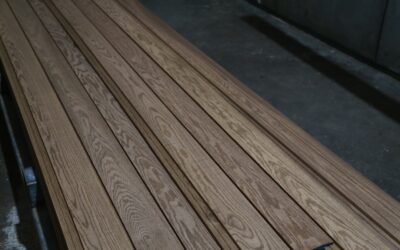
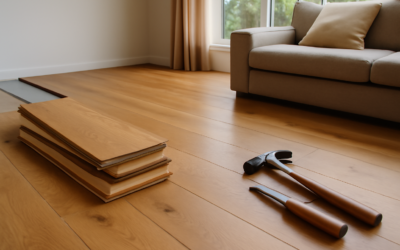
Red oak has been the default American hardwood for generations, and it is now just as common in engineered form. Engineered red oak flooring pairs a real red oak top layer with a stable plywood or hardwood core, so it looks like the solid floors in older homes while handling basements, concrete slabs, and humid climates far better. The most important number on the box is the wear-layer thickness: it decides whether the floor can be sanded and refinished once, several times, or not at all.
Engineered red oak keeps the species’ bold, open grain and warm pink-to-salmon undertone, takes stain readily, and usually costs less than premium white oak. It beats solid red oak below grade, over radiant heat, and over concrete. Solid still wins when you want the maximum number of refinishes over a century of use. Here is what to look for and how to decide.
- What Is Engineered Red Oak Flooring?
- Red Oak Grain and the Pink Undertone
- Wear-Layer Thickness and Resanding
- Where Engineered Beats Solid Red Oak
- Installation Methods
- Buying Checklist
- Troubleshooting Common Issues
- Caring for an Engineered Red Oak Floor
- Cost Ranges
- When to Call a Pro
- Frequently Asked Questions
What Is Engineered Red Oak Flooring?
Every engineered hardwood plank has two parts. The top is the wear layer (also called the veneer or lamella), a slice of real red oak. Beneath it is a core of cross-laminated plywood, multi-ply hardwood, or a stable fiber board. Because the core layers run in alternating directions, the plank resists the cupping and gapping that solid boards experience when humidity swings.
Engineered red oak and red oak engineered hardwood are the same product described two ways. The look on the floor is identical to solid once installed, since you only see the top face.
How the wear layer is cut
- Sawn-face veneer: sliced with a saw like solid lumber. Shows the most natural grain and handles moisture changes best.
- Sliced veneer: cut with a blade from a softened log. Grain looks close to sawn.
- Rotary-peeled veneer: unrolled from a spinning log like paper. Cheapest, with a wavy, plywood-like grain pattern that some people notice.
If the authentic red oak look matters, ask which cut the product uses. Sawn and sliced faces look most like traditional floors.
Red Oak Grain and the Pink Undertone
Red oak has a pronounced cathedral grain on plain-sawn boards, with open pores that soak up stain. Its natural color ranges from light tan to a distinct pink or salmon, and that undertone shows through clear finishes and light stains. In engineered form, the undertone is the same as solid, because the wear layer is real red oak.
How to work with the pink:
- Medium and dark stains (walnut, chestnut, espresso) cover it well and look rich on open red oak grain.
- Natural or clear finishes show the warmth honestly; many people love this traditional look.
- Light, gray, or Scandinavian finishes are harder. The pink can turn gray stains muddy or slightly purple. White oak is usually easier for that palette.
Prefinished engineered red oak arrives with a factory stain and finish, so you see the final color in the showroom. Unfinished engineered planks can be stained on site like solid wood.
Wear-Layer Thickness and Resanding
The wear layer is the only part of the plank that can be sanded. A full sanding typically removes roughly 1/32 inch or a bit more, depending on the floor’s flatness and the sander operator. Use these general guidelines:
| Wear layer | Typical refinish potential |
|---|---|
| Under 1 mm | Recoat only; no sanding |
| 1 to 2 mm | Possibly one light sanding by a skilled pro |
| 3 mm | About one to two full sandings |
| 4 to 6 mm | Several sandings, approaching solid |
Even a thin wear layer can be refreshed with a screen and recoat, which scuffs the top finish and adds a new coat without cutting into wood. That handles most everyday wear. Deep scratches, pet damage, or a color change require full sanding, which is where a thicker wear layer pays off.
Microbevels also matter. Prefinished planks with beveled edges lose that bevel detail if heavily sanded, so a floor might look different after refinishing.
Where Engineered Beats Solid Red Oak
- Basements and below-grade rooms: solid hardwood is not recommended below grade. Engineered planks are often approved with a proper moisture barrier.
- Over concrete slabs: engineered red oak can be glued down or floated over a slab, while solid needs a plywood subfloor.
- Radiant heat: the stable core handles temperature cycling better. Check the maker’s radiant guidelines.
- Humid or dry climates: less seasonal gapping and cupping.
- Wide planks: wide solid oak boards move a lot; engineered stays flatter at 7 inches and up.
- Height constraints: thinner engineered planks help where door clearances and transitions are tight.
Where solid red oak still wins
Solid 3/4-inch red oak can be sanded many times over its life and is easy to patch with matching boards from a lumberyard. In a main-level home with a wood subfloor and stable humidity, solid is a durable, long-term choice. For historic homes being matched, solid often blends best.
Installation Methods
- Nail or staple down: over plywood subfloors; traditional feel.
- Glue down: over concrete or plywood; solid underfoot and quiet.
- Floating: click-lock engineered red oak over an underlayment; fastest DIY method.
Acclimate according to the maker’s instructions, check subfloor flatness (often within 3/16 inch over 10 feet), and test concrete moisture before gluing or floating. Leave expansion gaps at walls covered by baseboard or shoe molding.
Removing old flooring in an older home needs care. Vinyl tile, sheet flooring, and black mastic installed before the 1980s can contain asbestos; have them tested before disturbing. Wear a respirator when cutting planks or sanding.
Buying Checklist
- Confirm the wear-layer thickness in millimeters and the veneer cut.
- Check the core type: multi-ply hardwood or plywood cores are generally more stable than lower-cost fiber cores.
- Look at plank width and length mix; longer boards look more upscale.
- Review the finish type (aluminum oxide urethane, hardwax oil) and its maintenance needs.
- Read warranty terms for moisture, below-grade use, and radiant heat.
- Order 7 to 10 percent extra for cuts and future repairs.
- View samples in your own light next to cabinets and trim, since the pink undertone shifts with lighting.
Troubleshooting Common Issues
Gaps in winter. Low indoor humidity. Engineered moves less than solid but still responds; a humidifier keeping relative humidity in the 35 to 55 percent range helps.
Hollow sounds in a floating floor. Usually an uneven subfloor. Small dips can be filled under a few planks; widespread hollows mean the subfloor needed leveling.
Edge peaking or delamination. Moisture from below or a leak. Find and fix the source; delaminated planks must be replaced.
Finish wearing in traffic lanes. Schedule a screen and recoat before the finish wears through to bare wood.
Caring for an Engineered Red Oak Floor
Daily care is the same as solid hardwood. Sweep or vacuum with a hard-floor setting to remove grit, which acts like sandpaper underfoot. Damp-mop with a cleaner made for finished wood floors, wringing the mop nearly dry; never wet-mop or steam-clean, since water can work into seams and reach the core. Felt pads under furniture, mats at exterior doors, and trimmed pet nails prevent most scratches.
Engineered red oak flooring with a factory aluminum oxide finish often goes many years before needing a recoat. Hardwax oil finishes need periodic maintenance coats but allow spot repairs without sanding the whole room. Keep a box of spare planks from the original order so damaged boards can be replaced with a perfect color match.
Cost Ranges
Engineered red oak often lands in the low-to-mid range for real hardwood materials, typically less than engineered white oak of the same spec. Thin wear layers and rotary-peeled faces are cheapest; thick sawn-face planks with multi-ply cores cost more. Professional installation adds a per-square-foot labor charge that varies by method, with glue-down typically costing more than floating. Prices vary widely by region and plank width.
When to Call a Pro
Hire an installer for glue-down work over concrete, for subfloors that need leveling, and for stair treads and nosings. Any refinish on an engineered floor should be done by an experienced sanding pro who can measure the wear layer first, since a heavy-handed pass can expose the core.
Frequently Asked Questions
Can engineered red oak flooring be refinished?
Yes, if the wear layer is thick enough. Around 3 mm usually allows one or two full sandings, and 4 mm or more allows several. Thinner layers can still be screened and recoated.
Is engineered red oak cheaper than white oak?
Usually. Red oak is more plentiful and generally costs less than white oak in comparable engineered constructions, though prices vary by grade and width.
Can I install engineered red oak in a basement?
Many engineered products are approved below grade with a moisture barrier, unlike solid hardwood. Test the slab’s moisture and follow the maker’s instructions.
Does engineered red oak look different from solid?
Not once it is installed, since the visible face is real red oak. Rotary-peeled veneers can show a less natural grain pattern, so ask about the cut.
Can engineered red oak be stained gray?
It can, but the pink undertone often makes gray look muddy. Test stains on spare planks, or consider white oak if a cool gray floor is the goal.
Prefer to explore on your own?
See how new flooring looks in your actual room in seconds — free, no signup.
Try the free Floor Studio →