Choosing between fiberglass vs cellulose insulation is one of the most common decisions homeowners face during renovations or new builds. Both materials have been used in residential construction for decades, and each has genuine strengths depending on your climate, budget, and project scope. Getting this choice right can shave hundreds of dollars off your annual heating and cooling bills while keeping every room comfortable year-round.
How R-Value Stacks Up
R-value measures thermal resistance per inch of material thickness, and the numbers between these two products are closer than most people expect. Fiberglass batts deliver roughly R-3.2 to R-3.8 per inch, while blown-in fiberglass hits R-2.2 to R-2.7 per inch. Cellulose, almost always installed as blown-in loose-fill, lands at R-3.2 to R-3.8 per inch as well.
The real-world difference shows up in air sealing. Cellulose packs more densely into wall cavities and attic spaces, which reduces air infiltration. Fiberglass batts, by contrast, leave gaps around wiring, plumbing, and irregular framing if they are not carefully cut and fitted. Dense-pack cellulose in a 2×6 wall cavity achieves about R-20, while an R-19 fiberglass batt in the same cavity often underperforms due to compression and voids.
Material Cost Breakdown
On a pure material basis, cellulose is the cheaper option. Blown-in cellulose runs $0.60 to $1.00 per square foot at R-30 coverage in an attic. Fiberglass batts cost $0.65 to $1.20 per square foot for R-30, and blown-in fiberglass falls between $0.80 and $1.50 per square foot at the same R-value.
Labor shifts the equation. Installing fiberglass batts is straightforward enough for a confident DIYer, keeping labor costs at zero for handy homeowners. Blown-in cellulose requires a blowing machine, which home improvement stores like Home Depot often rent for around $50 to $100 per day when you purchase the material from them. Professional installation for cellulose averages $1.00 to $1.50 per square foot total, while fiberglass batt installation by a contractor runs $1.20 to $2.00 per square foot.
Fire and Moisture Performance
Fiberglass is naturally non-combustible. It will not ignite, and it does not need chemical treatment to resist fire. Cellulose, made from recycled newspaper, is treated with borate compounds to achieve a Class 1 fire rating. The borates also discourage mold growth and deter insects, which gives cellulose a useful secondary benefit.
Moisture behavior differs significantly. Fiberglass does not absorb water, but when it gets wet, it loses its insulating value and can harbor mold on surrounding surfaces. Cellulose absorbs moisture, buffers humidity fluctuations, and releases it slowly. However, if cellulose stays saturated for an extended period, it compacts and loses R-value permanently. In flood-prone crawl spaces or basement rim joists, closed-cell spray foam often outperforms both options.
Installation Differences
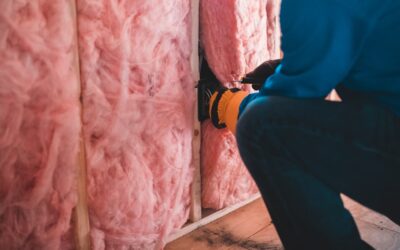
Fiberglass batts come in pre-cut rolls sized for standard 16-inch and 24-inch on-center framing. You unroll them, cut to length with a utility knife, and press them into the cavity. The process is simple but tedious. Every electrical box, pipe, and wire requires a custom cut, and even small gaps reduce performance.
Cellulose installation involves feeding bales of material into a blowing machine and directing the hose into cavities or across an attic floor. For open attic spaces, the process takes a two-person crew about two to four hours for a 1,200 sq ft attic. Dense-pack cellulose in enclosed walls requires drilling access holes, filling the cavity, and patching the holes afterward, which adds time and finish work.
- Attic open-blow: Cellulose is faster and fills around obstacles automatically
- New construction walls: Batts install quickly before drywall goes up
- Retrofit walls: Dense-pack cellulose wins because it does not require opening the wall fully
- Basement rim joists: Cut-and-fit fiberglass batts or rigid foam boards are easier to handle
Sound Dampening
Both materials reduce noise transfer, but cellulose has a measurable edge. Its higher density absorbs more sound energy across a broader frequency range. In STC (Sound Transmission Class) tests, a standard 2×4 wall insulated with cellulose scores around STC 38, versus STC 34 to 36 for fiberglass batts. If you are insulating between a bedroom and a home theater, or between floors in a two-story house, cellulose delivers noticeably quieter results.
Environmental Impact
Cellulose contains 80% to 85% recycled content, primarily post-consumer newspaper. Its manufacturing process uses far less energy than fiberglass production, which requires melting glass at over 2,500 degrees Fahrenheit. Fiberglass typically contains 30% to 40% recycled glass content, and its energy-intensive production leaves a larger carbon footprint per R-value delivered.
On the job site, fiberglass releases tiny glass fibers that irritate skin, eyes, and lungs. Proper PPE including long sleeves, goggles, gloves, and an N95 respirator is essential. Cellulose creates dust during blowing but does not carry the same skin irritation risk, though a dust mask remains necessary.
Longevity and Settling
Fiberglass batts maintain their thickness and R-value for the life of the home, assuming they stay dry and undisturbed. Cellulose settles over time. In an attic, expect 10% to 20% settling within the first few years. Professional installers account for this by over-filling to a calculated depth. A competent installer will blow cellulose to R-38 knowing it will settle to R-30 or slightly above.
In wall cavities, dense-pack cellulose at 3.5 pounds per cubic foot or higher resists settling almost entirely. Fiberglass batts in walls can sag over decades if they were not properly supported or if moisture compromised their facing. Neither material needs replacement on a fixed schedule, but checking attic insulation depth every five to ten years is sound practice regardless of material.
Which One Should You Choose?
For attic retrofits, cellulose is hard to beat. It fills gaps automatically, costs less per R-value, and provides superior air sealing. For new construction walls where cavities are open, fiberglass batts offer a simple, reliable, and DIY-friendly installation. If noise reduction matters, lean toward cellulose. If you are working in a moisture-prone area like a crawl space, fiberglass or spray foam makes more sense.
Budget-conscious homeowners doing attic work themselves should consider renting a blower and using cellulose. The total cost for a 1,000 sq ft attic at R-38 typically runs $500 to $800 in materials plus the machine rental. The same job with fiberglass batts costs $650 to $1,100 in materials alone. Whichever material you choose, achieving the right R-value for your climate zone matters far more than the insulation type itself.