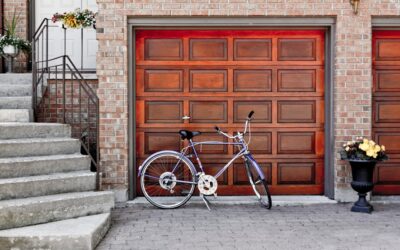
A garage door that refuses to close is the most common after-hours garage call in the country — and 70 percent of the time, the fix takes less than three minutes and zero dollars. Pros at Precision Door, A1 Garage Doors, and Sears Home Services bill $135 to $250 just for the diagnostic, and most leave with the truth: a spider web blocked the safety sensor. The garage not closing problem follows a predictable diagnostic ladder, and any homeowner with a flashlight and a step stool can work through it before paying anyone.
Start with the Photo-Eye Safety Sensors
Every garage door opener installed in the US since 1993 has photo-eye sensors mounted near the floor on each side of the opening, required by the Consumer Product Safety Act after a series of fatal entrapment cases. When the beam between sensors breaks, the door refuses to close. Common culprits include misalignment, dirty lenses, sun glare, spider webs, and the kid’s bicycle parked against the bracket.
Both sensor LEDs should glow steadily — typically one green and one red on LiftMaster, Chamberlain, and Genie units. A blinking LED means misalignment. Loosen the wing nuts on each bracket, eyeball both sensors at the same height (the CSPA requires no more than 6 inches above the floor), and tighten. Wipe the lenses with a microfiber cloth. If a halogen work light or low afternoon sun aims directly at the sensor, install a sensor sun shield ($12 from Liftmaster) or relocate the bracket.
Check the Remote and Wall Button
If the door closes from the wall button but not the remote, the remote battery is dying. Most LiftMaster Security+ 2.0 remotes use CR2032 or CR2025 coin cells ($4 per 10-pack on Amazon). Genie Intellicode remotes use the same. Chamberlain remotes often use AAA. Pop the back cover and swap the battery.
Re-pair the remote by pressing the LEARN button on the motor head (under the lens cover) until the LED illuminates, then pressing the remote button within 30 seconds. The motor beeps or clicks to confirm pairing. Newer myQ-enabled openers (Chamberlain B6753T, LiftMaster 8500W) pair through the myQ app — verify your home Wi-Fi is online and the app shows the unit as connected.
Inspect the Tracks and Rollers
A bent track or seized roller stops the door mid-travel and signals the opener to reverse. Walk both side tracks and look for kinks, twists, or visible dents. Use a 3-foot level along the vertical sections — tracks should be plumb within 1/8 inch. Loose bracket bolts let tracks drift over time; tighten with a 7/16-inch socket and a torque setting of 10 foot-pounds.
Inspect each roller. Nylon rollers (the quiet kind) crack with age and freeze in the track. Steel rollers with sealed bearings hold up better but eventually grind. Replace damaged rollers with Stanley nylon rollers ($25 for 10) or LiftMaster steel rollers ($35 for 10). Lubricate hinges, springs, and rollers with white lithium spray (3-in-1 Garage Door Lube, $7) — never WD-40, which attracts dirt and gums up tracks.
Spring Issues That Stop the Door
Torsion springs above the door bear the entire weight of the door (typically 150 to 400 pounds). A broken spring stops the opener from completing a close cycle because the motor cannot safely lower the unsupported weight. Look for a visible 2 to 3-inch gap in the spring coil along the shaft above the door.
Spring replacement is the most dangerous garage door repair — released energy can cause serious injury. Do not attempt without proper winding bars and torsion experience. Hire a licensed garage door technician ($250 to $400 for a single spring, $350 to $550 for a pair). Companies like Precision Door, A1 Garage Doors, and local IDA-certified installers carry the correct gauge wire (typically 0.243 to 0.273 inches) and inside diameter (1 3/4 to 2 inches) for your door weight class.
Force and Travel Limit Adjustments
Openers learn the floor position the first time they close. After replacing rollers, tracks, or springs, the limits may need re-learning. On LiftMaster wall consoles, hold the down arrow and the lock button for 6 seconds to enter program mode, then cycle the door once. On Chamberlain openers, use the up and down adjustment screws on the motor head — 1/4 turn moves the limit roughly 2 inches.
If the door closes but reverses before fully shutting, the close-force is set too low. Adjust the close-force dial on the motor head by 1/4 turn at a time. Always test that the door reverses on a 2×4 placed flat on the floor — this is the federally required safety reverse test under UL 325 standards.
Power Issues and Smart Disconnects
Some openers have power lock features that lock the motor during power outages. Pull the emergency release cord (the red rope hanging from the trolley) to disconnect the door from the opener, manually open and close to confirm operation, then re-engage by lifting the trolley arm.
If the LED on the opener flashes a specific count, check the manual for fault codes. A blinking 1 typically signals a safety sensor problem, blinking 2 indicates a force fault, and blinking 3 to 5 cover travel and power issues. LiftMaster, Chamberlain, and Genie all publish fault code charts on their websites — Google “myQ fault code 1-3” or similar for fast resolution.
When to Call a Professional
Call a pro for any broken spring, cable failure, bent panel, or motor unit older than 15 years showing inconsistent behavior. Garage door industry data from the International Door Association shows that openers last 10 to 15 years and complete repairs run $250 to $600. A full opener replacement (LiftMaster 84602, Chamberlain B6753T, or Genie SilentMax 1200) costs $400 to $850 installed and resets the 10-year clock.
Always get a written estimate before authorizing work. Reputable companies belong to the International Door Association (IDA) and carry general liability insurance. Avoid the door-to-door scammers who insist your “spring is dangerous” and pressure you to sign immediately. The garage not closing problem almost always traces to a simple fix you can handle yourself — only the small percentage that involve springs, cables, or motor failures justify a service call.