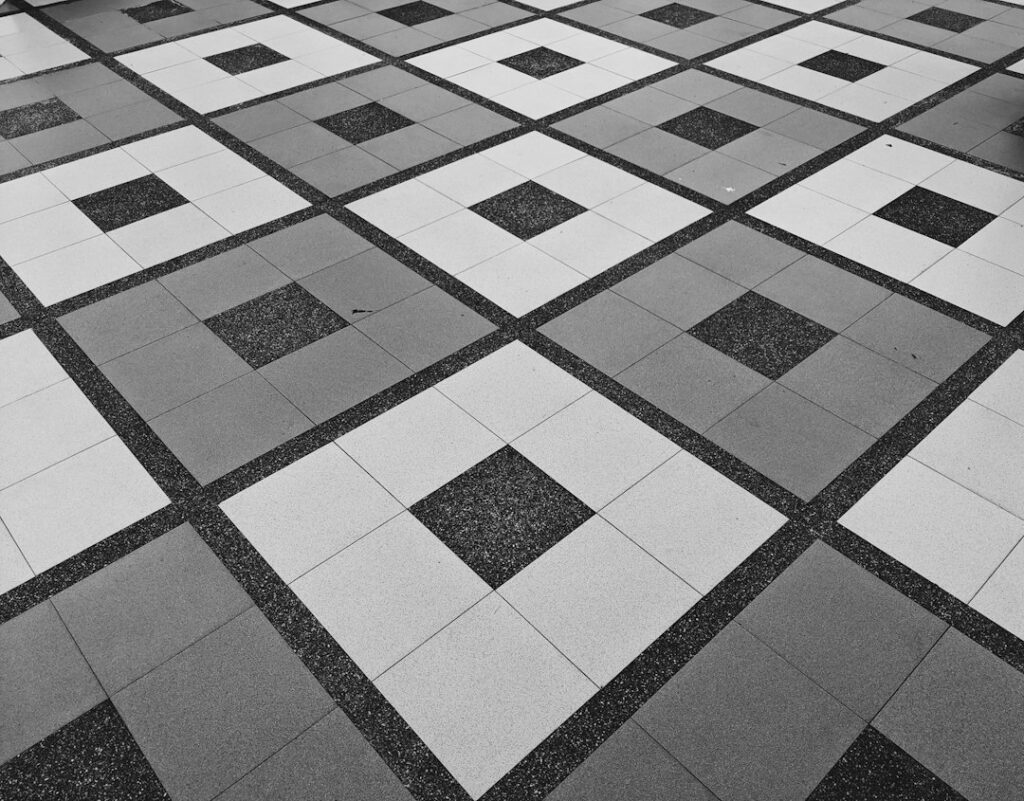
A plain floor fades into the background; a patterned one becomes the first thing people talk about. Geometric floor tile uses repeating shapes such as hexagons, triangles, chevrons, and star-and-cross patterns to turn an ordinary bathroom, entry, or kitchen into a design statement. The catch is that bold patterns magnify every layout error, from an off-center starting line to a skinny cut along a wall. With the right tile choice and a careful plan, though, geometric designs are well within reach for homeowners and their installers. Here is how to choose, budget, and lay them out successfully.
Part of our Tile & Grout guide — explore the full guide →
- Popular Geometric Floor Tile Shapes and Patterns
- Material Options: Porcelain, Cement, and Ceramic
- Room-by-Room Ideas
- Planning the Layout Before You Buy
- Installation Tips and Labor Costs
- Grout Color: The Detail That Changes Everything
- Cleaning and Long-Term Care
- Budgeting a Geometric Tile Floor
- Is Geometric Floor Tile Worth It?
Popular Geometric Floor Tile Shapes and Patterns
Geometric tile falls into two broad groups: tiles whose shape creates the pattern, and square tiles with a printed or encaustic design. Knowing the difference helps you understand labor costs and the look you will get.
Shape-Driven Tiles
- Hexagon: the most popular shape, from 1-inch mosaics to 10-inch and larger porcelain. Small hex reads vintage; large hex feels modern.
- Elongated hexagon and picket: stretched shapes that create a directional, contemporary look.
- Triangle: equilateral triangles in two or three colors form stars, diamonds, and cubes.
- Rhombus or diamond: three shades of a diamond tile produce the classic 3D tumbling-block illusion.
- Arabesque and lantern: curved outlines that interlock, softening a geometric floor.
- Fish scale and scallop: fan-shaped tiles, better suited to smaller floors and walls.
Pattern-Printed Squares
Square tiles, usually 8 x 8 inches, carry the geometry in their face design. Arranged together, they form larger repeating motifs, such as interlocking circles, stars, or Moroccan-inspired medallions. These install as simply as ordinary square tile, which keeps labor down.
Material Options: Porcelain, Cement, and Ceramic
Choosing the right material affects durability, maintenance, and cost as much as the pattern itself.
| Material | Typical Cost | Key Traits |
|---|---|---|
| Porcelain | $3 to $12 per sq ft | Dense, stain-resistant, suitable for wet areas and some outdoor use |
| Cement (encaustic) | $8 to $20 per sq ft | Handmade look, pigment through the body, needs sealing |
| Glazed ceramic | $2 to $8 per sq ft | Affordable, wide colors, softer body best for light traffic |
| Natural stone mosaic | $12 to $35 per sq ft | Marble and limestone, luxurious, needs regular sealing |
For kitchens, entries, and main bathrooms, porcelain with a PEI rating of 3 or higher is the most practical choice. Look for a wet dynamic coefficient of friction (DCOF) of 0.42 or greater for any floor that will get wet. Cement tile delivers a rich, matte, handcrafted character but will patina with use; many owners love that aging, while others find it too high-maintenance.
Room-by-Room Ideas
Bathrooms are where geometric floor tile shines most. Small spaces mean less material to buy, so a $15-per-sq-ft cement tile on a 40 sq ft floor costs about $600 in material. Classic white and black 1-inch hex mosaics suit vintage bathrooms, while 8-inch terrazzo-look hexes give a modern spa feel. Keep walls quieter so the floor carries the design.
Entryways and mudrooms benefit from durable porcelain in a bold pattern that hides dirt. Mid-tone grays, blues, and terracotta shades mask tracked-in grit better than white.
Kitchens call for balance. A large-scale pattern over a big open floor can overwhelm, so consider defining a zone, such as a patterned rug-style inset under the dining table or a band running in front of the range. Laundry rooms, meanwhile, are an ideal low-risk place to try an adventurous pattern.
Planning the Layout Before You Buy
Geometric patterns require careful layout, and that planning determines whether the floor looks professional. Start with an accurate floor plan including doorways, toilet flange, vanity, and cabinet locations. Then decide where the eye will land, usually the main doorway, and center the pattern there.
- Find the center lines. Snap chalk lines through the room’s centers, then adjust so the pattern is centered on the most visible sightline.
- Dry-lay the tile. Lay out at least two full pattern repeats on the floor without mortar, ideally along both main lines.
- Check the edges. Adjust the starting point so cuts at walls are at least half a tile wide; slivers look like mistakes.
- Plan thresholds. Decide how the pattern will meet adjoining floors, often with a marble threshold or a clean straight border of solid tile.
- Number multi-color layouts. For triangle or diamond patterns in several colors, sketch the sequence and label rows before setting.
A solid-color border of 4 to 6 inches around the room edge is a popular trick. It frames the pattern and hides the fact that walls are rarely perfectly square, since the border can absorb small variations without disrupting the design.
Installation Tips and Labor Costs
Labor for geometric tile typically runs higher than for standard square tile. Expect $8 to $15 per sq ft for ordinary porcelain, rising to $12 to $25 per sq ft or more for complex shapes like triangles, hex mosaics requiring many cuts, or multi-color patterns. Small mosaics on mesh sheets install relatively fast, but they need careful sheet alignment so the seams between sheets disappear.
- Substrate: the floor must be flat within 1/4 inch in 10 feet for most tile; large-format hexes over 15 inches require even tighter tolerances
- Mortar: use a polymer-modified thinset suited to porcelain; for mosaics, a 3/16-inch V-notch or 1/4-inch square-notch trowel prevents squeeze-up in joints
- Underlayment: an uncoupling membrane over wood subfloors reduces cracking risk
- Cutting: a wet saw handles straight cuts; angle cuts on triangles and diamonds need a guide or jig for consistency
- Cement tile: seal before grouting to prevent grout pigment from staining the surface, then seal again after
Order 15 to 20 percent overage for geometric patterns, compared with 10 percent for simple layouts. Shaped tiles produce more waste, and discontinued colors are difficult to match years later if you need repairs.
Grout Color: The Detail That Changes Everything
Grout choice can emphasize or soften a pattern. A contrasting grout, such as charcoal against white hexagons, outlines each shape and makes the geometry pop. A matching grout blends the tiles into an overall field so that color variations, not outlines, create the pattern. For multi-color designs, pick a grout that matches the dominant or lightest color to avoid a busy look.
Grout joint width matters too. Porcelain hexes often use 1/16 to 1/8 inch joints, while handmade cement tiles typically need 1/16 inch because of their precise edges. Consider urethane or single-component grout, which resists stains without sealing, especially in kitchens and entries.
Cleaning and Long-Term Care
Porcelain and glazed ceramic geometric tile need only regular sweeping and damp mopping with a pH-neutral cleaner. Avoid oil soaps and wax-based products, which leave residue in textured surfaces. Cement and natural stone tiles need a penetrating sealer, typically reapplied every one to three years depending on traffic. Test by dropping water on the surface: if it darkens the tile within a few minutes, it is time to reseal.
Use felt pads on chair legs and a doormat at entries to reduce abrasive wear. In homes with pets, porcelain holds up best because its hard, dense body resists scratches and stains.
Budgeting a Geometric Tile Floor
Putting the numbers together helps you decide how bold to go. Take a typical 60 sq ft primary bathroom floor. Mid-range porcelain hex at $6 per sq ft with 15 percent overage comes to about $415 in tile. Add $60 to $100 for thinset and grout, $150 to $250 for an uncoupling membrane, and $900 to $1,500 in labor at pattern rates. The finished floor lands roughly between $1,500 and $2,300, excluding demolition of the old floor, which adds $2 to $4 per sq ft if a crew handles it.
Swap in handmade cement tile at $16 per sq ft and the material cost alone jumps past $1,100, plus two sealing passes. A triangle or three-color diamond pattern pushes labor toward the top of the range because every piece must be oriented correctly. If the budget is tight, a patterned 8 x 8-inch porcelain square gives a similar geometric effect at standard square-tile labor rates, often saving $300 to $600 on a room this size.
- Save money: choose printed porcelain squares, keep the pattern to one room, use a solid border to reduce shaped cuts
- Worth spending on: a flat, well-prepared substrate, quality thinset, and an experienced setter who has laid your chosen shape before
- Ask for photos: request pictures of previous hex, triangle, or encaustic floors before hiring an installer
Is Geometric Floor Tile Worth It?
Geometric floor tile costs more to install than plain square tile, and it demands more planning, but the payoff is a floor with real personality. Choose porcelain for durability and budget, cement for handcrafted character, and mosaics for vintage charm. Plan your layout carefully, spend time on the dry lay, and choose grout with intention. Done well, a geometric floor tile design looks timeless rather than trendy and becomes the feature that defines the room for decades.
Prefer to explore on your own?
See how new flooring looks in your actual room in seconds — free, no signup.
Try the free Floor Studio →