Two rugs with the same pattern and the same wool can differ in price by a factor of ten, and the reason is hidden on the underside. The phrase hand woven rugs gets used loosely in shops and listings, covering everything from rugs knotted one strand at a time over many months to rugs shot with a hand-held tufting gun in an afternoon. Knowing how each one is built tells you how long it will last, how it should be cleaned, and whether the price makes sense.
The short answer: hand-knotted rugs are tied knot by knot on a loom and can last for generations. Flat-woven rugs are also made on a loom by hand, with no pile, and are durable, reversible and budget friendly. Hand-tufted rugs are punched through a backing cloth and glued, so they look plush but usually last years rather than decades. Machine-made rugs are produced on power looms, cost the least, and vary widely in quality. Flip the rug over and the back will usually tell you which one you are holding.
- How Hand Woven Rugs Are Made: The Main Methods
- How to Identify Each Type from the Back
- Lifespan, Traffic and Price Compared
- Choosing the Right Rug for Your Room
- Care and Cleaning by Construction
- Rug Pads and Slip Safety
- Troubleshooting Common Rug Problems
- General Cost Ranges
- When to Call a Rug Specialist
- Frequently Asked Questions
From there, the choice comes down to traffic, budget and how much care you are willing to give. Each construction type is explained here, followed by an identification checklist, care routine and cost ranges.
How Hand Woven Rugs Are Made: The Main Methods
Hand-knotted
A weaver strings vertical warp threads on a loom, then ties short lengths of yarn around pairs of warps, one knot at a time. After each row, horizontal weft threads are packed down to lock the knots in place. Knot density is often described in knots per square inch, ranging from under 60 in coarse village rugs to several hundred in fine pieces. An 8 x 10 hand-knotted rug can take months to finish. Because the pile is tied into the foundation rather than glued, a well-made piece can be washed, repaired and reused for decades.
Flat-woven
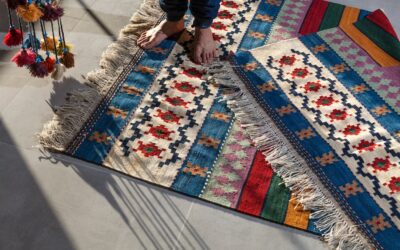
Flat weaves such as kilims and dhurries are made on a loom by interlacing colored weft threads through the warps, with no knots and no pile. The result is thin, light and often reversible. Good flat weaves are surprisingly tough, easy to shake out and a natural fit for dining rooms, entries and layered looks. Their thinness does mean they need a good pad to stay put.
Hand-tufted
Hand-tufted rugs start with a pattern drawn on a stretched canvas. A worker uses a hand-held tool to punch loops of yarn through the canvas, then a layer of latex adhesive is spread across the back and covered with a secondary fabric backing. Loops may be sheared for a cut-pile surface. The process is fast, which keeps prices moderate, but the pile is held by glue. Over years the adhesive can dry out, the backing can loosen, and tufts may shed.
Machine-made
Power looms weave machine-made rugs from wool, synthetic fibers or blends. Quality ranges from thin, low-density rugs to dense, well-finished pieces that wear nicely. They are consistent, affordable and widely available, but they generally cannot be restored the way a hand-knotted piece can.
How to Identify Each Type from the Back
Turn a corner of the rug over in good light and look for these signs:
- Hand-knotted: the pattern is clearly visible on the back, with small irregularities and individual knots you can count. The fringe is an extension of the warp threads, not sewn on.
- Flat-woven: the front and back often look nearly the same. There is no pile and no separate backing cloth.
- Hand-tufted: the back is covered with a canvas or cloth layer, often in a plain color, and the pattern is hidden. Fringe, if any, is usually sewn or glued on.
- Machine-made: the back shows the pattern with very uniform, grid-like rows and perfectly straight edges. Fringe is often attached separately.
Two more clues help. Hand-knotted rugs are rarely perfectly square, and the size may vary by an inch or two from end to end. Tufted rugs sometimes carry a faint latex smell when new.
Lifespan, Traffic and Price Compared
| Type | Typical lifespan | Best for |
|---|---|---|
| Hand-knotted | Decades, often generations | Living rooms, heirloom pieces, high traffic if dense wool |
| Flat-woven | 10 to 20+ years | Dining rooms, entries, kitchens, layering |
| Hand-tufted | About 5 to 10 years | Bedrooms, low to medium traffic areas |
| Machine-made | About 3 to 20 years depending on quality | Budget rooms, rentals, spots that see spills |
For busy halls and family rooms, a dense hand-knotted wool rug or a sturdy flat weave usually holds up best. Wool naturally resists crushing and hides soil, which is why a wool area rug remains a common recommendation for high-traffic rooms. Tufted rugs work well where feet are bare and traffic is lighter, like a bedroom.
Choosing the Right Rug for Your Room
- Measure the space. In a living room, aim for a rug that lets at least the front legs of seating rest on it. In a dining room, allow about 24 inches beyond the table edge so chairs stay on the rug when pulled out.
- Rate the traffic. Entry, hallway and family room traffic call for hand-knotted wool or flat weaves.
- Consider spills and pets. Flat weaves shake out and clean more easily. Low pile hides less dirt but vacuums faster.
- Check the fiber. Wool offers resilience and stain resistance, cotton suits flat weaves, and silk accents add sheen but mark easily.
- Set a realistic budget. A smaller hand-knotted rug may be a better long-term value than a large tufted one that needs replacing in a few years.
Care and Cleaning by Construction
Vacuum all rugs regularly with suction only or a brush roll set high. Avoid vacuuming the fringe, which tangles in the roller. Rotate each rug every 6 to 12 months to even out sun fading and wear.
- Hand-knotted and flat-woven: blot spills immediately with a white cloth and cool water. Have them professionally washed every few years depending on traffic. Many can be fully immersed and rinsed by a rug specialist.
- Hand-tufted: use as little water as possible, since soaking can weaken the latex. Spot clean and use professional dry or low-moisture cleaning.
- Machine-made: follow the label. Some synthetic rugs tolerate household carpet cleaners; others do not.
When cleaning with any product, test it on a hidden corner first, keep the room ventilated, and never mix cleaners.
Rug Pads and Slip Safety
A pad protects the rug and the floor and, most importantly, keeps the rug from sliding. Thin flat weaves are the biggest slip risk on hardwood, tile and vinyl. Choose a pad sized about 1 inch smaller than the rug on every side so it does not show. A felt and natural rubber combination pad offers grip plus cushion; a thin rubber grip pad suits doorways where height matters. Keep the rug edges flat. If a corner curls, reverse-roll it for a day or use rug corner grippers so it does not become a trip hazard.
Troubleshooting Common Rug Problems
- Shedding: normal for new wool rugs for a few months. Persistent shedding on a tufted rug may signal a failing backing.
- Curling edges: reverse-roll the edge, weigh it down, or add grippers.
- Color bleeding: stop wetting the area and consult a rug cleaning specialist.
- Moth damage: vacuum under furniture regularly, including the back of the rug, and keep stored rugs clean and wrapped in breathable fabric.
- Musty smell: dry the rug thoroughly in shade with good airflow, and check the floor beneath for moisture.
General Cost Ranges
Machine-made rugs sit at the lowest price point. Flat weaves cover a wide range from affordable cotton dhurries to fine wool kilims. Hand-tufted rugs occupy the middle. Hand-knotted rugs start higher and climb steeply with knot density, fiber and age, with fine or antique pieces reaching into luxury territory. Professional washing is typically priced by the square foot, with hand-knotted and silk pieces costing more to clean.
When to Call a Rug Specialist
Bring in a specialist for pet urine odors, deep stains, color runs, torn fringe, holes or moth damage on a hand-knotted piece. Restoration can extend the life of a good rug by decades, while a DIY attempt with the wrong cleaner can set stains permanently. For an antique or valuable piece, ask about an appraisal before any major work.
Frequently Asked Questions
Are hand-tufted rugs the same as hand woven rugs?
Not really. Hand-tufted rugs are made by punching yarn through a canvas and gluing it, while woven rugs are built on a loom from interlaced or knotted threads.
How can I tell if a rug is hand-knotted?
Look at the back. You should see the pattern clearly with slight irregularities, and the fringe should be part of the warp threads rather than sewn on.
Which rug type lasts the longest?
A dense hand-knotted wool rug usually lasts the longest, often for generations with regular care and occasional professional washing.
Do flat-woven rugs need a rug pad?
Yes. Flat weaves are thin and slide easily on hard floors, so a grippy pad is important for slip safety.
Why does my new wool rug shed?
Loose fibers from the spinning process work their way out over the first few months. Regular vacuuming reduces shedding over time.