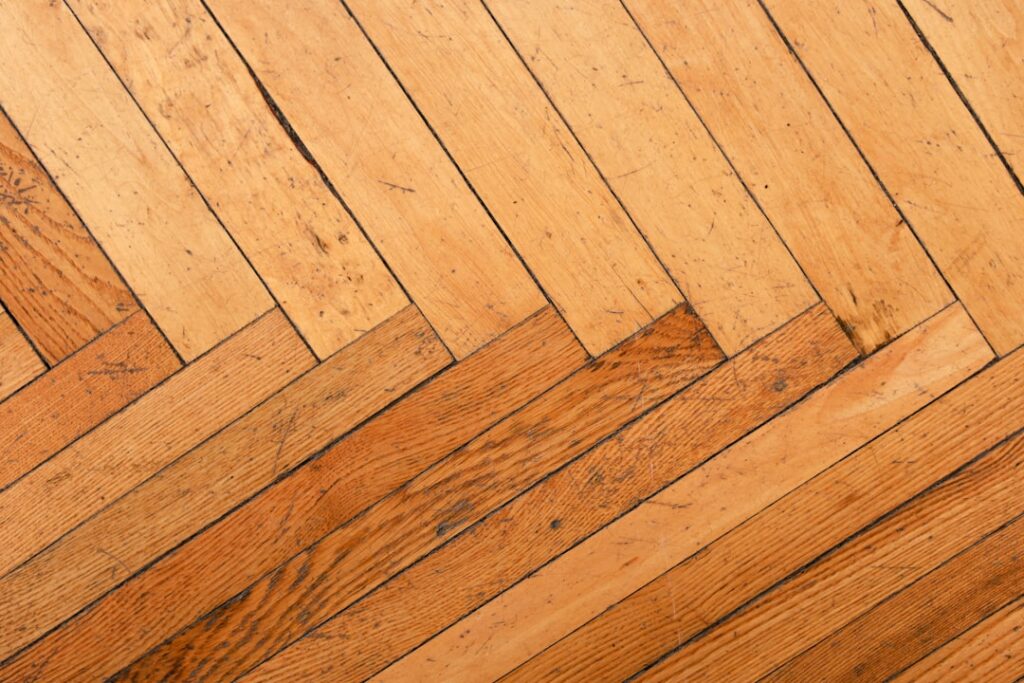
The pattern decision adds or subtracts roughly $5 per square foot from your install budget, and that math drives a lot of remodels in unhelpful directions. Herringbone vs straight flooring is not just an aesthetic question — it changes the room’s perceived size, the cost per square foot, the labor timeline, and the resale appeal in measurable ways. After running both patterns across 40-plus jobs in the past five years, I can tell you when the herringbone premium pays off and when straight plank is genuinely the smarter choice.
Cost Difference at the Material Level
Material costs run nearly identical for both patterns when comparing the same wood and finish. Most engineered hardwood manufacturers sell the same SKUs in standard plank length and shorter herringbone-cut blocks. The difference shows up in waste — herringbone needs 12 to 15 percent overage versus 7 to 10 percent for straight plank. On a $7 per square foot floor at 1,000 sq ft, that is $350 to $500 more in materials.
Solid hardwood herringbone costs slightly more because the blocks are precision-cut to specific tolerances. Expect a 5 to 10 percent material premium on solid herringbone. Engineered herringbone usually does not carry this premium because manufacturers cut both straight plank and herringbone from the same production stock.
Cost Difference at Installation
This is where the real money shows up. Standard straight plank install runs $4 to $6 per square foot in labor for prefinished engineered hardwood. Herringbone runs $9 to $14 per square foot for the same wood. A 1,000 sq ft floor that costs $5,000 in straight install costs $11,000 to $13,000 as herringbone.
The labor premium reflects three things: pattern alignment time, miter cuts at the borders, and skill. Not every installer can lay herringbone correctly. Roughly one in three flooring contractors I have hired over the years have done herringbone before, and only about half of those produce results that look right. Vet your installer specifically on pattern work.
- Straight plank install: $4 to $6 per sq ft labor
- Herringbone install: $9 to $14 per sq ft labor
- Chevron install (mitered): $11 to $16 per sq ft labor
- Custom Versailles panels: $18 to $28 per sq ft labor
Visual Impact and Room Size Perception
Straight plank emphasizes the long dimension of a room. In a long narrow space, planks running parallel to the long wall make the room feel even longer and narrower. Running them perpendicular shortens the room visually. The orientation choice matters more than most homeowners realize.
Herringbone disrupts the linear perspective and makes rooms feel more square. In a 12 by 16 foot bedroom, herringbone reduces the perceived length-to-width ratio because the eye registers the angled blocks instead of long lines. Designers use this trick to balance proportions in irregular rooms.
Pattern Scale Considerations
Block size matters. Standard herringbone blocks run 4 to 9 inches wide and 12 to 36 inches long. In a small bathroom or hallway, smaller 4 by 12 blocks read appropriate. In a great room, 8 by 36 blocks scale correctly with the space. Mismatched scale is the most common pattern mistake.
Wider modern herringbone uses 6 to 8 inch blocks at 24 to 36 inch lengths. This contemporary scale works in open-concept spaces and reads less formal than traditional Versailles. For period homes and formal rooms, traditional 4 by 18 inch herringbone is the right choice.
Resale Value and Buyer Appeal
The 2024 NAR luxury market survey put hand-laid herringbone hardwood among the top three “most desirable interior features” for homes priced above $1 million. In that price segment, herringbone adds roughly 4 to 7 percent to perceived home value. Below $750,000, the resale premium drops to 1 to 3 percent — still positive, but smaller.
For homes priced under $500,000, straight plank is usually the right call. The herringbone premium of $6,000 to $10,000 does not return at resale in mid-priced markets, and some buyers actively prefer the simpler look. Match the floor to the home’s price bracket, not the homeowner’s aspiration.
Where Each Pattern Belongs
Herringbone shines in formal rooms — entry foyers, dining rooms, primary bedrooms, and small libraries. The pattern adds visual weight that supports formal furniture and architectural features. It works less well in playrooms, basements, and casual family rooms where the formality competes with the room’s intended use.
Straight plank is the right call for casual living spaces, bedrooms in younger households, kitchens with active cooking, and anywhere the floor should disappear into the background. The simpler pattern lets furniture, art, and architecture take center stage.
Common Mistakes to Avoid
Herringbone over a wavy subfloor is a disaster. The pattern amplifies any subfloor flatness issues because the eye reads the block alignment. Spec a maximum 1/8 inch variance over 10 feet for herringbone installs, and budget self-leveling underlayment if needed.
The other mistake is pattern direction. Herringbone has a “fly direction” — the V-shapes point one way down the room. The convention is to align the pattern with the longest sightline from the main entry of the room. Skipping this step gives the floor a haphazard look that homeowners notice but cannot articulate.
Hybrid Approaches That Work
Some of my favorite installs use both patterns intentionally. A herringbone medallion at the foyer or dining room with straight plank in the surrounding spaces creates a focal point without paying for herringbone everywhere. Material costs work out roughly the same because the herringbone is concentrated in 100 to 200 square feet.
Another hybrid is a herringbone runner down a long hallway, with straight plank in the rooms on either side. This treats the hallway as an architectural element and saves significant labor cost compared to herringbone in every room.
Final Decision Framework
Choose herringbone when the home value supports the labor premium, the room is rectangular and well-proportioned, the floor is intended as a design feature, and the installer has documented herringbone experience. Choose straight plank for everything else. The straight floor done right looks better than herringbone done poorly, and budget always plays a role.
For most homes, the right answer is straight plank in 90 percent of the floor and a herringbone or chevron accent in one design moment. That gives you the visual richness without the whole-house labor bill, and the herringbone vs straight flooring debate becomes a both-and instead of either-or.
Prefer to explore on your own?
See how new flooring looks in your actual room in seconds — free, no signup.
Try the free Floor Studio →