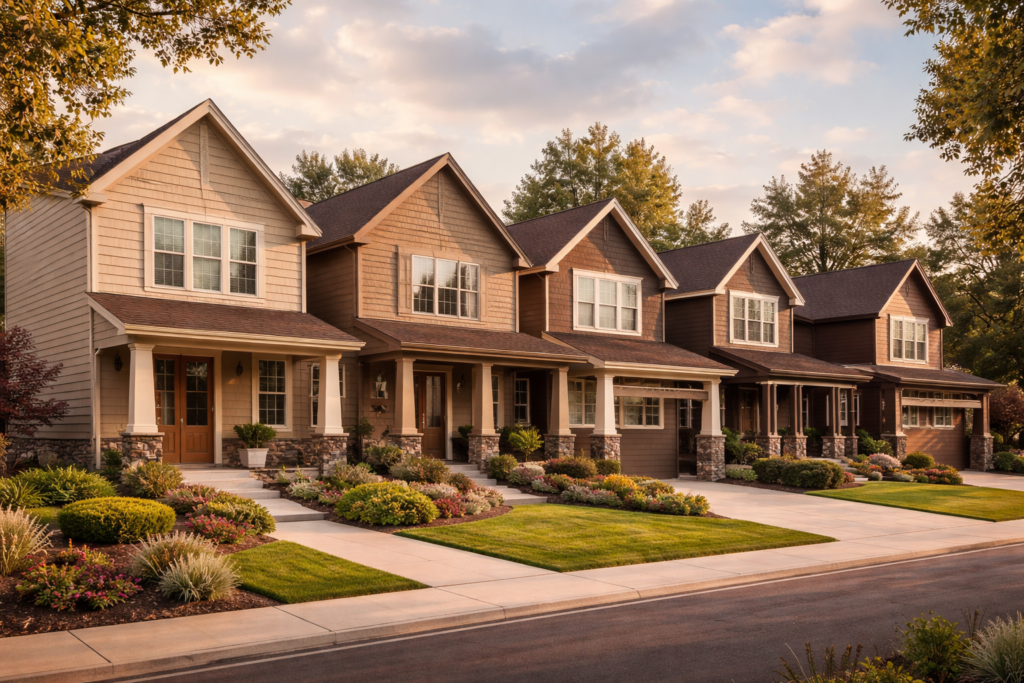
Earth tones are the quiet workhorses of house siding. They hide dust and pollen, sit comfortably beside brick and stone, and rarely look dated ten years later. The James Hardie earth tone colors in the factory-finished Statement Collection range from a soft sandy beige to a near-black brown, with one barn-style red for homeowners who want warmth with more personality.
All four appear in the Statement Collection color grid of the manufacturer’s current national product catalog, finished with ColorPlus Technology, the factory-applied, baked-on finish. The two other popular warm browns in the lineup, Monterey Taupe and Timber Bark, have their own dedicated pages, so they show up here mainly as trim partners.
- James Hardie Earth Tone Colors Side by Side
- Navajo Beige: The Light, Warm Neutral
- Khaki Brown: A Mid-Tone With Warmth
- Rich Espresso: The Darkest Brown
- Countrylane Red: Warm Red With an Earthy Base
- How to Choose Among the Four
- Warranty, Touch-Up and Care
- Troubleshooting Earth Tone Siding Choices
- General Cost Ranges and When to Hire a Pro
- Frequently Asked Questions
One caution before falling for a chip: the manufacturer states that the Statement Collection is tailored to your home’s region and that the product offering differs by area. Confirm with a local dealer or contractor, or check availability by location on the manufacturer’s site, before you design the whole house around one color.
James Hardie Earth Tone Colors Side by Side
The manufacturer does not publish light reflectance values (LRVs) for its siding colors on its color pages, and printed or on-screen swatches only approximate the factory finish. The comparison uses descriptive terms instead. Order a physical sample before deciding; the maker notes that samples are offered in its Select Cedarmill texture.
| Color | How it reads | Trim ideas | Roof ideas |
|---|---|---|---|
| Navajo Beige | Light, warm sandy beige; the lightest of the four | Timber Bark (maker’s colonial suggestion), Arctic White, Khaki Brown | Weathered wood, brown or charcoal shingles |
| Khaki Brown | Medium warm brown with a golden, earthy lean | Arctic White, Navajo Beige, Rich Espresso | Brown blends, weathered wood, dark bronze metal |
| Rich Espresso | Deep, dark chocolate brown; reads near-black in shade | Arctic White, Navajo Beige, natural cedar accents | Charcoal or black shingles, dark bronze metal |
| Countrylane Red | Muted barn red with a brown base | Arctic White (maker’s colonial suggestion), Navajo Beige | Charcoal, black or weathered gray shingles |
| Monterey Taupe (related) | Gray-brown taupe | Arctic White, Timber Bark | Charcoal or weathered wood |
| Timber Bark (related) | Deep gray-brown | Navajo Beige, Arctic White | Brown or charcoal shingles |
Trim and roof ideas are design suggestions, not rules. Your brick, stone, window frames and the neighborhood all affect what looks right.
Navajo Beige: The Light, Warm Neutral
Navajo Beige is the color many people mean when they search for hardie navajo beige or navajo beige hardie board. It is a warm, sandy neutral that looks natural next to fieldstone, tan brick and cedar. The manufacturer’s own colonial-style guide suggests its Select Cedarmill lap siding in Navajo Beige for a raw wood look, paired with Hardie Trim in Timber Bark. That combination gives a classic brown-on-beige outline without the stark contrast of white trim.
The maker’s regional color article also names Navajo Beige and Khaki Brown as particular favorites in the South Central region, where earth tones that echo the plains landscape are popular. It also notes that pairing shingle and lap siding in a warm beige like Navajo Beige creates a cohesive look, which is handy for gables and dormers.
Because it is the lightest of the four, Navajo Beige shows the least fading and heat gain in strong sun. It can look a bit flat on large plain walls, so board and batten sections, shingle gables or darker trim help give the house some depth.
Khaki Brown: A Mid-Tone With Warmth
James Hardie khaki brown sits a clear step darker than Navajo Beige. It has a warm, slightly golden lean that reads like dry grass or tanned leather in daylight. It suits ranch homes, craftsman bungalows and any house surrounded by trees, where it blends into the landscape instead of standing out.
Khaki Brown with Arctic White trim is crisp and traditional. With Navajo Beige trim, the look is softer and more monochrome. For a woodsy feel, a sage or moss green front door ties it to the yard. Rich Espresso shutters or a dark front door add weight to the facade without introducing another color family.
Rich Espresso: The Darkest Brown
Rich espresso hardie siding gives a strong, grounded look that works especially well on modern farmhouses, mountain homes and contemporary designs with clean lines. In shade it reads almost black, and in full sun the chocolate warmth comes through. That shift makes it softer than a true black siding.
Dark colors carry a few tradeoffs. They absorb more heat, show dust and pollen more readily, and can reveal fading sooner on the sunniest walls than light colors do. The factory finish is designed for color retention, but for a south- or west-facing wall in a hot climate, it is worth discussing expectations with your installer. Rich Espresso is also handy as a trim, fascia or accent color with Navajo Beige or Khaki Brown bodies. Trim color availability differs from siding availability, so confirm which trim colors are stocked in your area.
Countrylane Red: Warm Red With an Earthy Base
James Hardie countrylane red is the most distinctive of the group. It is a muted, brown-based red that brings to mind old barns and country farmhouses rather than a bright fire-engine red. The manufacturer’s colonial style guide shows it on Select Cedarmill lap siding with Arctic White trim, which gives an eye-catching, traditional contrast.
Navajo Beige trim is a softer alternative that keeps the whole palette in the earth-tone family. Red siding also looks good with charcoal or black roofing and black window frames. Avoid pairing it with warm red-orange brick, which can make both look off; gray or tan stone is an easier companion.
How to Choose Among the Four
Picking between James Hardie earth tone colors is mostly a question of contrast and setting. Light Navajo Beige suits sunny lots and smaller homes, while Khaki Brown, Rich Espresso and Countrylane Red add weight to larger or more shaded houses.
- Start with what you cannot change. Roof color, brick, stone and window frames limit your choices more than personal taste. Hold samples next to each.
- Check regional stock. Look up which Statement Collection colors are stocked near you. If a color is not stocked, the separate made-to-order Dream Collection offers a much wider range of finishes in the United States, typically with added cost and lead time.
- Look at samples outdoors. View each sample on the north and south sides of the house, in morning and late afternoon. Siding colors look lighter outdoors than they do on an indoor chip.
- Think about contrast. Light body with dark trim, or dark body with light trim, both read clearly from the street. A similar body and trim value looks calm but can feel flat.
- Check HOA rules. Many associations require color approval before any siding work, and red or very dark colors are sometimes restricted.
Warranty, Touch-Up and Care
According to the manufacturer’s national catalog, Hardie siding, trim and soffit carry a 30-year non-prorated limited substrate warranty, and ColorPlus Technology finishes carry a 15-year limited finish warranty. Read the current warranty document for your product and region, since terms and conditions apply.
Factory-finished boards still get cut ends and occasional scratches during installation. Installers use color-matched touch-up kits on cut edges and nicks, and the manufacturer lists a color-matched sealant for Statement Collection products. Keep any leftover touch-up material for future repairs. For routine care, rinse the siding with a garden hose and a soft brush once or twice a year. Skip high-pressure washing at close range, which can damage the finish and force water behind the boards.
Troubleshooting Earth Tone Siding Choices
- The beige looks pink or yellow next to the roof: Undertones are clashing. Try a sample against the shingles in daylight and consider Khaki Brown or a grayer neutral.
- The house looks too dark: Use Rich Espresso for trim, shutters or one gable section rather than the whole body.
- The red looks orange: Strong late-day sun warms it up. Balance it with cooler white trim and a charcoal roof.
- Color is out of stock locally: Ask the dealer about lead times, or consider a made-to-order option, which may add time and cost.
General Cost Ranges and When to Hire a Pro
Factory-finished fiber cement usually costs more for materials than primed boards, but it removes the field-painting step. Installed fiber cement siding projects commonly fall in a broad per-square-foot range that depends on region, house height, trim complexity and tear-off. Darker or made-to-order colors can add lead time and cost.
Fiber cement is heavy, and cutting it releases crystalline silica dust, so most homeowners hire an installer who follows the manufacturer’s installation instructions, which also matters for warranty coverage. Work above the first story calls for proper scaffolding or a professional crew. In older homes, test existing paint for lead before scraping or removing old siding, and test older siding and some old roofing or felt materials for asbestos before disturbing them.
Frequently Asked Questions
Are Navajo Beige and Khaki Brown in the Statement Collection?
Yes. Both appear in the Statement Collection color grid of the manufacturer’s national catalog, though stocked colors vary by region.
What trim goes with Navajo Beige siding?
The manufacturer’s colonial guide pairs Navajo Beige siding with Timber Bark trim. Arctic White and Khaki Brown are other common choices.
What trim goes with Countrylane Red?
Arctic White trim gives a crisp, classic contrast and appears in the manufacturer’s own colonial example. Navajo Beige is a softer option.
Does James Hardie publish LRV for siding colors?
Not on its color pages. Judge lightness from a physical sample viewed outdoors, and ask a dealer if you need technical data.
Will Rich Espresso fade faster than lighter colors?
Dark colors generally show fading and heat sooner on sunny walls. The factory finish is designed for color retention and carries a limited finish warranty.
Can I get these colors anywhere in the US?
Availability varies by region. If a color is not stocked near you, ask a dealer about made-to-order options and lead times.