Grass and mulch have their place, but neither holds a candle to stone when you want a tree base that looks finished and stays that way for years. Landscaping around trees with rocks gives you a clean, low-maintenance ring that suppresses weeds, defines the tree in the landscape, and never needs replacing the way mulch does every spring. Done thoughtfully, a rock ring adds real curb appeal and protects the trunk from mower and string-trimmer damage. Done carelessly, it can slowly choke the very tree you are trying to showcase. Here is how to get the look without hurting the tree.
- Why Use Rocks Around Trees
- Best Rock Types for Tree Rings
- Design Ideas That Look Professional
- How to Install a Rock Ring Step by Step
- The Big Mistake: Don’t Bury the Root Flare
- Watch Heat and Soil Compaction
- Maintenance and Long-Term Care
- How Much Rock to Buy
- Edging Options to Keep Rocks Contained
- Rock vs. Mulch: Which Is Better Around Trees
Why Use Rocks Around Trees
Rock has several advantages over the alternatives. It does not decompose, so unlike wood mulch you are not hauling and spreading new material every year. It stays put in wind and heavy rain far better than lightweight bark. It resists weeds, especially over a proper barrier. And it stands up to foot traffic and pets.
There are aesthetic wins too. A crisp ring of river rock or crushed granite reads as intentional and tidy in a way a patchy grass collar never does. It creates a visual “frame” that draws the eye to the tree, and you can match the stone color to your home’s exterior or other hardscaping for a coordinated look.
Best Rock Types for Tree Rings
Not all stone works equally well around a living tree. Your choice affects both looks and the tree’s health.
- River rock: Smooth, rounded stones in 1- to 3-inch sizes. The most popular choice, natural-looking and comfortable underfoot. Runs about $50 to $80 per cubic yard or $4 to $8 per bag.
- Mexican beach pebbles: Dark, polished, uniform stones for a high-end look. Pricier, often $15 to $25 per bag, but striking around ornamental trees.
- Crushed granite or gravel: Angular and inexpensive, good for a natural, rustic feel; packs tighter than round rock.
- Lava rock: Lightweight, porous, and available in red or black. Insulates soil well, but can be sharp and tends to fade over time.
- Flagstone or larger accent boulders: Use a few larger stones as focal points within a bed of smaller rock for depth and interest.
Lighter-colored stone reflects heat and stays cooler, which matters in hot climates, dark rock like lava or basalt can absorb a lot of sun and raise soil temperature around shallow roots.
Design Ideas That Look Professional
A pile of rock around a trunk looks like a landfill. A designed ring looks like landscaping. Try these approaches:
- The clean circle: A simple 3- to 5-foot-diameter ring of uniform river rock with a crisp steel or stone edge. Timeless and easy.
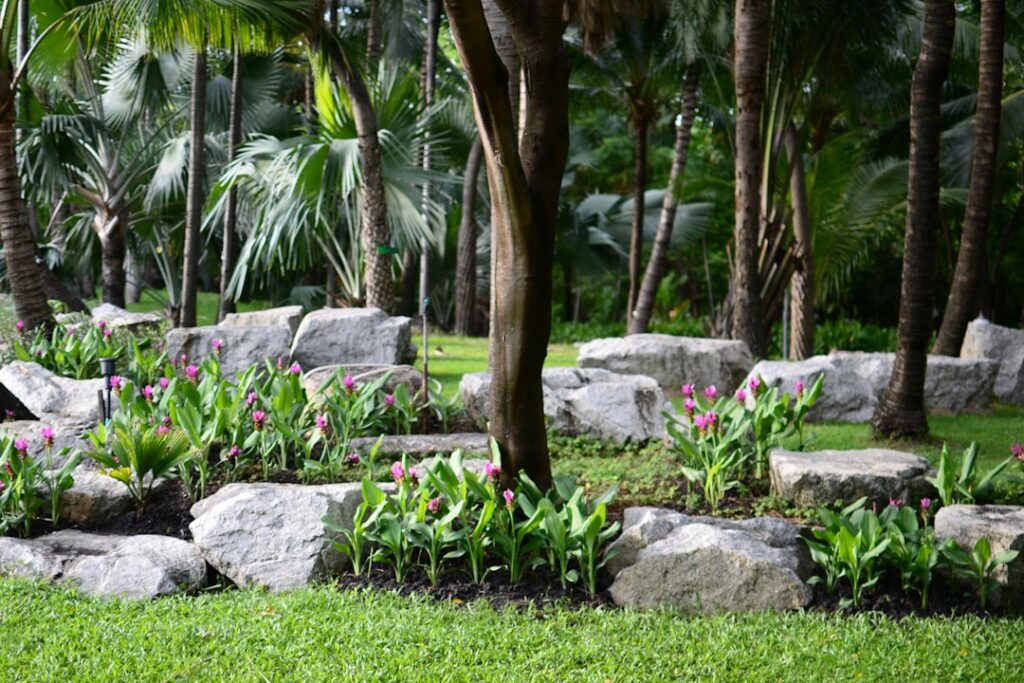
- Layered sizes: Larger stones or a few boulders near the outer edge, grading to smaller pebbles toward the trunk, for a natural streambed effect.
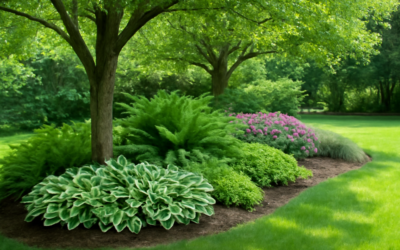
- Rock and plant combo: Ring the tree with rock, then tuck in a few shade-tolerant perennials or ornamental grasses like hostas, liriope, or heuchera for color and texture.
- Boulder accents: Set two or three sizable boulders asymmetrically within a gravel bed to mimic a natural outcrop.
- Color coordination: Match rock tones to your home’s stone or brick, or to a nearby patio, so the whole yard feels cohesive.
How to Install a Rock Ring Step by Step
The installation is straightforward, but a couple of steps protect both the look and the tree.
- Mark the ring. Aim for a bed at least as wide as the tree’s mature drip line where possible, but a 3- to 6-foot diameter is common. Use a hose or spray paint to lay out a smooth circle.
- Remove grass and weeds inside the ring down to bare soil. Do not till deeply, you want to avoid slicing surface roots.
- Install edging. Set steel, aluminum, or stone edging around the perimeter to keep rock from migrating into the lawn.
- Lay landscape fabric. A permeable woven fabric over the soil suppresses weeds while letting water and air through. Cut a slit to fit around the trunk, never wrap it tight.
- Spread the rock. Add stone 2 to 3 inches deep. Order roughly 1 cubic yard for every 100 sq ft at that depth.
- Keep it off the trunk. Pull all rock back so there is a clear 3- to 6-inch gap of open soil around the base of the trunk.
The Big Mistake: Don’t Bury the Root Flare
This is where good intentions kill trees. The root flare, where the trunk widens into the roots at the soil line, must stay exposed and dry. Piling rock (or mulch) up against the trunk in a volcano shape traps moisture against the bark, invites rot and disease, and encourages girdling roots that slowly strangle the tree.
Always leave a clear ring of open soil right around the trunk. Keep the rock layer thin near the base and never mound it. If you can see the flaring buttress roots at the soil surface, you have done it right.
Watch Heat and Soil Compaction
Rock has two downsides you should manage. First, stone absorbs and radiates heat. In hot southern climates a dark rock ring can bake shallow roots, so choose lighter-colored stone and keep the layer moderate. Second, rock is heavy and does not feed the soil the way decomposing mulch does. Over years it can contribute to compaction and offers no organic matter to the roots. To offset this, some homeowners keep a thin layer of mulch under the fabric near the tree or use rock only in the outer portion of the bed and mulch closer to the trunk.
Maintenance and Long-Term Care
A rock ring is low-maintenance, not no-maintenance. Leaves and debris collect in the stones, so blow or rake it out a couple of times a season. Occasional weeds will still sprout in accumulated organic debris on top of the fabric, pull them while small. Every few years you may want to top up or rinse the rock to refresh the look. Because stone does not retain moisture like mulch, water the tree deeply during dry spells; the rock will not do it for you.
Landscaping around trees with rocks is one of the best-value upgrades you can make: install it once, and it holds its clean, finished look for years. Just remember the golden rule, keep the stone off the root flare, choose a cooler-colored rock in hot climates, and lay it over quality fabric with solid edging. Respect the tree, and the rock ring will reward you with curb appeal that lasts far longer than any bed of mulch.
How Much Rock to Buy
Ordering the right quantity keeps you from making a second trip or overpaying. Rock coverage depends on the diameter of your ring and how deep you spread the stone. At a 2- to 3-inch depth, one cubic yard of rock covers roughly 100 to 130 square feet. For a common 5-foot-diameter ring, that is about 20 square feet, so a few bags or a fraction of a yard will do.
Bagged stone runs about 0.5 cubic feet per bag, so you would need roughly a dozen bags for a small ring, which quickly gets expensive compared to bulk. For anything larger than a single small tree, buying by the cubic yard from a landscape supply yard is far cheaper, often $40 to $80 per yard versus $4 to $8 per half-cubic-foot bag. Measure the diameter of each ring, calculate the square footage, and order a little extra to account for settling and uneven ground.
Edging Options to Keep Rocks Contained
Without edging, your rock ring slowly migrates into the lawn, where it dulls mower blades and looks messy. Good edging is what keeps the whole installation crisp for years. Steel and aluminum edging give the cleanest, most modern line and hold their shape against mower wheels; expect $2 to $4 per linear foot. Natural stone or concrete pavers set around the perimeter create a more substantial, decorative border and double as a mowing strip. Plastic landscape edging is the budget choice at around $1 per foot, though it can heave and warp over time in freeze-thaw climates.
Whatever you choose, set the edging so its top sits slightly above the surrounding soil to contain the rock but low enough to mow over cleanly. A defined edge is the single biggest factor in whether a rock ring reads as intentional landscaping or a random pile of stone.
Rock vs. Mulch: Which Is Better Around Trees
Homeowners often ask whether they should use rock or mulch, and the honest answer is that each has its place. Rock is permanent, tidy, and never needs replacing, but it adds no organic matter, can heat the root zone, and does not feed the soil. Mulch decomposes into rich material that benefits the tree and keeps roots cooler, but it breaks down and must be topped up every year or two. For a tree’s actual health, a wide mulch ring is gentler. For a low-maintenance, decorative finish that stays put, rock wins. Many homeowners split the difference, keeping mulch closer to the trunk where the tree benefits most and rock toward the outer edge for the clean look, giving you the best of both around your trees.