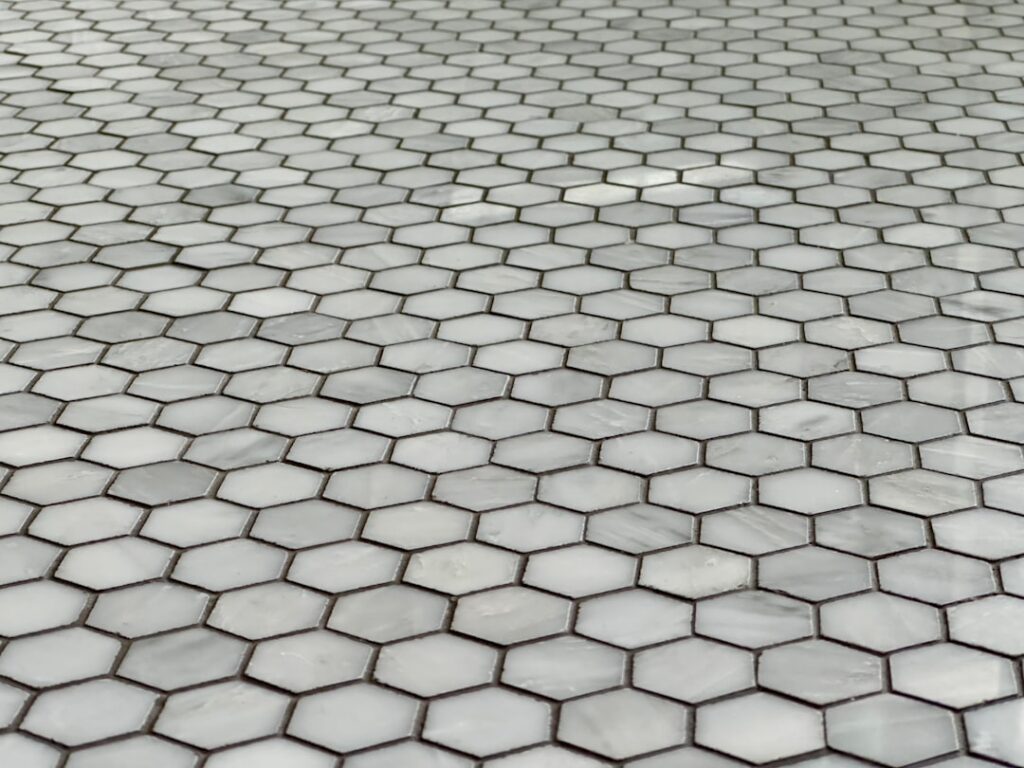
Large hexagon floor tile has moved from a niche mosaic accent to one of the most requested flooring shapes in modern bathrooms, entryways, and open-concept kitchens. Where the classic penny-hex was a tiny 1- or 2-inch mosaic sheet, today’s large-format hexagons run 8, 10, 12, and even 24 inches across, giving you the honeycomb geometry without the maze of grout lines. This guide covers the sizes and materials available, what installation really involves, realistic pricing, and the mistakes that turn a striking floor into a lippage-riddled headache.
Part of our Tile & Grout guide — explore the full guide →
- What Counts as "Large" Hexagon Tile
- Materials and Finishes
- Why Layout Is Trickier Than Square Tile
- Grout: Color, Width, and Type
- Subfloor Prep and Lippage
- Realistic Costs
- DIY Considerations
- Common Mistakes to Avoid
- Design Pairings That Work
- Where to Use Large Hexagon Tile
- Maintenance and Longevity
- Bringing the Look Home
What Counts as “Large” Hexagon Tile
In tile terms, “large-format” generally means any tile with at least one side of 15 inches or more, but for hexagons the label is used more loosely. Common large hexagon sizes include:
- 7″ to 8″ hexagons: the entry point to the large look, great for bathroom floors
- 10″ hexagons: a popular middle ground for powder rooms and mudrooms
- 12″ to 14″ hexagons: genuine large-format, ideal for open living spaces
- 24″ hexagons: dramatic, statement-making tiles for spacious rooms
The bigger the hexagon, the fewer grout lines, which reads as calmer and more contemporary. Smaller hexagons give a busier, more textural pattern that leans traditional or vintage.
Materials and Finishes
Large hexagon floor tile comes in nearly every material, and the choice affects durability, slip resistance, and price:
- Porcelain: The workhorse. Dense, water-resistant with a low absorption rate under 0.5 percent, rated for floors, and available in matte, polished, and wood-look or marble-look prints. Best all-around choice.
- Ceramic: Softer and cheaper than porcelain, fine for low-traffic bathrooms but less durable underfoot.
- Natural stone (marble, slate, travertine): Gorgeous but porous; requires sealing and is heavier and harder to cut cleanly into hexagons.
- Cement (encaustic): Bold patterns and color, but needs sealing and careful maintenance.
For wet areas, look for a Dynamic Coefficient of Friction (DCOF) rating of 0.42 or higher, which is the ANSI benchmark for floors that may get wet. A matte or textured porcelain hexagon in a bathroom is far safer than a polished one.
Why Layout Is Trickier Than Square Tile
Hexagons do not forgive a crooked start the way a square grid can hide small errors. Because six sides meet at each vertex, any drift in alignment compounds visibly across the room. Professional installers dry-lay the field first, snap careful centerlines, and often start from the most visible sightline, such as a doorway or the room’s focal wall, rather than a corner. Because hexagons naturally create a zigzag edge at walls, you will cut a lot of partial tiles, which increases waste. Order 15 to 20 percent overage rather than the usual 10 percent.
Grout: Color, Width, and Type
Grout lines define a hexagon floor, so treat grout as a design decision, not an afterthought. A matching grout color makes the tiles blend into a seamless surface and emphasizes the shape only subtly. A contrasting grout, such as charcoal grout with white tiles, turns every honeycomb into a graphic outline. For large-format tiles, keep grout joints tight, typically 1/8 inch, and use an unsanded or fine-sanded grout accordingly.
Epoxy grout resists stains and never needs sealing, which is worth the extra cost and effort in a shower or entry. Standard cement grout is cheaper but should be sealed. Whatever you choose, buy a grout float and mix small batches, because hexagon geometry means more linear feet of joint per square foot than square tile.
Subfloor Prep and Lippage
Large-format tile of any shape demands a flat substrate. Industry guidance calls for a subfloor flat to within 1/8 inch over 10 feet for tiles 15 inches or larger. If your floor dips or humps, the corners of adjacent hexagons will sit at different heights, a defect called lippage that you feel with bare feet and catch with your eye. Self-leveling underlayment fixes low spots. On plywood subfloors, install a proper uncoupling membrane or cement backer board, never tile directly over standard plywood or OSB.
Use a large-format, medium-bed mortar (sometimes labeled LFT or LHT thinset) and back-butter each tile to achieve at least 85 percent mortar coverage in dry areas and 95 percent in wet areas. Tile leveling clips and wedges are almost mandatory for big hexagons; they hold adjacent edges flush while the mortar cures.
Realistic Costs
Material and labor vary by region and material, but expect:
- Porcelain large hexagon tile: $4 to $12 per square foot for the tile itself; designer or Italian lines run $15 to $25
- Natural stone hexagons: $10 to $30 per square foot
- Professional installation: $8 to $15 per square foot, higher than square tile because of the cutting and layout complexity
- Materials (thinset, grout, membrane, leveling clips): $2 to $4 per square foot
A 60-square-foot bathroom floor in mid-range porcelain, professionally installed, commonly totals $1,200 to $2,000.
DIY Considerations
A patient DIYer can install a large hexagon floor tile in a small room, but budget for a quality wet saw with a good blade. Hexagons require angled cuts at 30 and 60 degrees along walls, which a snap cutter handles poorly. Rent or buy a wet saw with an adjustable miter guide. The two skills that separate a clean job from an amateur one are precise angled cutting and disciplined use of leveling clips. If your room has many niches, a curved wall, or a shower pan, the cut count climbs fast and a pro often pays for itself.
Common Mistakes to Avoid
Do not skimp on subfloor flatness; lippage is the number one complaint with large-format hexagons. Do not under-order tile, because dye-lot differences make matching a later batch nearly impossible. Do not start tiling from a corner and hope the pattern lands well at the opposite wall; dry-lay and center first. Avoid polished tile in wet areas where slip resistance matters. And do not rush the grout, tight hexagon joints show every smear, so clean the surface thoroughly before the haze sets.
Design Pairings That Work
Large hexagon floor tile is versatile, but a few pairings consistently look intentional rather than trendy. In a bathroom, white or greige matte hexagons with a coordinating grout create a clean, spa-like base that lets a bold vanity or wallpaper shine. Wood-look porcelain hexagons bring warmth and geometry together, striking in an entryway or powder room. Marble-look hexagons in a soft veined pattern read as high-end without the maintenance of real marble. For a bolder statement, a two-tone or gradient layout, where a field of light hexagons scatters in darker accent tiles, turns the floor into art. Keep wall tile and cabinetry simpler when the floor is doing the geometric heavy lifting, so the room does not feel busy.
Where to Use Large Hexagon Tile
Because porcelain is so durable and water-resistant, large hexagon floor tile works almost anywhere in the home. Bathrooms and powder rooms are the classic application, where the pattern adds personality to a small footprint. Entryways and mudrooms benefit from the durability and easy cleanup. Kitchens and open-concept living areas can carry 12-inch or larger hexagons for a contemporary, seamless look, especially in wood-look or stone-look finishes. Laundry rooms and sunrooms are great low-stakes places to try a bolder pattern. The main caution is slip resistance: in any space that gets wet, choose a matte or textured finish with a DCOF of 0.42 or higher rather than a slick polished tile.
Maintenance and Longevity
One of the quiet advantages of porcelain hexagon tile is how little it asks of you. Day to day, sweep or vacuum grit that can dull the surface, and damp-mop with a neutral pH cleaner, avoid acidic or harsh chemicals that can degrade grout over time. The grout lines, not the tile, are the maintenance point: seal cement grout on installation and re-seal it every year or two, or sidestep the issue entirely with epoxy grout that never needs sealing. Address any cracked or loose tile promptly, because water intrusion under a tile can spread. Done right, a porcelain hexagon floor easily lasts 20 years or more, often outliving the design trends that inspired it, which is why choosing a finish you genuinely love matters as much as the shape.
Bringing the Look Home
Large hexagon floor tile rewards planning. Choose a dense porcelain in the right size for your room, decide early whether you want grout to whisper or shout, invest in a flat subfloor and leveling clips, and order generous overage. Get those fundamentals right and you end up with a floor that feels custom and contemporary, the kind of honeycomb geometry that makes visitors look down and ask where you found it.
Prefer to explore on your own?
See how new flooring looks in your actual room in seconds — free, no signup.
Try the free Floor Studio →