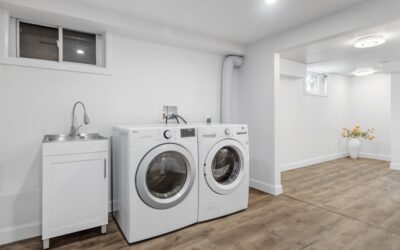
A single failed washer hose dumps 4 to 6 gallons per minute onto the floor before most homeowners notice the noise, and that one risk dictates almost every flooring decision for the laundry room. Laundry flooring must handle continuous moisture exposure, vibration from front-load washers spinning at 1,400 rpm, and routine detergent and bleach spills that destroy most softwood finishes. Expect $2.99 to $9.99 per square foot installed, depending on whether you go with SPC plank, sheet vinyl, or porcelain tile.
The Real Risks That Drive the Spec
Catastrophic water failure tops the list. Washing machine supply hoses fail at the crimp every 5 to 8 years on average, and the resulting 200 to 400 gallon dump destroys hardwood, laminate, and most engineered planks within hours. Only fully waterproof products survive that scenario without subfloor damage and mold remediation.
Daily-use moisture is the secondary concern. Detergent drips, fabric softener spills, dryer lint accumulation, and bleach splatter all hit the floor in small amounts hundreds of times per year. Over a 20-year ownership, that adds up to a meaningful chemical and moisture load that softwood and felt-back vinyl cannot handle.
Best Flooring Options Ranked
Porcelain tile leads on durability and water resistance. A 6×36 inch wood-look porcelain plank set with sanded grout and silicone movement joints shrugs off any laundry scenario for 30 to 50 years. Pricing runs $4.99 to $9.99 per square foot installed, depending on tile cost and prep complexity.
Rigid-core SPC plank takes second place at a much lower price point. The 100% waterproof composition and click-lock floating install handle a flooded room without delaminating, and a damaged plank can be replaced individually after a major leak. Pricing lands at $3.49 to $5.99 per square foot installed.
Sheet vinyl with fiberglass back is the budget winner. A seamless 12-foot or 15-foot roll covers most laundry rooms in one piece with no joints to leak through. Pricing comes in at $2.99 to $4.49 per square foot installed.
Materials to Avoid
- Solid hardwood — swells and cups within 24 hours of contact, unrepairable without full board replacement
- Engineered hardwood with HDF core — slightly more tolerant than solid but still fails on a major leak
- Standard laminate without water-resistant joints — the HDF core swells like a sponge and lifts at the seams
- Carpet of any type — traps moisture, grows mold, and absorbs detergent odors permanently
- Felt-back sheet vinyl — the felt wicks water under the seams and rots within 6 to 12 months
Pros of Going With Tile
Porcelain tile delivers indestructible water resistance and the longest service life of any flooring option. A properly installed tile floor with sealed grout handles every laundry scenario for the life of the home, including a washing machine fire that exceeds 1,000°F at the source. Resale appraisers also credit tile in wet rooms at full value, while hardwood and laminate in laundry rooms can flag as installation defects on a home inspection.
Heated tile is also feasible. A 120V radiant mat under the tile from Schluter Ditra-Heat or WarmlyYours runs $7 to $10 per square foot installed and turns a cold laundry room into a pleasant space for folding and ironing. The mat draws roughly 12 watts per square foot, so a 60 square foot laundry uses about $5 per month of electricity in winter.
Pros of Going With Vinyl Plank
SPC plank installs in a single day with minimal disruption. A 60 square foot laundry room with prep, install, and trim takes a competent installer 4 to 5 hours, versus the 8 to 12 hours plus 24-hour cure time required for tile and grout. For renovation timelines where the washer needs to be back in service quickly, that speed matters.
Replacement after a flood is also simpler. Lift the damaged planks, dry the slab or subfloor, and snap in new planks from your saved attic stock. Tile repair requires matching grout color, breaking out damaged tile without cracking neighbors, and waiting for thinset cure — much slower and more expensive in labor.
Cost Per Square Foot in 2026
- Builder-grade SPC plank installed: $3.49 to $4.99
- Premium SPC with 22 mil wear layer installed: $4.99 to $5.99
- Sheet vinyl 15-foot fiberglass installed: $2.99 to $4.49
- Wood-look porcelain plank tile installed: $7.49 to $9.99
- Heated tile mat addition: $5.99 to $8.99
- Floor drain and pan retrofit: $400 to $1,200 total
Floor Drains and Pans Worth Adding
A floor drain is the highest-leverage upgrade most homeowners skip. A 4-inch round floor drain piped to the home’s main waste line catches a full washer flood without damaging anything beyond the laundry room itself. The retrofit runs $400 to $1,200 in slab-cut homes and $200 to $500 in unfinished basement applications where the plumber can access framing.
Washing machine drain pans are a cheaper second line of defense at $30 to $80 from any plumbing supply house. The pan sits under the washer, collects up to 5 gallons of slow leak, and drains through a 1-inch sidewall fitting to a floor drain or exterior wall. Connect the pan drain or you defeat the purpose — a full pan eventually overflows the same as no pan at all.
Installation Notes
For SPC plank, run the planks parallel to the longest wall and lay perpendicular under appliance feet so the front load washer’s vibration spreads across multiple boards. Use a Roberts 10-26 tapping block and pull bar — never strike the plank edge directly. Leave a 1/4 inch expansion gap at all walls and cover with quarter-round.
For porcelain tile, use a modified thinset like Mapei Ultraflex 2 or LATICRETE 257 Titanium and run a Schluter Kerdi or Ditra uncoupling membrane under any tile installed over wood subfloor. The membrane absorbs minor subfloor movement that would otherwise crack grout or tile within 5 years. Sand the grout with a quality stain blocker like Aqua Mix Sealer’s Choice Gold.
Where to Buy Laundry Flooring
Floor and Decor and Lumber Liquidators stock the volume SPC and porcelain plank tile options at competitive pricing. Home Depot, Lowe’s, and Menards carry the major brands of sheet vinyl and entry-level SPC. Specialty tile shops like Tile Shop and Daltile dealers stock the premium 12×24 and 6×36 porcelain ranges. Whichever route you take, install a quality braided stainless steel washer supply hose with a manual or automatic shut-off valve — the floor handles the leak risk, but stopping the leak first is even better.
Prefer to explore on your own?
See how new flooring looks in your actual room in seconds — free, no signup.
Try the free Floor Studio →