A single round pendant floating over a six-foot island looks like an afterthought, and three mismatched pendants can turn a clean kitchen into a lighting yard sale. Linear pendant lights for kitchen island installations solve both problems with one elongated fixture that echoes the island’s shape and washes the whole counter in even light. It’s the fixture that reads as designed rather than decorated, which is why it has become the go-to choice for modern and transitional kitchens with longer islands.
Part of our Kitchen Remodeling guide — explore the full guide →
Linear Pendant vs. Multiple Round Pendants
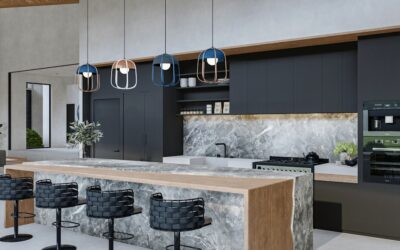
Both approaches light an island, but they create very different effects. A row of round pendants offers a classic, rhythmic look and lets you space light exactly where you want it — great for shorter islands or when you want a more traditional feel. A linear pendant, by contrast, delivers a single continuous fixture that’s simpler to install, easier to align, and reads as more contemporary and streamlined.
The practical win is alignment. Getting three pendants perfectly spaced and level is a fussy job; a linear fixture hangs from one point and lands straight every time.
Sizing for Your Island
Proportion is everything. A linear pendant should span roughly one-half to two-thirds of your island’s length, leaving at least 6 inches of counter clear at each end. On a 6-foot island, that points to a fixture between 36 and 48 inches long. Undersize it and the ends fall dark; oversize it and the fixture crowds the island’s edges.
Also check the fixture’s depth against your island width. It should sit comfortably within the counter’s footprint without projecting over the walkway on either side.
Correct Hanging Height
Hang the bottom of the pendant 30 to 36 inches above the countertop. That clearance keeps the light out of sightlines, shields diners from bare bulbs, and puts illumination right on the work surface. For ceilings taller than 8 feet, raise the fixture about 3 inches for each additional foot of height to maintain balanced proportions.
If people sit at the island, favor the higher end of that range so the fixture doesn’t block face-to-face conversation across the counter.
Popular Styles
- Minimalist LED bars: Slim, seamless profiles with integrated diffused LEDs for a clean modern look.
- Multi-globe linear: A horizontal frame holding several glass globes or shades for a softer, layered glow.
- Industrial: Black or bronze frames with exposed Edison bulbs and metal cages.
- Cage and lantern: Open metalwork that casts patterned light and suits farmhouse kitchens.
Coordinate the finish with your cabinet hardware and faucet. Matte black, aged brass, and brushed nickel work across the widest range of kitchen styles.
Light Output and Bulbs
Because the island doubles as a prep station, brightness counts. Target around 300 to 400 lumens per linear foot of island for comfortable task lighting. Warm-white LEDs at 2700K to 3000K flatter both food and finishes, while 3500K delivers a crisper, cleaner white if you prefer it. Look for a high color rendering index (CRI 90-plus) so colors on the counter look true.
Wire the fixture to a dimmer. Bright light serves cooking and homework; a lower setting shifts the room into dining or entertaining mode. A dimmable LED switch costs about $20 and greatly expands the fixture’s usefulness.
Installation Tips
Most linear pendants hang from a single ceiling junction box, but length and weight matter. Longer fixtures need a fixture-rated box and often a brace secured to the joists so the fixture can’t sag or pull loose. Center the box over the island’s midpoint before you hang anything.
Basic Steps
- Cut power at the breaker and confirm the circuit is dead.
- Verify the box is fixture-rated and centered on the island.
- Set the cable or rod length to achieve 30 to 36 inches of clearance.
- Connect matching wires, secure the canopy, and mount the fixture.
- Install bulbs, restore power, and confirm the fixture hangs level and parallel to the island.
Take your time leveling it. A linear pendant that hangs even slightly askew over a long island draws the eye immediately.
Layering the Rest of Your Kitchen Lighting
A linear pendant handles the island beautifully, but a kitchen needs more than one light source to function well. Use the pendant as your task-and-accent layer over the island, then add recessed cans for overall ambient light and under-cabinet strips to illuminate perimeter counters. This layered approach keeps the whole room evenly lit and lets the pendant stand out as the design centerpiece rather than straining to light the entire space.
Wire each layer to its own dimmer switch. Full brightness on the pendant serves prep and cleanup, while a lower setting shifts the mood for dining, with the recessed lights filling in softly. That separation of controls is what makes a kitchen feel flexible and intentional at every hour of the day.
Avoiding the Two Big Mistakes
Most disappointing island lighting comes down to sizing and centering. A pendant that’s too short for the island leaves the ends dark and looks undersized, while a fixture hung off-center from the island’s midpoint reads crooked from across the room. Measure the island carefully, confirm the ceiling box sits dead center, and choose a length at one-half to two-thirds of the island before you buy. Nailing those two details is most of what makes the finished result look professional.
Frequently Asked Questions
How long should a linear pendant be over an island?
Plan for one-half to two-thirds of the island’s length, with at least 6 inches of counter clear at each end. A 6-foot island typically pairs well with a 36-to-48-inch linear fixture.
Is one linear pendant better than three round ones?
It depends on style. A linear pendant is simpler to install and reads modern and streamlined, while three round pendants give a classic, rhythmic look. For longer islands and contemporary kitchens, the linear option usually wins.
How high should the pendant hang above the counter?
Set the bottom 30 to 36 inches above the countertop. Add roughly 3 inches per foot of ceiling height beyond 8 feet, and hang higher if the island has seating so it doesn’t block sightlines.
How much light do I need over a kitchen island?
Aim for about 300 to 400 lumens per linear foot of island for effective task lighting. Use warm-white LEDs around 2700K to 3000K with a high CRI, and add a dimmer for flexibility.