
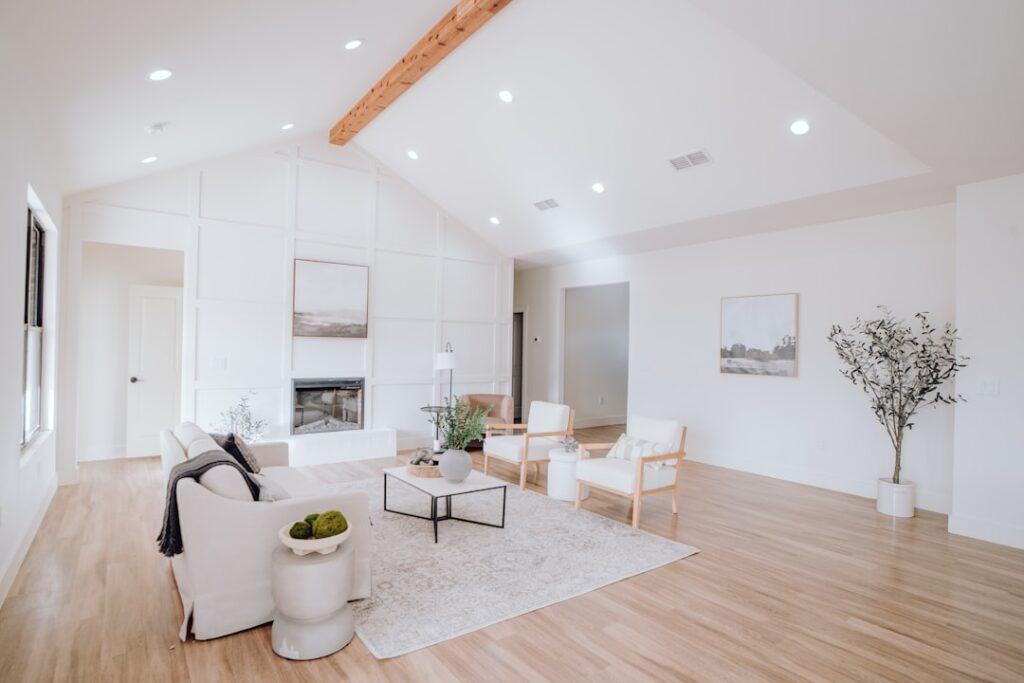
The living room takes more foot traffic and hosts more life than almost any other space in the house, yet it is often the last room people invest in. Smart living room remodeling ideas do not require gutting the space to the studs. A fresh floor, better lighting, and a reworked layout can shift the feel of a room dramatically for a fraction of a full renovation. Before you pull out a sledgehammer, decide whether you are chasing a cosmetic refresh in the $2,000 to $8,000 range or a structural change that can climb past $25,000.
Start With the Floor
Flooring sets the tone for everything else, and it is the single change that resets a tired room fastest. Luxury vinyl plank runs $3 to $7 per square foot installed and shrugs off pets, kids, and spilled wine. Engineered hardwood lands closer to $8 to $14 per square foot and brings warmth that vinyl still cannot quite match. For a 16-by-20-foot living room, that is roughly 320 square feet, so plan on $960 to $4,480 depending on material.
If your subfloor is solid and level, many homeowners install click-lock LVP themselves over a weekend, cutting labor costs entirely. Add a 3/8-inch foam underlayment for sound dampening, especially in second-floor rooms or condos.
Rethink the Layout, Not Just the Decor
Most living rooms suffer from furniture pushed flat against the walls, which makes a room feel both empty in the middle and cramped at the edges. Pull the sofa 8 to 12 inches off the wall and float a sectional to define a conversation zone. Anchor the arrangement with a rug large enough that the front legs of every seat sit on it; a 9-by-12-foot rug suits most medium rooms.
If the room serves double duty as an office or playroom, use a bookcase or a console table as a soft divider instead of building a wall.
Lighting Layers Change Everything
A single ceiling fixture flattens a room. Build three layers instead: ambient from recessed cans or a flush mount, task lighting from floor and table lamps, and accent lighting from picture lights or LED strips behind a media console. Recessed lighting installation runs $150 to $250 per fixture when you hire an electrician, and dimmer switches at $20 each let you tune the mood from movie night to morning coffee.
Swap warm-white 2700K bulbs into living spaces; the cooler 4000K and 5000K bulbs belong in garages and kitchens, not where you relax.
Make a Feature Wall the Focal Point
Every well-designed room needs one wall that earns attention. Shiplap or board-and-batten paneling costs $200 to $600 in materials for an accent wall and reads as custom millwork. A deep paint color like Sherwin-Williams Naval or Benjamin Moore Hale Navy turns a flat surface into a backdrop for art. If you have a fireplace, refacing it with stacked stone veneer at $15 to $30 per square foot instantly modernizes a dated brass-and-brick relic.
Built-Ins and Storage That Disappear
Clutter ruins even the best design. Flanking a fireplace or TV wall with floor-to-ceiling built-in cabinets adds storage without eating floor space. Stock cabinetry from a home center, topped with a custom shelf, delivers a high-end look for $1,500 to $4,000 instead of the $8,000-plus custom shops charge. Closed lower cabinets hide game consoles and cords; open upper shelves display books and objects.
Budget-Friendly Updates Under $500
Not every remodel needs four figures. Some of the highest-impact living room remodeling ideas cost almost nothing:
- Repaint the room a single cohesive color, roughly $80 in paint for an average space
- Replace dated outlet covers and switch plates with screwless modern versions
- Add crown molding, around $1.50 per linear foot in materials
- Swap throw pillows and a new rug to refresh the palette seasonally
- Install a smart thermostat and smart bulbs for everyday convenience
These small moves compound, and together they can make a room feel renovated for the price of a nice dinner out.
Window Treatments and Natural Light
Light is a design element people forget when they think about remodeling. Maximizing natural daylight makes a room feel larger and lifts the mood without adding a dollar to the electric bill. Hang curtains high and wide so the panels frame the window rather than cover the glass, and choose light-filtering sheers for daytime privacy that still lets the sun pour in. If your windows are dated single-pane units, replacement with energy-efficient double-pane windows runs $450 to $1,000 per window installed but pays back in comfort and lower heating costs.
For rooms that get harsh afternoon glare, motorized roller shades let you tune the light from the couch, while plantation shutters add architectural character that reads as permanent and high-end. Even a large mirror placed opposite a window bounces daylight deeper into the room and can make a cramped space feel twice as open.
Add Warmth With Texture and Greenery
The most-designed rooms still fall flat if every surface is hard and smooth. Layering texture is what gives a living room that collected, lived-in warmth. Mix a chunky knit throw, a leather accent chair, a jute rug, and linen drapes so the eye has variety to travel across. A few large potted plants, a fiddle-leaf fig or a snake plant, soften corners and bring life to the space for under $50 each.
Group accessories in odd numbers and at varying heights on shelves and the mantel, since clusters of three or five read as intentional while pairs can feel stiff. These finishing touches cost little but are often the difference between a room that looks renovated and one that looks truly finished.
Know When to Call a Pro
Cosmetic work is fair game for a confident DIYer, but draw the line at anything structural or electrical beyond swapping a fixture. Removing a wall to open the floor plan means checking whether it is load-bearing, which usually requires an engineer’s sign-off and a permit. Expect $1,200 to $3,000 just to remove a non-load-bearing wall, and far more if a steel beam is involved.
Plan your project in phases. Floor first, then walls and trim, then lighting, then furnishings. Working in that order keeps you from scratching a new floor while painting or running wire through finished walls, and it lets you spread the cost over several months without ever living in a job site.


